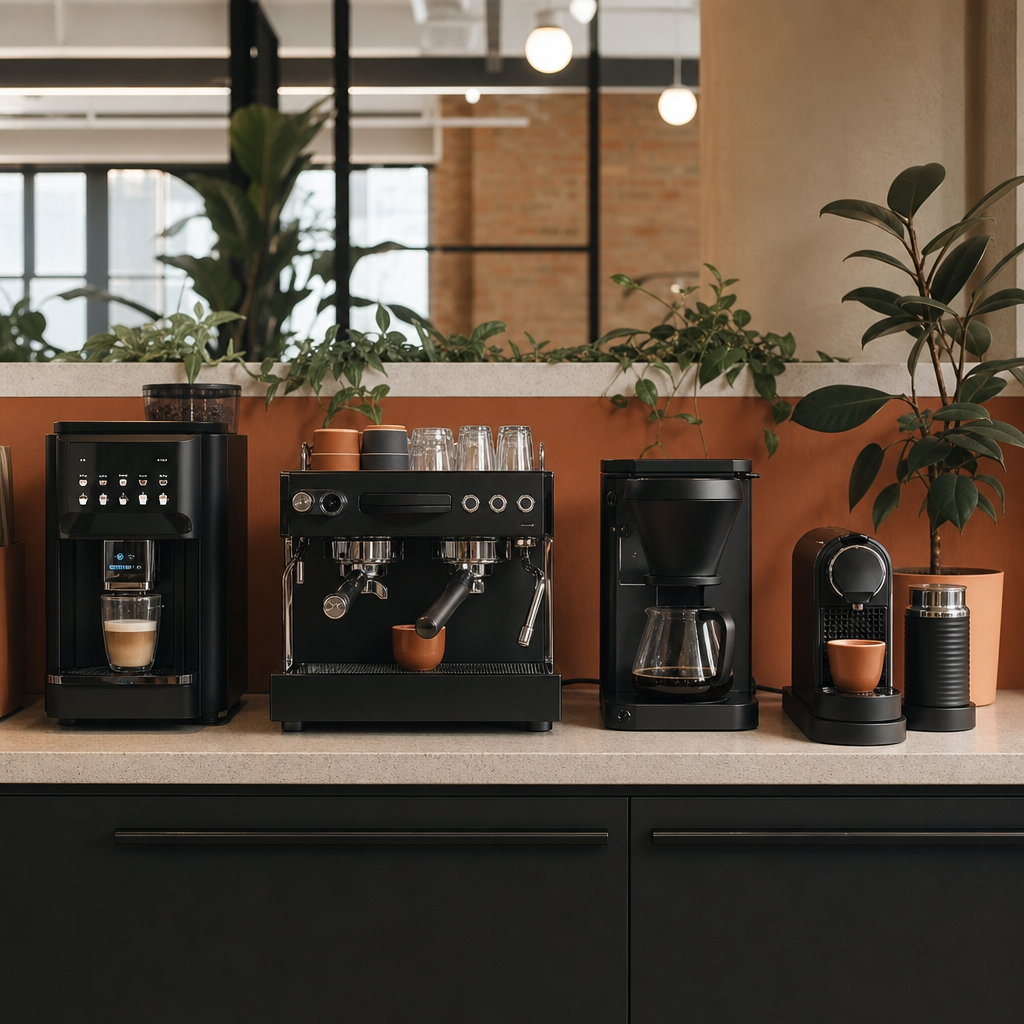
Office coffee machine types fall into four main categories: automatic bean-to-cup, traditional espresso, filter or batch brew, and pod or capsule systems. The right choice depends on peak demand, staff preferences, available space, plumbing, cleaning capacity and service support. Most Australian offices are best served by a properly sized automatic machine.
Introduction
Choosing an office coffee machine is not simply a choice between cheap and expensive equipment. You are choosing how drinks will be made, who will operate the system, how quickly it handles busy periods and what happens when something fails.
Melbourne employees are surrounded by excellent cafés. The gap between that standard outside the building and poor coffee inside it makes little sense. This guide compares the main commercial coffee machine categories and explains where each one fits.
Boutique Coffee at Work in numbers
The figures below come from Boutique Coffee at Work's internal client records as of 2026.
| Business measure | Current position | Source |
|---|---|---|
| Active Melbourne workplace clients renting | 200+ | Boutique Coffee at Work client data, 2026 |
| Average active client relationship | 5+ years | Boutique Coffee at Work client data, 2026 |
| Typical response time on service calls | 24 hours | Boutique Coffee at Work client data, 2026 |
| Largest workplace supported | 400+ people | Boutique Coffee at Work installation data, 2026 |
Key Takeaways
The best office coffee system is the one that meets real peak demand without creating unnecessary work. Machine specifications matter, but fit, installation, beans and ongoing accountability determine whether employees actually receive consistently good coffee.
- Automatic bean-to-cup machines suit most medium and large offices because they combine speed, consistency and simple operation.
- Traditional espresso systems produce excellent coffee but require trained operators and more daily cleaning.
- Filter systems work well where many people need black coffee quickly.
- Pod machines are convenient for light or occasional demand, but their per-drink waste and ongoing consumable requirements can become drawbacks.
- Headcount alone is not enough. Peak usage, milk preferences, bench space, plumbing and service access must be assessed.
- A commercial machine without responsive maintenance can become an expensive bench ornament.
Summary of Office Coffee Machine Types
Each machine category solves a different workplace problem. Automatic machines prioritise consistency, traditional espresso prioritises operator control, filter brewing prioritises volume, and pod systems prioritise simplicity. This comparison provides a starting point, but the final decision should follow an on-site assessment of demand, utilities and workflow.
| Machine type | Main strength | Main limitation | Best workplace fit |
|---|---|---|---|
| Automatic bean-to-cup | Consistent drinks at the press of a button | Requires regular cleaning and professional servicing | Medium to large offices with mixed drink preferences |
| Traditional espresso | High control over extraction and milk texture | Needs training, a grinder and active operation | Staffed hospitality areas, showrooms and offices with skilled users |
| Filter or batch brew | Serves black coffee efficiently in volume | Limited milk-based drink capability | Meetings, events and teams that mainly drink long black coffee |
| Pod or capsule | Compact and straightforward | Ongoing capsule handling, waste and limited adjustment | Small offices, meeting rooms and low-volume locations |
Automatic Bean-to-Cup Machines
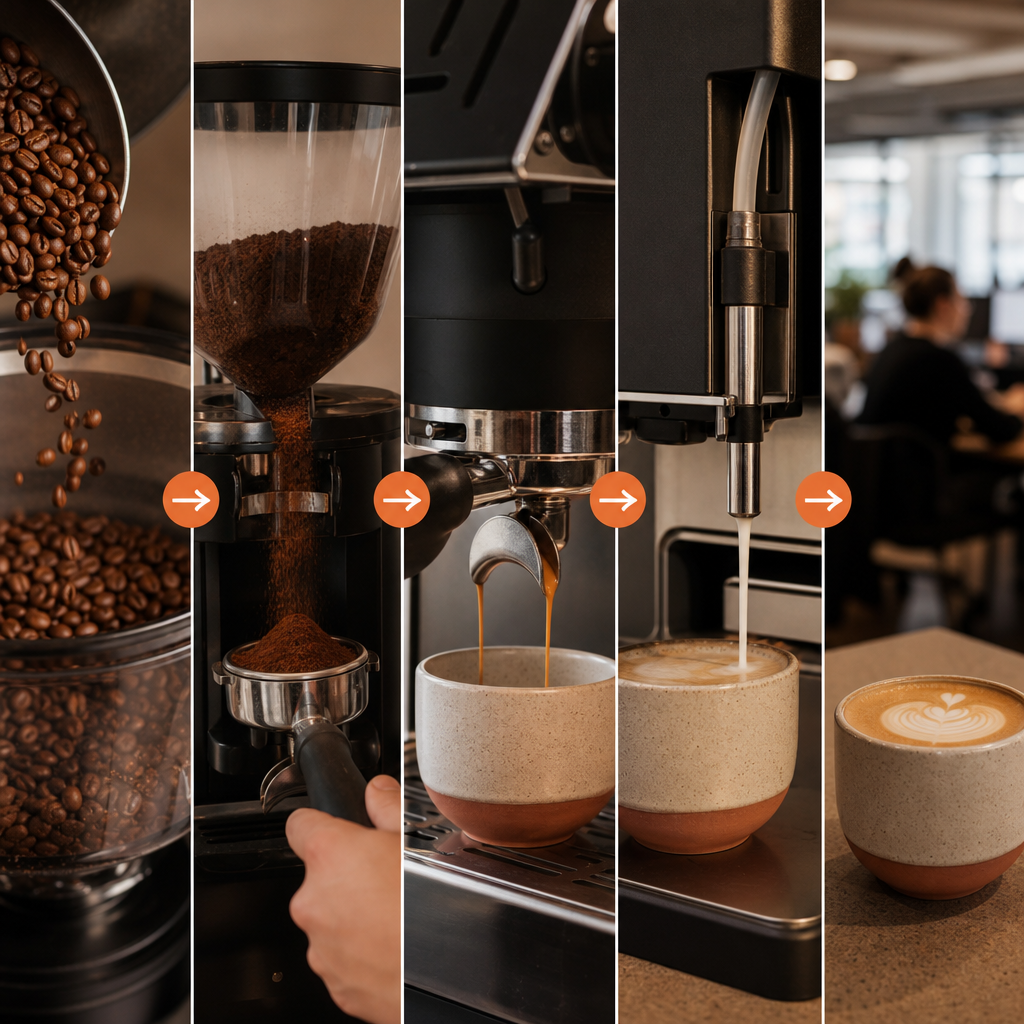
Automatic bean-to-cup machines grind whole beans, extract coffee and dispense selected drinks through a guided interface. They are usually the strongest choice for offices needing café-style coffee without employing a barista. Correct sizing is essential because domestic-grade equipment will not tolerate sustained commercial demand.
A user selects a drink, places a cup and lets the machine control grinding, dosing, extraction and, where fitted, milk delivery. This removes many variables that cause inconsistent results on manual equipment.
Advantages of automatic office coffee machines
The biggest advantage is repeatability. A new employee and an experienced user can order the same drink without learning how to dose a group handle or texture milk.
Other benefits include:
- fast self-service during morning and lunch peaks
- a broad menu covering espresso, long black, flat white, cappuccino and hot chocolate
- controlled recipes for cup size, strength and milk quantity
- no need for a dedicated operator
- easier training for new staff
- drink counters and cleaning prompts on many commercial models
An automatic office coffee machine in Australia must still be configured for local preferences. Melbourne offices often lean heavily towards milk-based drinks, so milk capacity, refrigeration and cleaning matter as much as espresso output.
Limitations to plan for
Automatic does not mean maintenance-free. Milk lines need disciplined cleaning. Waste trays must be emptied. Beans need to remain fresh, and the grinder must be dialled in for the selected blend.
The machine also needs enough capacity for the busiest part of the day. Average daily consumption can hide the real problem. If much of the team arrives between similar hours, the relevant question is how many people will be waiting at once.
Case study: replacing an underperforming office setup
A mid-sized Melbourne engineering office had an existing coffee arrangement that was not meeting employee expectations. I upgraded the site to a WMF commercial machine and included installation, staff training and ongoing service within the rental.
The site manager reported that the system was easy to use and produced coffee and hot chocolate the team genuinely enjoyed. The more important outcome was consistency. Regular personal servicing kept that experience in place for years rather than only during the first weeks after installation.
That is the standard I look for: café-quality, made practical.
Traditional Espresso Systems
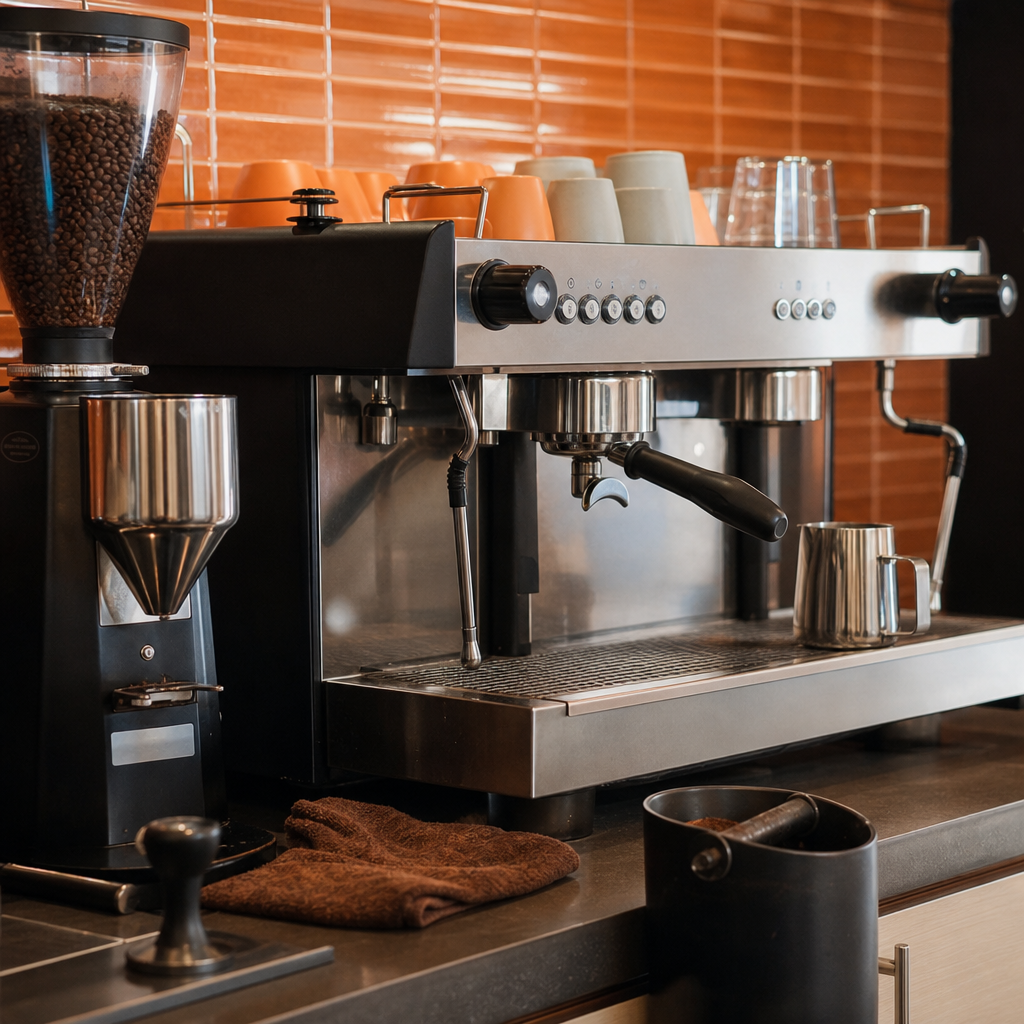
Traditional espresso systems offer the greatest hands-on control over grinding, dosing, extraction and milk texture. They can produce outstanding coffee, but only when users have the skill and time to operate them correctly. They suit staffed environments better than general office kitchens where responsibility changes throughout the day.
A traditional setup generally includes an espresso machine, a separate commercial grinder, a knock box, milk jugs, cleaning tools and enough clear bench space for preparation. Plumbing and suitable electrical supply may also be required.
Where manual espresso works well
Traditional machines make sense in client-facing spaces where the preparation process contributes to the experience. Examples include prestige showrooms, staffed reception areas, hospitality venues and larger workplaces with an internal barista.
They allow direct adjustment of:
- grind size and dose
- extraction time
- coffee yield
- milk texture and temperature
- drink construction
The Specialty Coffee Association's published Coffee Standards reinforce the importance of controlling brewing variables. In an office, the practical issue is whether anyone will control those variables consistently.
The hidden operational cost
The machine may be capable of excellent coffee, but capability is not the same as repeatable delivery. Untrained users can waste beans, leave milk residue on steam wands and produce widely different drinks from the same equipment.
Cleaning is also more involved. Group heads require backflushing, steam wands need wiping and purging, and the grinder area needs attention. If nobody owns these tasks, quality and hygiene deteriorate.
Traditional espresso is therefore not my default recommendation for an unstaffed office. It is chosen on purpose when the workplace has the people, workflow and interest needed to use it properly.
Filter and Batch Brew Options
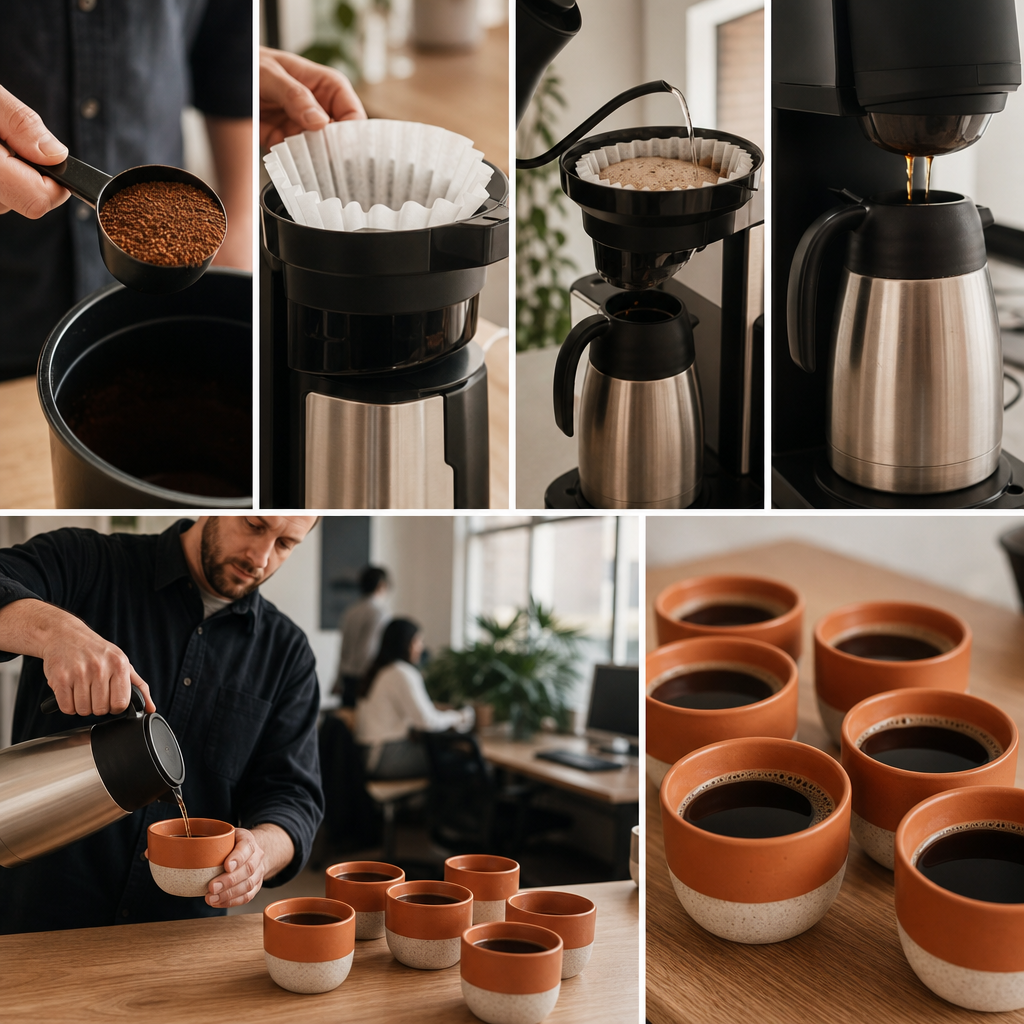
Filter and batch brew systems are effective when a workplace needs substantial quantities of black coffee with minimal preparation time. They brew into a glass vessel, insulated server or dispensing urn. They are less suitable when employees expect individually prepared flat whites, cappuccinos or other milk-based café drinks.
Filter brewing has an important operational advantage: one brewing cycle serves several people. That can reduce queues during large meetings, training days and scheduled breaks.
Best use cases for filter coffee
Batch brewing is worth considering for:
- conference and training facilities
- offices with strong long black or black filter preferences
- catered meetings
- workplaces with concentrated break times
- temporary events requiring straightforward service
Coffee can be ground fresh for each batch, which gives filter systems a quality advantage over instant coffee. However, brewed coffee should not be left sitting indefinitely. The workplace needs a routine for brewing the right quantity at the right time.
Filter as part of a combined system
Filter does not have to replace espresso-based coffee. In a large workplace, a batch brewer can absorb demand from black coffee drinkers while an automatic machine handles milk-based drinks.
This hybrid approach can be more sensible than forcing one machine to serve every use case. It also creates backup capacity for meetings or unusually busy days.
The Specialty Coffee Association provides recognised guidance for brewed coffee variables through its Coffee Standards. In practice, fresh grounds, clean equipment, appropriate water and controlled holding time all influence the result.
Pod and Capsule Machines
Pod and capsule machines provide simple, portioned coffee with little training. They suit low-volume offices, private meeting rooms and locations where compact dimensions matter more than drink flexibility. For sustained daily demand, capsule handling, limited adjustment and accumulated packaging usually make a commercial bean-to-cup system more practical.
A capsule contains a pre-portioned amount of coffee. The machine pierces the capsule and passes water through it, reducing the need for grinding, dosing or adjusting recipes.
Why offices choose pods
Pod systems are attractive because they are familiar and easy to start using. They require little bench space, and sealed capsules make stock control straightforward.
They can suit:
- small professional offices
- boardrooms used occasionally
- satellite sites with limited demand
- workplaces without plumbing access
- spaces where users mainly want espresso or long coffee
Where pods become restrictive
The convenience comes with trade-offs. Employees must continually load and dispose of individual capsules. Milk-based drinks may require a separate frother or a more complex capsule system. Drink strength and extraction variables are also constrained by the capsule format.
Packaging deserves consideration as well. Some capsule suppliers offer collection or recycling arrangements, but the workplace must actually separate and manage the used capsules. A recycling programme that nobody follows is not an operational solution.
For a small team, that may be acceptable. For a busy office making drinks throughout the day, handling individual capsules can become unnecessary friction.
Choosing the Right Type for Your Office
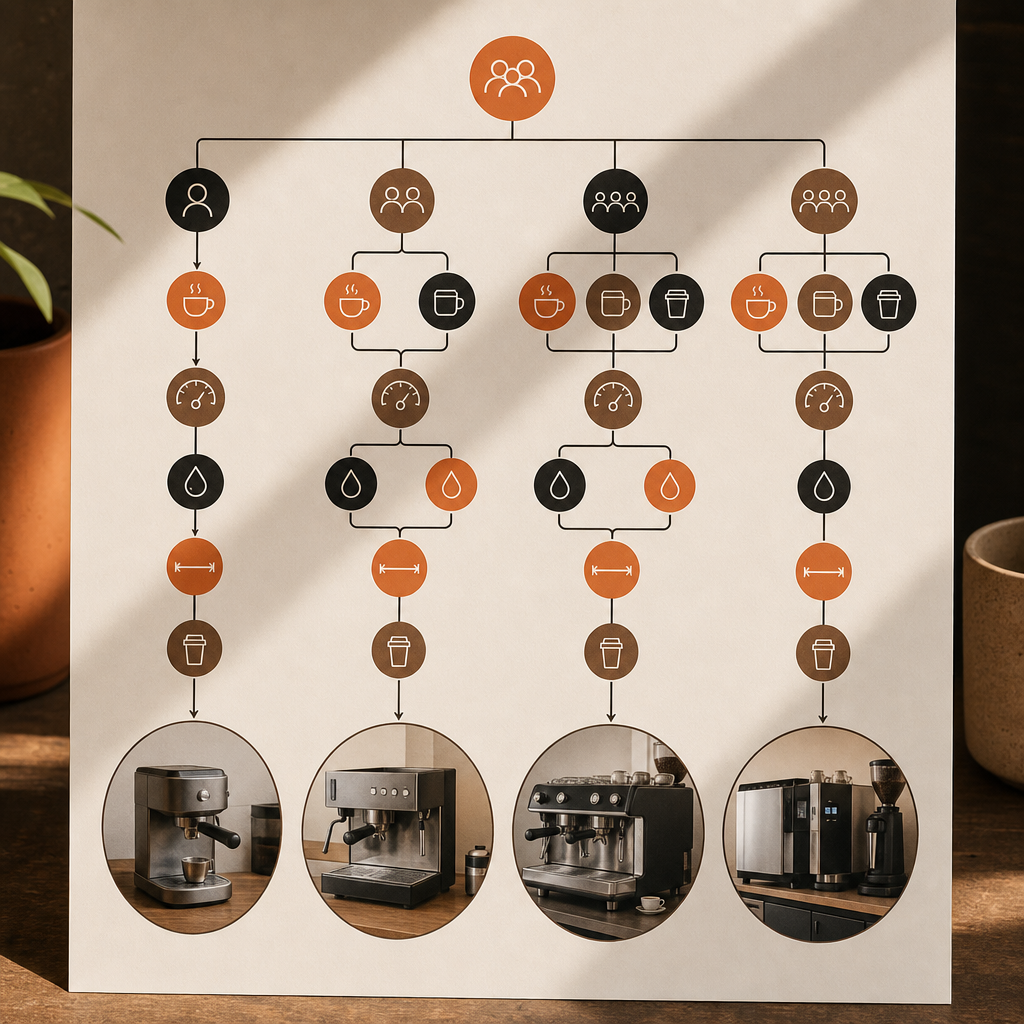
Choose an office coffee machine by measuring peak demand, drink preferences, available utilities, cleaning responsibility and support requirements. Do not select equipment from headcount or purchase price alone. The cheapest suitable system is better than an oversized machine, while undersized equipment creates queues, breakdowns and avoidable replacement costs.
Start with peak demand, not average demand
Ask when people make coffee and how concentrated that activity becomes. A workplace with staggered shifts behaves differently from an office where most employees arrive and take lunch together.
Record the drinks people actually order. A team dominated by flat whites places different demands on a machine from one that mainly drinks long blacks. Hot chocolate, alternative milk and hot water demand should also be included.
Match capacity honestly
I do not believe in upselling equipment for hypothetical future growth. A 12-person team does not need a $15,000 Eversys. At the other end, an 80-person team can exhaust a home-grade Jura within a month if it is treated like commercial equipment.
The right commercial category sits between those mistakes. It has enough capacity to handle real demand, without forcing the business to pay for features it will never use.
Our broader workplace coffee solutions are structured around this fit rather than a single preferred machine.
Inspect the physical site
A commercial coffee machine must work in the available environment. Before recommending equipment, I check:
- bench width, depth and overhead clearance
- power outlets and circuit suitability
- water supply and drainage
- access for installation and servicing
- milk refrigeration
- location of waste and cleaning facilities
- pedestrian flow around the coffee point
Food handling and cleaning obligations should also be considered where a workplace prepares drinks for customers. Food Standards Australia New Zealand explains applicable controls in Standard 3.2.2A, Food Safety Management Tools.
Decide who owns cleaning
Every system requires an owner. That does not have to be a full-time barista, but someone must know who empties waste, refills beans and completes the required cleaning cycle.
Training should cover normal operation and simple fault checks. Many apparent machine problems are caused by an empty hopper, full waste bin, displaced tray or missed cleaning prompt. When the person answering the service call knows the exact installation, these issues can often be resolved quickly.
Assess support before signing
A machine's service arrangement matters as much as its feature list. Ask who answers the phone, what maintenance is included, how consumables are replenished and what happens if the machine stops during peak hours.
My model is one number, one person. There are no call centres, no corporate runaround. Boutique Coffee at Work records a typical service-call response time of 24 hours across its active Melbourne client base in 2026.
Case study: preventing disruption in a busy workplace
A busy Melbourne workplace was experiencing havoc whenever its coffee machine failed during peak office hours. The issue was not simply the machine. There was no dependable service rhythm behind it.
I supplied a commercially appropriate machine, scheduled regular maintenance and remained the direct contact for any fault. A workplace contact reported that reliable servicing meant the team had coffee when it was needed, rather than discovering a problem during the busiest part of the day.
The lesson is straightforward. Reliability is the combined result of equipment, preventive maintenance and accountability.
Why Supplier Accountability Beats a Longer Feature List
The overlooked distinction between office coffee systems is not automatic versus manual. It is accountable versus unaccountable. A sophisticated machine backed by slow, fragmented support creates more disruption than a simpler machine maintained by someone who knows the site, the team, the beans and the installation history.
Many comparison pages focus on touchscreens, drink menus and technical specifications. Those details have value, but they do not answer the question an office manager faces when the machine stops before a meeting.
My position is founder-led, always. One person remains responsible from the first site visit through installation and ongoing servicing. Boutique Coffee at Work's active Melbourne clients have an average relationship length exceeding five years, according to the business's 2026 client records. That retention comes from fit and service, not contractual friction.
Rentals operate month-to-month with one month's notice and free machine pickup. No lock-in, ever. If a machine and service arrangement only retains a client because leaving is difficult, the relationship is already broken.
The Six-Step Process
For suitable Melbourne workplaces, the Six-Step Process moves from enquiry to ongoing supply:
- Enquiry: the business submits basic team and site details.
- Phone call with Chris: requirements, likely machine options and rough pricing are discussed.
- On-site visit: power, plumbing, bench space and workflow are assessed.
- Install day: the machine is connected, the grinder is dialled in and test shots are checked.
- First brew and training: at least two staff members receive training and a practical cheat sheet.
- Ongoing rhythm: service visits replenish beans and consumables while keeping the machine operating correctly.
Most suitable Melbourne installations move from first call to installed machine in 5-7 business days, based on Boutique Coffee at Work's stated operating process.
Testimonial from a retail workplace
A manager at a busy Melbourne retail business credited my attention to detail, fresh bean supply and personal equipment maintenance with helping the team serve consistently good coffee to staff and customers each day. That feedback matters because the machine was supporting a customer-facing operation, not sitting unused in a back room.
Beans are then matched through the Curated Coffee Plan. I ask whether the team prefers espresso or milk-based drinks, discuss strength and dislikes, start with a suitable blend, and adjust it using feedback from the first month. You can also review the available coffee options.
The machine is only one part of the result. Fit, dialled-in beans, installation, training and responsive servicing must operate as one system.
Get the Machine Type Right Before Comparing Models
Selecting the category first prevents feature lists from driving the decision. Establish peak demand, preferred drinks, available space, cleaning responsibility and service expectations. Then compare machines capable of meeting those requirements. For a direct recommendation based on your Melbourne workplace, contact Boutique Coffee at Work.
References
These sources provide supporting information on coffee preparation standards, commercial machine categories, capsule systems and Australian food safety responsibilities. Equipment specifications vary by model, so current manufacturer documentation and a physical site assessment should be checked before making a final selection.
- Specialty Coffee Association, Coffee Standards.
- Food Standards Australia New Zealand, Standard 3.2.2A, Food Safety Management Tools.
- WMF Professional Coffee Machines, Commercial coffee machine information.
- Eversys, Commercial espresso systems.
- Nespresso Professional Australia, Professional capsule coffee systems.
FAQ_SCHEMA_JSON
Frequently asked questions
What type of coffee machine is best for an office?
A commercial automatic bean-to-cup machine is the best fit for most medium and large offices because it provides consistent drinks without requiring barista skills. Small, low-volume offices may prefer capsules, while staffed client areas can justify traditional espresso equipment.
What is the difference between automatic and traditional office coffee machines?
An automatic machine controls grinding, dosing and extraction after the user selects a drink. A traditional espresso system requires someone to grind, dose, tamp, extract and texture milk manually.
Are pod coffee machines suitable for offices?
Pod machines suit small offices, meeting rooms and locations with occasional demand. Larger workplaces generally benefit from a commercial bean-to-cup machine that is designed for repeated daily use.
Does an office coffee machine need plumbing?
Not every office coffee machine needs plumbing. Compact machines may use refillable tanks, while higher-capacity commercial systems are commonly plumbed to avoid interruptions from manual refilling.
Should an office buy or rent a coffee machine?
Buying provides ownership but leaves the business responsible for capital outlay and maintenance. Renting can combine the equipment, installation and service. Businesses should compare inclusions, exit terms and service responsibility.
Can we trial an office coffee machine first?
A trial can confirm whether employees like the drinks and whether the machine suits the workplace workflow. Boutique Coffee at Work offers free trials to eligible Melbourne businesses, subject to site and service suitability.
Chris
Chris
Keep reading
Company credentials and commercial coffee experience
Company credentials and commercial coffee experience should prove that a provider can select, install, supply and maintain the right workplace coffee system…
Office Coffee Machine Rental FAQs: Straight Answers for Melbourne Workplaces
Office coffee machine rental means paying a monthly fee to use a commercial machine that the supplier installs, services and looks after, rather than buying it…
Office Coffee Machine Rental Services in Melbourne: How the Process Actually Works
An office coffee machine rental service in Melbourne supplies a commercial-grade machine, installs it properly, trains your staff, and keeps beans and…