The best office coffee in Melbourne comes from a commercial bean-to-cup or espresso machine sized to your headcount, rented month-to-month with installation, training, beans and servicing included. Choose a supplier who answers the phone personally, fits the machine to your actual team size, and does not lock you into a contract.
Melbourne workers walk past some of the best cafés in the world on the way to the office. Then they walk in and face instant coffee, a pod machine or a commercial unit that breaks every second week. This guide closes that gap.
It is a hub. Each section answers one big question briefly, then points you to the deeper topic. By the end you will know what machine suits your team, how renting compares with leasing, what to expect on cost and service, and how to get café-quality coffee at work without a long contract.
Key Takeaways
- Melbourne's café culture has set the standard. Instant coffee and pods now read as a downgrade to most staff.
- Size the machine by headcount and peak-hour demand. A machine that is too small or too large costs you money either way.
- Renting month-to-month keeps risk with the supplier and lets you change machines as your team changes.
- Judge cost by what is included (machine, installation, training, servicing), not by the headline rental fee alone.
- One accountable person and one phone number beats a call centre. Ask any supplier who you will actually speak to when the machine stops.
- Beans should be matched to your team through a short feedback loop, not supplied as a one-size default.
Summary Table
| Topic | Core question | Short answer | Best for |
|---|---|---|---|
| Why it matters | Is office coffee worth upgrading? | Yes. Staff compare it with the café outside. | Anyone still on instant or pods |
| Machine choice | What size and type do we need? | Match headcount and peak demand, not price or looks. | Teams unsure where to start |
| Rent, lease or subscribe | How should we pay for it? | Rent month-to-month for flexibility. Lease only if you want to own. | Growing or hybrid teams |
| Cost | What is included? | Machine, install, training and service should be bundled. | Office managers building a budget |
| Service | Who fixes it? | One person, one number, no escalation paths. | Workplaces that cannot afford downtime |
| Beans and milk | How do we keep people happy? | Match the blend to the team, then adjust after a month. | Teams with mixed drink preferences |
Why does Melbourne office coffee deserve better?
Melbourne office coffee deserves better because your team is surrounded by excellent cafés every day, then returns to instant, pods or an unreliable machine. That gap is a daily signal about how the workplace values small moments. Closing it is practical, affordable and does not need a long contract.
Founder Chris Prokopiou never understood that gap. Melbourne people hold strong views on coffee, yet many offices serve something nobody would buy at a café. In 2008 he started Boutique Coffee to fix one thing: workplace coffee that matches the city. In 17 years we have done nothing else, and we are still Melbourne-only.
The reasons to care are practical rather than sentimental:
- The coffee moment is a meeting point. The queue at the machine is where cross-team conversations happen. A bad machine turns that into a complaint session.
- People notice quality. Staff who pay for a good flat white on the way in will notice when the office version is poor.
- Hybrid work raises the stakes. If you want people on site, the office needs to offer something they cannot easily get at home. Good coffee is one of the cheapest options.
- Variety matters as much as quality. Milk alternatives, decaf and hot chocolate mean everyone gets a drink they like.
- Sourcing questions are now normal. Staff ask where the beans come from. A supplier should be able to tell you.
To put numbers on our own track record: we currently look after 200+ active Melbourne workplace clients, and the average client relationship runs 5+ years. Those figures are our own book of business, not an industry benchmark. The point is that people stay because they choose to.
How do you choose the right commercial coffee machine for your office?
Size a commercial coffee machine by headcount and peak-hour demand, not by price or appearance. A machine that is too small creates queues and breakdowns. One that is too large wastes money and cleaning time. Match capacity to how many people drink coffee and when, then pick the grinder and milk system.
The extremes show the principle. A 12-person team does not need a $15,000 Eversys. An 80-person team will break a home-grade Jura within a month, because those machines are built for a household, not a busy office at 9am. The largest single client we have installed for has a team of 400+ people, and that is a different category of equipment again.
Consider an office of 40 where most people want a milk-based coffee between 8:30 and 9:30. Total daily cups matter less than that one-hour spike. A machine that copes at 2pm can still fail the morning rush. Always size for the peak.
What to work out before you shop
- Headcount and attendance. Count people on site on your busiest days, not total employees. Hybrid teams change the answer.
- Drink mix. Espresso and black coffee are simple. Flat whites and lattes need a proper milk system, which affects machine choice.
- Who will use it. If staff will serve themselves, you want a machine with simple buttons and forgiving settings.
- Site conditions. Power, plumbing and bench space decide what physically fits. These are checked on an on-site visit.
- Water. Water quality affects both flavour and scale build-up. The Specialty Coffee Association (https://sca.coffee) publishes water quality guidance for this reason, and a filter is worth discussing at install.
We recommend the machine that fits the team, even when that is the cheaper option. At one mid-size Melbourne office, the existing setup was not meeting the team's needs. We replaced it with a WMF commercial machine, with installation, training and ongoing service included in the rental. The change was noticed across the whole office, and the site manager later reported easy daily use and great coffee and hot chocolate, with consistent service over the years.
For how the rental process works step by step, see our guide to office coffee machine rental services in Melbourne.
Should you rent, lease or subscribe?
Rent if you want the supplier to own the machine, carry repair risk and let you change equipment as the team changes. Lease if you want to own the machine eventually and accept a fixed term. A subscription bundles beans, and sometimes the machine, into one regular arrangement. Most workplaces are best served by renting.
| Option | Who owns the machine | Commitment | Flexibility | Suits |
|---|---|---|---|---|
| Month-to-month rental | Supplier | Short notice to exit | High | Growing, hybrid or uncertain teams |
| Lease | You, eventually | Fixed term | Low | Stable teams planning long-term |
| Subscription | Varies by provider | Varies | Medium | Teams wanting one simple bundle |
Our position is firm. Every rental is month-to-month with one month's notice to exit and free machine pickup. In 17 years, that policy has never cost us a client worth keeping. Clients who stay by choice are worth more than clients who stay by contract. We treat the exit terms as proof of confidence, not a risk.
There is also a legal angle. The ACCC (https://www.accc.gov.au) publishes guidance on unfair contract terms, and these protections can apply to small businesses signing standard form contracts. If you are offered a long fixed term with heavy exit fees, read it closely. For GST credits and deductions on rental or lease payments, speak to your accountant. The ATO (https://www.ato.gov.au) publishes the general rules.
For the full comparison, read our lease vs month-to-month rental article. If a bundled arrangement appeals, our office coffee subscriptions article covers how those work.
What does office coffee cost, and what is included?
Office coffee cost has three parts: the machine (rented, leased or bought), consumables such as beans, milk and cleaning products, and service. A good rental bundles machine, installation, training and servicing into one fee, leaving beans and milk as the main variable cost. Always confirm what is included before comparing quotes.
We keep exact pricing in a separate pricing plans article, because it depends on machine, team size and consumption. Here is the high-level framework for comparing any supplier, including us.
What a rental should include
- The commercial machine and grinder
- Delivery and installation
- Staff training
- Scheduled servicing and breakdown support
- Repairs to the machine itself
- Free pickup when you finish
What to check for hidden costs
- Separate call-out or after-hours fees
- Installation or connection charges
- Water filter and descaling costs
- Minimum bean order quantities
- Exit fees or pickup charges
- Whether quoted prices include GST
Work out your cost per cup
The fairest comparison is cost per cup, not monthly fee. Add the monthly machine cost to your monthly spend on beans, milk and consumables, then divide by the cups your team actually drinks. Compare that figure with what staff would spend at a café. This also shows whether a cheaper machine is false economy once downtime is counted.
How do installation, training and ongoing service work?
Installation, training and service work best when one accountable person handles all three. At Boutique Coffee that means one number, one person, no call centres and no corporate runaround. Most Melbourne clients go from first call to an installed machine in 5 to 7 business days, and service calls typically get a response within 24 hours.
We run every new client through the same six steps. We call it The Six-Step Process:
- Enquiry (2 minutes). You submit basic team details.
- Phone call with Chris (15 to 20 minutes). We shortlist machines and give rough pricing.
- On-site visit (30 minutes). We assess power, plumbing and bench space.
- Install day (45 minutes). The machine is connected, the grinder dialled in and the shots tested.
- First brew and training (20 minutes). At least two staff are trained and we leave a cheat sheet.
- Ongoing rhythm. Weekly or fortnightly service visits, with beans and consumables topped up.
The 24-hour response, the 5 to 7 day install window and the step timings are our own operating figures across our active client base.
Why no escalation paths?
Most suppliers route issues through helpdesks, ticket systems and tiered support. Our view is the opposite. Most fixes can be talked through in two minutes when the person who answers already knows your setup. Same-day or next-day on-site response is only possible when there is no internal runaround to navigate first.
The cost of getting this wrong is real. At one busy Melbourne workplace, the team was disrupted whenever the machine went down during peak hours. We supplied a reliably maintained machine with regular scheduled servicing and direct personal contact for any issue. The client told us that regular service meant the team always had coffee when they needed it most, and the havoc of a broken machine stopped.
For what happens on install day and how staff are trained, see our installation and staff training article. For what to do when something goes wrong, see our service and breakdown support article.
How do you get the most from your beans, milk and coffee station?
Good office coffee comes down to beans matched to your team, sensible milk options and a station that is easy to keep clean. Start with a Curated Coffee Plan: ask what people drink, begin on a well-matched blend, then adjust within the first month based on team feedback.
Beans: chosen on purpose
A default supply suits no one. We start by asking about your team's drink preferences: espresso or milk-based, strength, and any dislikes. We then start on a well-matched blend and ask for feedback during the first month. Small changes to the roast or blend at that stage make a bigger difference than most people expect. This is what we mean by dialled-in beans.
Milk, decaf and hot chocolate
Variety is as important as quality. Plan for dairy and at least one plant-based option, a decaf choice and hot chocolate. In practice, hot chocolate is often what wins over the people who do not drink coffee. Cover these at install so nobody is left out.
Setting up the station
- Put the machine where people can queue without blocking a walkway.
- Keep cups, lids, stirrers and a bin within reach.
- Leave the cheat sheet visible near the machine.
- Nominate two trained staff to handle daily wipe-downs and basic issues.
- Report problems early. A small fix on a Tuesday is easier than a breakdown on Friday.
Sustainability
Staff increasingly ask about sourcing and waste. Ask your supplier where the beans come from, whether certifications apply, and what options exist for reusable cups. A supplier who cannot answer is telling you something.
A retail business we look after serves coffee daily to both staff and customers. We supply the fresh beans and manage the machine personally. They credit that attention to detail for being able to serve great coffee every day without interruption.
Where should you go next?
Start with the topic that matches your biggest question. Worried about process? Read the rental walkthrough. Weighing cost? Read the pricing plans. Unsure about commitment? Compare lease and month-to-month. The index below groups every deeper guide by topic so you can go straight to the one you need.
- How the process works: Office Coffee Machine Rental Services in Melbourne: How the Process Actually Works
- Cost: our pricing plans article
- Commitment and contract: Lease vs Month-to-Month Rental
- Bundled supply: our office coffee subscriptions article
- Getting started on site: our installation and staff training article
- When things go wrong: our service and breakdown support article
- Industry fit: Which Melbourne Industries Rent Commercial Coffee Machines
- Quick answers: our rental FAQs
- Where we operate: our service coverage and delivery areas page
Ready to talk it through? Contact Boutique Coffee to discuss the right commercial machine for your workplace, rented month-to-month with no lock-in contract. You will speak to the person who looks after your machine, not a call centre.
Why the right machine is often the cheaper one
Most of the industry will tell you a bigger machine is a safer, more future-proof choice. I disagree, and so does the way we run the business. The honest answer is usually the smaller machine, and sometimes it is another supplier entirely. I am not trying to be the biggest.
There is a simple logic here. An upsold machine inflates the first invoice, but it also raises running costs, cleaning time and the chance your team never learns to use it properly. A fitted machine keeps the client for years. With an average relationship of 5+ years, one inflated first invoice is a poor trade.
I also hold that service quality shows itself when a client leaves a bad supplier. At one Melbourne site, a person who had worked at a previous client found us and asked for a card. He wanted to pass it to senior management because, in his words, their current supplier provided the worst coffee. That is the real test of this business. People who care about coffee will go looking for someone who answers the phone.
That is why we are founder-led, always. One number, one person. If the fit is not right, we will say so, and we will point you elsewhere if that is better for you.
References
Frequently asked questions
How much does office coffee machine rental cost in Melbourne?
It depends on the machine, your team size and what is bundled in. A good rental includes the machine, installation, training and servicing, leaving beans and milk as the variable cost. Compare cost per cup rather than monthly fee, and check whether quotes include GST.
What size coffee machine does my office need?
Size it by the number of people on site and your peak-hour demand. A small team of around 12 does not need a high-end machine. An 80-person office will quickly break a home-grade unit. A short call and an on-site visit will confirm the right fit.
Is it better to rent or buy a commercial coffee machine?
For most workplaces, renting is better. The supplier owns the machine and carries repair risk, and you can change equipment as your team changes. Buying or leasing suits stable teams that want ownership and accept a fixed commitment. Check any contract terms carefully before signing.
How long does installation take?
Most Melbourne clients go from first call to an installed machine in 5 to 7 business days. The install itself takes around 45 minutes, followed by a 20-minute training session. These are Boutique Coffee's own operating timings across its active client base.
What happens if the machine breaks down?
You call one number and speak to the person who knows your setup. Many issues can be talked through in minutes. Where a visit is needed, Boutique Coffee's typical response is within 24 hours across its active client base.
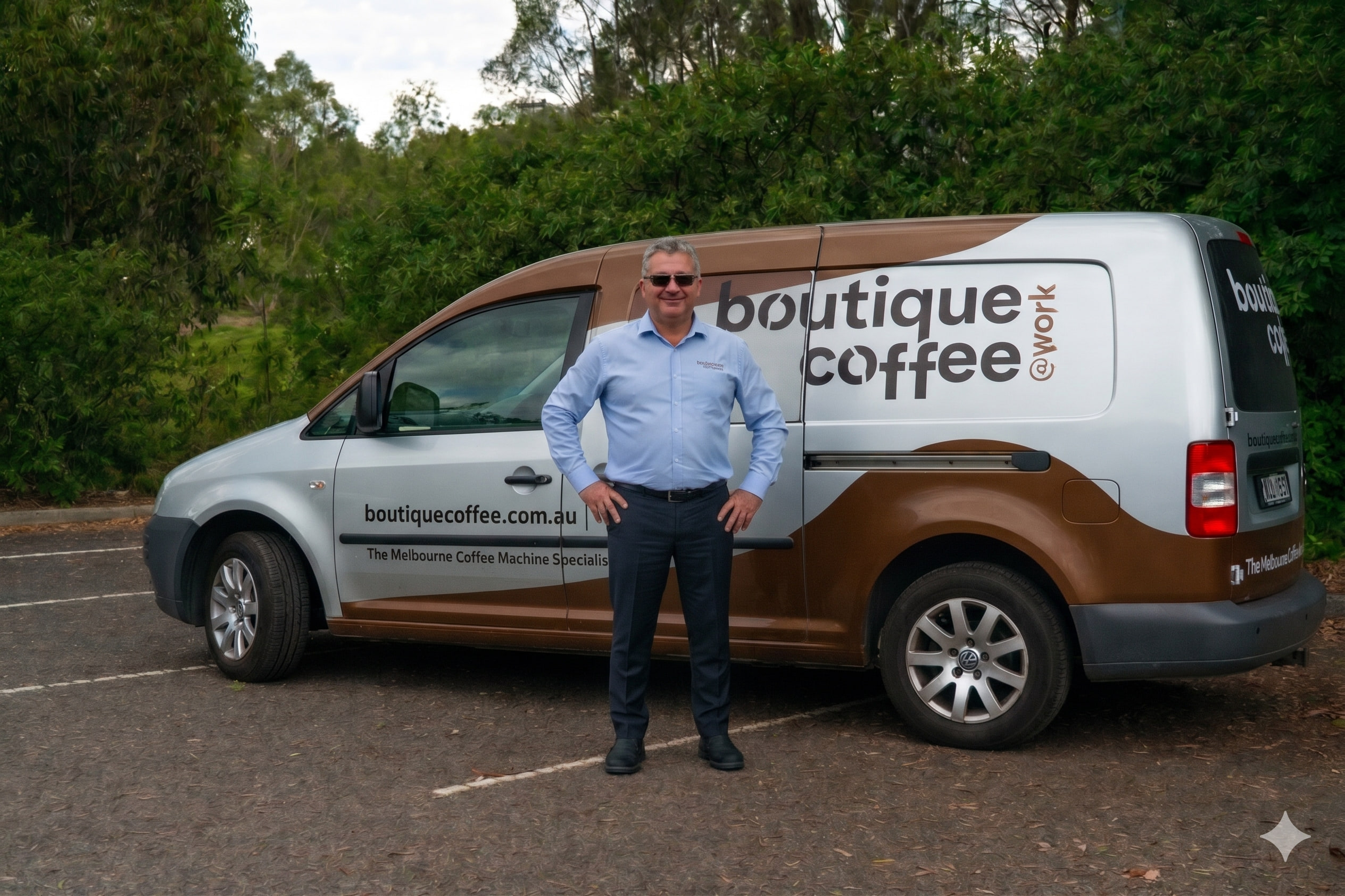
Chris
Chris
Keep reading
Office Coffee Machine Rental FAQs: Straight Answers for Melbourne Workplaces
Office coffee machine rental means paying a monthly fee to use a commercial machine that the supplier installs, services and looks after, rather than buying it…
Office Coffee Machine Rental in Melbourne: Find Your Next Step by the Question You're Asking
Office coffee machine rental in Melbourne means paying a monthly fee for a commercial machine that comes installed, serviced and supplied with beans by one…
Office Coffee Machine Rental Pricing in Melbourne: Transparent Plans and What's Included
Office coffee machine rental in Melbourne is priced as a monthly fee driven mainly by headcount, daily cup volume, machine type, milk system and site setup. At…