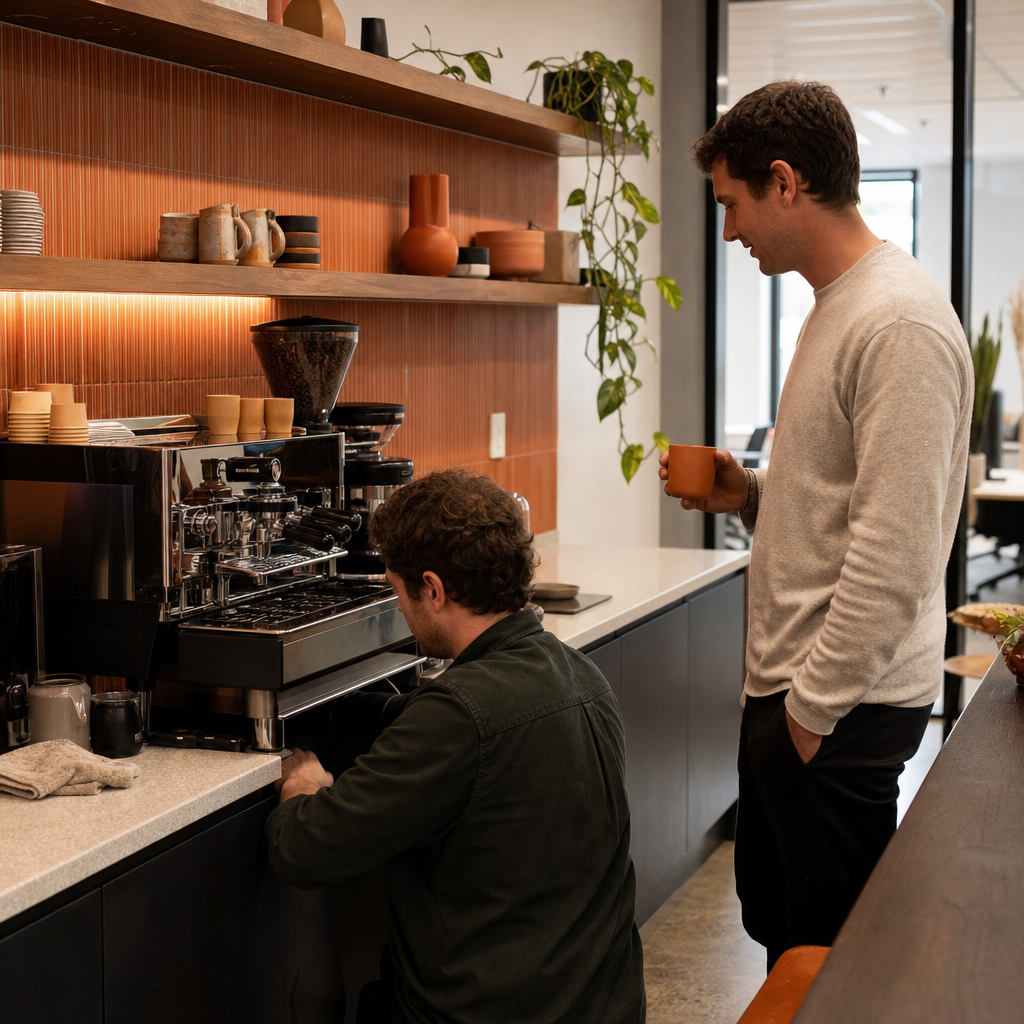
Good office coffee machine service in Melbourne means scheduled preventative visits, one phone number answered by someone who knows your machine, and a typical on-site response within 24 hours. At Boutique Coffee, one accountable person handles setup, servicing and repairs, with no call centres or ticket queues.
Most office coffee frustration starts after the install. The machine looked great on day one. Then it throws an error on a Monday morning, nobody knows who to call, and the supplier points at the bean company, who points at the plumber.
This article sets out what proper service, maintenance and breakdown support should look like for a rented commercial machine in a Melbourne workplace. You will get a clear split between routine care and repairs, a realistic response-time benchmark, daily care tasks your staff can do, and the questions to ask any provider before you sign.
Key Takeaways
- A breakdown costs far more than the repair. The real price is lost time, staff leaving the building and a drop in morale.
- Routine maintenance and breakdown support are different jobs. You need both, and preventative care reduces how often you need the second.
- Call centres and tiered support slow repairs. One accountable person who knows your setup can often solve a fault in a two-minute phone call.
- A typical 24-hour on-site response is a fair benchmark. Ask any provider what it means in writing.
- Five minutes of daily care by staff prevents many common faults.
- Before you sign, ask who you call, how fast they respond and what happens if you want to leave.
Summary Table
| Area | What good looks like | What poor looks like |
|---|---|---|
| Who you call | One person, one number, who knows your machine | A helpdesk, a ticket number and a different voice each time |
| Routine maintenance | Scheduled visits with beans and consumables topped up | Visits only when something has already failed |
| Breakdown support | Fix talked through by phone first, on-site visit fast if needed | Triage script, then a wait for a subcontractor |
| Responsibility | One party owns the machine, beans and service | Finger-pointing between machine, bean and maintenance suppliers |
| Staff involvement | A short daily routine and a cheat sheet | Nobody trained, so small faults become big ones |
| Exit terms | Month-to-month, short notice, pickup included | Long lock-in with penalties for leaving |
Why does an office coffee machine breakdown cost more than you think?
A broken office coffee machine costs more than the repair. It sends people out of the building for coffee, disrupts the meetings that rely on it, and reminds staff that the workplace sits a step below the café on the corner. The damage is mostly lost time and morale, not the fault itself.
Melbourne workers are surrounded by some of the best coffee in the country. A flat white from the café downstairs sets the standard. When the office machine goes down, people do not simply go without. They walk out, and they rarely go alone. A quick coffee run becomes a small team outing, and the people left behind at their desks notice.
Consider a 40-person office on a Monday morning. The machine shows a fault light at 8:45am. By 9:15am half the floor has left for the café. Nobody has measured the cost, but everybody feels it. The machine becomes the thing people complain about at lunch.
Chris Prokopiou, our founder, has seen this pattern on site. A busy Melbourne workplace we look after used to suffer when their machine went down during peak hours. After we moved them to a reliably maintained machine with regular scheduled servicing and direct personal contact for any issue, the team always had coffee when they needed it most. The client's own description was that it removed the havoc a broken machine used to cause.
That is the gap worth closing. Coffee is one of the small moments that decide whether an office feels looked after.
What is the difference between routine maintenance and breakdown support?
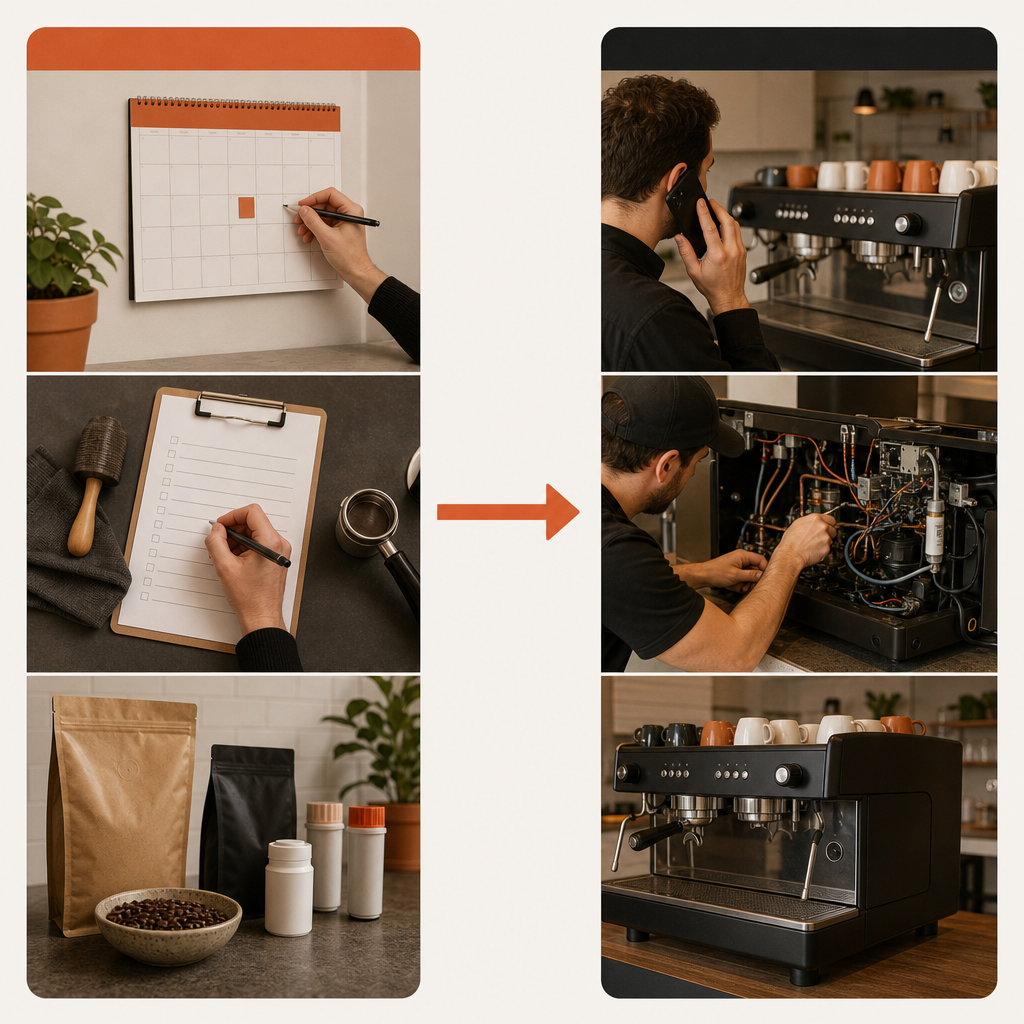
Routine maintenance is scheduled care that stops faults forming. Breakdown support is the response when something fails anyway. Maintenance protects your coffee quality and machine life. Breakdown support protects your team's day. A good provider delivers both, and treats the first as the best way to reduce the second.
The two are often sold as one thing, but they work differently.
| Routine maintenance | Breakdown support | |
|---|---|---|
| Purpose | Prevent faults and keep coffee consistent | Restore the machine quickly after a failure |
| Timing | Planned, on a regular rhythm | Unplanned, triggered by your call |
| Who benefits | Everyone, every day, without noticing | The team on the day it matters |
| Warning sign if neglected | Coffee slowly gets worse | Machine stops entirely |
| Questions to ask | How often do you visit and what do you check? | Who answers, and how fast do you attend? |
Why preventative care keeps machines running
Commercial espresso machines work under heat, pressure and constant contact with water, milk and coffee oils. Hard water leaves scale. Milk residue builds up. Grinders drift as beans, humidity and usage change. None of these problems arrive with a bang. They creep in, and the first symptom is usually coffee that tastes a bit off.
The Specialty Coffee Association publishes water quality standards for brewing because water chemistry affects both flavour and equipment life. You do not need to become a water chemist. You do need a provider who pays attention to it.
Our ongoing rhythm is weekly or fortnightly service visits, with beans and consumables topped up each time. That visit is also the moment someone who knows your machine looks at it. A grinder that needs a small adjustment, a slightly slow flow or a worn component can be caught before it becomes a Monday morning failure. This is what we mean by dialled-in beans: the grinder, the blend and the machine all checked against what your team actually drinks.
Exactly what is covered by any provider's service should be confirmed in writing before you sign. Do not assume.
Why do call centres and ticket queues slow down coffee machine repairs?
Tiered support slows repairs because each layer adds a handover. A first-line agent logs the fault, a second line reviews it, and a technician is eventually booked. Nobody in that chain knows your machine. One accountable person who does can often fix the problem in a two-minute call.
Most corporate coffee suppliers route issues through helpdesks, ticket systems and tiered teams. That model suits the supplier. It protects their staff from having to know individual clients, and it scales neatly across thousands of sites. It does not suit you.
Here is what typically happens when you ring a tiered system:
- You explain the problem to someone who has never seen your machine.
- They run a script, usually asking you to switch it off and on again.
- A ticket is created and you get a reference number.
- The ticket is assigned to a technician or subcontractor, who may not be local.
- Someone eventually calls to book a visit.
Now imagine the same fault with one person who installed your machine, trained your staff and visits every week or fortnight. They already know the model, the grinder setting, the water situation and the room it sits in. A good share of faults are small and fixable by phone. Our experience is that most can be talked through in two minutes when the person answering knows your setup.
The second problem is finger-pointing. When the machine, the beans and the service come from different parties, each one can say the problem belongs to someone else. Is the coffee sour because of the beans, the grinder or the machine? When one person is responsible for all three, that question gets answered rather than argued.
This is what we mean by one number, one person. There are no call centres and no corporate runaround. It also explains why same-day or next-day on-site attendance is possible. There is no internal queue to wait behind.
What response time should you expect for office coffee machine repairs?
A reasonable benchmark is a typical on-site response within 24 hours of a service call. Across our active Melbourne client base, 24 hours is the typical response on any service call. That is our own data, not an industry standard, so ask every provider to state theirs in writing.
The number matters less than what it covers. When a provider says they respond within a set time, find out which of these they mean:
- Phone answered: a person picks up and engages with the fault.
- Remote fix attempted: someone who knows the machine tries to solve it by phone.
- Technician on site: a person is physically at your machine.
- Machine working again: the fault is actually resolved.
Providers often quote the first or second and let you assume the fourth. Ask for the third and the fourth.
Be realistic as well. A typical response is not a guarantee, and some repairs need a part that has to be sourced. Any honest provider will tell you so on the call, rather than leaving you waiting. The measure of good support is that you know what is happening and when.
It also helps to know how a provider handles the gap. If a repair will take longer, what happens in the meantime? Do they talk you through a workaround or offer another solution? Providers who answer that question confidently usually run their service properly.
If you want to see how coverage works across the city, check the delivery areas of any provider you are considering. Travel distance affects how fast anyone can reach you.
What can staff do each day to prevent common coffee machine faults?

Staff can prevent many common faults with a few minutes of daily care: wiping and purging the steam wand after each use, emptying the drip tray, keeping the bean hopper clean and reporting early warning signs. These habits protect coffee quality and stop small problems becoming service calls.
The following tasks are written in plain language. Always follow the instructions for your specific machine, and treat the cheat sheet left at your first brew and training session as the final word.
| Daily task | What it helps prevent |
|---|---|
| Wipe the steam wand and purge it straight after steaming milk | Baked-on milk, blocked wand, off flavours |
| Empty and rinse the drip tray and used-coffee bin | Overflow, smells, mess near the machine |
| Keep the bean hopper lid on and only use beans supplied for your machine | Stale coffee, grinder problems from unsuitable beans |
| Leave grinder settings alone | Coffee that suddenly tastes sour, bitter or weak |
| Keep the water tank topped up if your machine uses one | Pump strain and sudden stoppages |
| Wipe down the machine and bench at the end of the day | Build-up of coffee oils and grime |
| Report odd noises, leaks, slow flow or warning lights early | Small faults turning into breakdowns |
Train more than one person
When we install a machine, at least two staff are trained at first brew. This matters. If only one person knows the routine, it stops the day they take leave. Two or more people means the habits survive holidays, team changes and busy weeks.
Report early, not late
The most useful daily habit is the cheapest. If coffee tastes different, shots run slower or the machine sounds odd, say so that day. A quick call about a small change is easy for someone who knows your machine. A call after a complete failure is not.
Do not try improvised repairs or use household cleaning products on a commercial machine. That is how small faults become expensive ones.
What should you ask any provider about service before you sign?
Ask five things: who you call, how fast they respond, what is included in service, who owns the machine, beans and repairs, and what happens if you want to leave. The answers show whether the provider will support you after the install or disappear behind a helpdesk.
Use these questions whether you are choosing a first provider or comparing against your current one.
- Who do I call when something goes wrong? Ask for the name of the person and whether the same person answers each time. Our answer is one number and one person.
- How fast will someone attend? Get the typical response in writing and ask what it covers. Remember the four meanings of response above.
- What does routine service include, and how often? Ask what is checked on each visit and what is topped up.
- What is covered in the rental, and what costs extra? Do not assume repairs are included. Get it in writing.
- Who is accountable for the machine, the beans and the service? One party is better than three.
- What happens if the machine cannot be fixed? Ask how replacement works and how long it takes.
- Is this machine the right size for my team? A good provider will recommend the machine that fits, even if it is the cheaper one.
- What happens if I want to leave? This is the question most people forget.
On the last point, our terms are month-to-month with one month's notice and free machine pickup. Other providers use long fixed terms, so read exit and renewal clauses closely. The ACCC publishes guidance on unfair contract terms in standard form contracts, which can apply to small businesses, and it is worth reading before you commit to anything long.
On question seven, consider the extremes. A 12-person team does not need a $15,000 Eversys. An 80-person team will break a home-grade Jura within a month. A provider who sells you the wrong machine has already set up a service problem. If you want the background on how rentals and leases differ, our guides on lease versus month-to-month rental cover that ground, so I will not repeat it here.
Why we never lock clients in, and why it makes service better
Our view is that service quality is the product, and a contract should not be what keeps you. Every rental we run is month-to-month. In 17 years of operating exclusively in workplace coffee, since 2008, no-lock-in has never cost us a client worth keeping.
Here are the numbers behind that. We currently look after 200+ active Melbourne workplace clients, and the average client relationship runs 5+ years. Those are our own figures across our active client base. Nobody is held in place by a contract. They stay because the machine works and someone answers the phone.
That is not an accident. If the exit is easy, we have to keep earning the account every month. It changes how you treat a service call. You pick up. You turn up. You fix it. This is what we mean by being a coffee partner, not a supplier.
Chris started the business because the gap between café coffee outside the office and the instant coffee inside never made sense to him. Melbourne workers should not have to drop their standards when they walk into work. That conviction has not changed since 2008. Good office coffee should match the café standard, and be made practical for a workplace.
A few moments from the job show what that looks like in practice.
- A mid-size Melbourne office had a coffee setup that was not meeting the team's needs. Chris upgraded them to a WMF commercial machine, with install, training and ongoing service included in the rental. The site manager reported easy daily use, great coffee and hot chocolate, and consistent service maintained for years. At one point the manager told his staff to keep doing what they were doing, which is about the best feedback a supplier can hear.
- A busy retail environment needed great coffee served daily to staff and customers. Chris supplied the beans and a fully maintained machine, and managed supply and upkeep personally. The client credited that attention to detail for being able to serve great coffee every day without interruption.
- A stranger asked for Chris's card. While Chris was attending another client's site, a person from a former client's office was waiting to meet him. His current coffee supplier, he said, provided the worst coffee, and he wanted Chris's card to pass to senior management. Nobody can buy that kind of referral.
There is a fair caveat. Month-to-month terms only work if you keep your side of the deal. We do not chase clients with penalties, so if service slips, we pay for it in lost accounts. That is the point. I am not trying to be the biggest provider in Melbourne. I am trying to be the one that picks up.
If your current machine keeps failing, or the person you call changes every time, talk to the one person who will look after your machine. Call Boutique Coffee at Work and ask about a month-to-month rental with no lock-in. If we are not the right fit for your team, we will say so.
References
- Boutique Coffee at Work, own client data (2026): 200+ active Melbourne workplace clients, average relationship length of 5+ years, 24-hour typical service response, operating exclusively in workplace coffee since 2008. https://www.boutiquecoffee.com.au/
- Australian Competition and Consumer Commission (ACCC), Unfair contract terms guidance for businesses. https://www.accc.gov.au/business/business-rights-and-obligations/unfair-contract-terms
- Specialty Coffee Association (SCA), water quality standards and research resources. https://sca.coffee/
Frequently asked questions
How often should an office coffee machine be serviced?
It depends on the machine, the number of drinks made each day and your water. A good routine is regular scheduled visits rather than waiting for faults. Our rhythm is weekly or fortnightly service visits, with beans and consumables topped up. Ask any provider to state the schedule and what is checked on each visit.
Who is responsible for repairs on a rented office coffee machine?
It depends on your agreement, so check it before you sign. With a rental from Boutique Coffee, install, training and ongoing service are part of the arrangement, and one person is accountable for the machine, beans and service. If repairs are listed as extra elsewhere, ask for the terms in writing.
How quickly should an office coffee machine repair happen in Melbourne?
A fair benchmark is a typical on-site response within 24 hours of a service call. That is the typical response across Boutique Coffee's active client base. Ask what response means: a call answered, a remote fix attempted, a technician on site or the machine working again. Parts can extend a repair, and an honest provider will say so.
What are the signs an office coffee machine needs servicing?
Watch for coffee that tastes sour, bitter or flat, slow or uneven flow, weak or noisy steam, leaks, unusual sounds and warning lights. Most of these appear gradually before a full breakdown. Report them early to the person who looks after your machine, and do not try improvised repairs.
Can I leave a rented coffee machine provider if the service is poor?
Only if your agreement allows it. Many providers use long fixed terms. Boutique Coffee rentals are month-to-month with one month's notice and free machine pickup. If you are considering other providers, read the exit and renewal clauses carefully, and see the ACCC guidance on unfair contract terms.

Chris
Chris
Keep reading
Office Coffee Machine Rental Pricing in Melbourne: Transparent Plans and What's Included
Office coffee machine rental in Melbourne is priced as a monthly fee driven mainly by headcount, daily cup volume, machine type, milk system and site setup. At…
Coffee Machine Installation and Staff Training: How Melbourne Offices Get Café-Quality Coffee From Day One
Good coffee machine installation and staff training means the machine is connected correctly, at least two staff learn basic operation, cleaning and milk…
Office Coffee Subscriptions in Melbourne: Why a Month-to-Month Machine Rental Beats Pods and Lock-In Contracts
The best office coffee subscription for a Melbourne workplace is a month-to-month commercial machine rental that includes installation, regular servicing and…