The simplest way to get proper coffee into a Melbourne office is to rent a commercial machine month-to-month from a local supplier that installs it, trains your staff, supplies the beans and services it. Match the machine to your headcount, get everything in one monthly price, and avoid lock-in contracts.
I'm Chris Prokopiou, founder of Boutique Coffee. Melbourne workers walk past some of the best coffee in the world on the way to the office, then pour instant or a pod into a mug at their desk. That gap never made sense to me, and closing it has been our only focus since 2008.
This guide is the starting point. It follows the decisions in the order you will actually face them: your options, the cost, the machine and setup, then keeping it running. Each section gives a short practical answer. Where there is a deeper guide on our site, I point to it by name so you can go further when you need to.
Key Takeaways
- Melbourne offices are replacing instant and pods with commercial machines because staff expect café-quality coffee at work.
- Month-to-month rental removes the biggest risk: being stuck with a machine or supplier that does not suit you.
- Monthly pricing is driven by machine size, team consumption, bean supply and service frequency. Ask for all of it in one quote.
- The right machine is the one that fits your team's real size, not the most expensive one on the list.
- Installation and training decide whether a machine gets used properly or ignored.
- Good service means one person, one phone number and no escalation paths.
Summary: The Four Decision Stages
| Stage | The question you are asking | The short answer | Where to go deeper |
|---|---|---|---|
| 1. Understand your options | Rent, lease or stay with pods? | Rent month-to-month for flexibility and service included | Lease vs month-to-month rental, subscriptions vs pods |
| 2. Work out the cost | What should I pay for, and what should be included? | One monthly price covering machine, install, beans and service | Rental pricing |
| 3. Choose and set up | Which machine suits my team? | Size to peak-hour demand and headcount, then train at least two staff | Installation and staff training |
| 4. Keep it running | Who do I call when it breaks? | One accountable person with one number | Service, maintenance and breakdown support |
Why Melbourne Offices Are Closing the Café Gap
Melbourne offices are closing the café gap because staff already know what good coffee tastes like and notice when work does not match it. A proper commercial machine is now a practical, affordable way to offer it, and it signals that the business pays attention to the small things.
Melbourne is a coffee city. Your team buys a flat white on the way in, often more than one. When the office alternative is a jar of instant or a pod that tastes like warm cardboard, people do one of two things. They leave the building for a café run, or they grumble and drink it anyway. Neither is great for a workplace.
A café run is not just a coffee. It is a long walk, a queue and a 20-minute absence that rarely stays at 20 minutes. I am not saying a coffee machine fixes productivity by itself. I am saying that good coffee on site keeps people together, and the coffee moments that matter (the pre-meeting catch-up, the 3pm slump, the chat that solves a problem) happen in your kitchen instead of someone else's queue.
Who this guide is for
This guide is for office managers, operations leads and business owners in Melbourne who are tired of instant coffee or pods and want a simple path to a commercial machine. You do not want a lock-in contract. You do not want to chase a call centre when the machine stops working.
It is written for workplaces of all sizes. Our clients range from small teams to one client with a team of more than 400 people. If you are still weighing up whether a machine suits your industry or suburb, check the pages on which Melbourne industries rent machines and our service coverage and delivery areas. We are Melbourne-only on purpose. I'm not trying to be the biggest, I'm trying to be the one who turns up.
Why I started doing this exclusively
I never understood why people accepted a gap between the café quality outside the door and the instant coffee inside. So I built a business around closing it: rent a proper commercial machine, install it properly, keep the beans coming and actually answer the phone when something goes wrong.
As of 2026, that has meant 17 years of doing this exclusively since 2008, with more than 200 active Melbourne workplace clients and an average client relationship of more than 5 years. These are our own figures across our active client base. I mention them because longevity is the best evidence available that a supplier does the unglamorous parts well.
Stage 1: Understand Your Options (Rental vs Lease vs Pods)
Your three realistic options are renting a commercial machine, leasing one over a fixed term, or using pod or capsule machines. Rental on a month-to-month basis gives you café-quality coffee with service included and no long commitment, which is why it suits most Melbourne workplaces.
Here is how the three compare in plain terms.
| Factor | Month-to-month rental | Fixed-term lease | Pods or capsules |
|---|---|---|---|
| Coffee quality | Fresh beans, café-style | Fresh beans, café-style | Convenient but limited |
| Commitment | Short notice to exit | Locked in for the term | None |
| Servicing | Usually bundled | Varies by provider | Minimal, often disposable machines |
| Fit for bigger teams | Strong | Strong | Poor at peak times |
| Flexibility if your team changes | High | Low | High |
Rental: what I recommend for most offices
With rental, you pay a monthly amount and the supplier owns, installs and maintains the machine. If your team grows, shrinks or moves, the machine changes with you. Our terms are simple: all rentals are month-to-month, with one month's notice to exit and free machine pickup. No lock-in, ever.
In 17 years, that policy has never cost me a client worth keeping. A client who stays because the coffee and service are good is worth far more than one who stays because of a contract clause.
Lease: when it makes sense, and when it does not
A lease usually ties you to a fixed term. That can look cheaper per month on paper. The risk is what the number does not show: what happens if the machine is too big or too small, if service slips, or if your office moves.
If you are offered a long-term agreement, read it carefully. The ACCC publishes guidance on unfair contract terms in standard form contracts for small businesses, and it is worth a look before you sign anything with a long tail. For a side-by-side breakdown, see our guide to lease vs month-to-month rental.
Pods: fine for a very small team, a poor fit beyond it
Pods are easy, but the machine is built for a household, the cost per cup adds up and the waste piles up with it. They struggle when many people want a drink at once, and milk-based drinks are rarely as good as a real espresso machine produces. Our comparison of office coffee subscriptions vs pods covers the trade-offs in more detail.
My honest view: if you have a very small team and coffee is an afterthought, pods are fine. If coffee matters to your culture, a commercial machine is the better choice.
Stage 2: Work Out the Cost
Monthly pricing for a commercial office coffee machine is driven by the machine's capability, your team's consumption, the beans you use and how often the machine needs servicing. A good quote bundles the machine, installation, training, beans and service into one clear monthly figure with nothing hidden.
I am not going to put a number in this guide, because the honest answer depends on your team. Anyone quoting a price without asking about your headcount, drink preferences and bench space is guessing or selling you something. Our rental pricing page explains how we price, and the first phone call gives you a rough figure.
What drives the monthly price
Four things move the price more than anything else:
- Machine tier. A machine built for heavy daily use costs more to rent than one built for a small team. Matching the machine to your actual needs is how you avoid overpaying.
- Consumption. More people drinking more cups means more beans, milk-based drinks and wear on the machine.
- Bean supply. Blend choice and how often we top you up.
- Service rhythm. Weekly or fortnightly visits depending on how hard the machine works.
What should be included
Before you compare quotes, write down what you expect to be covered. Then check every supplier against the same list:
- The machine itself, installed and connected
- A site visit to assess power, plumbing and bench space
- Staff training and a simple cheat sheet
- Beans and consumables, topped up regularly
- Scheduled servicing and breakdown support
- Exit terms in writing, including notice and machine pickup
If any of those are extras, the headline price is not the real price. Ask whether pickup at the end is free. Ours is.
The hidden cost nobody mentions: bad coffee
The cost of a poor setup does not appear on any invoice. It shows up as staff leaving for café runs, a machine nobody trusts and the quiet resentment that builds when the coffee is bad. When I compare quotes with a prospective client, I ask what they spend now on coffee, pods and café runs combined. Most have never added it up.
Stage 3: Choose and Set Up Your Machine
Choose a machine by matching it to your headcount and peak-hour demand, not by picking the most impressive model. A small team needs reliability and simplicity. A large team needs speed and durability. Installation and training then decide whether the machine delivers day to day.
Sizing a machine to your team
I have a firm rule: recommend the machine that fits the team's actual size, even if that is the cheaper option. A 12-person team does not need a $15,000 Eversys. An 80-person team will break a home-grade Jura within a month. Both mistakes are expensive, one for your budget and one for your patience.
When I size a machine, I ask:
- How many people are in the office on a typical day, not just on the payroll?
- When do they reach for coffee? Most offices have a morning rush and an after-lunch bump.
- Is it mostly black coffee, or milk-based drinks like flat whites and lattes?
- Do visitors and clients get coffee too?
- Is there hot chocolate demand? Surprisingly often, yes.
Peak demand matters more than the daily total. A machine that copes with a quiet day but queues at 8:45am will frustrate people quickly.
The Curated Coffee Plan: matching beans to your team
The machine is only half the story. I use what I call the Curated Coffee Plan to match beans to the team rather than defaulting to a one-size supply:
- Ask about the team's drink preferences: espresso or milk-based, strength, any dislikes.
- Start on a well-matched blend based on that profile.
- Adjust based on team feedback within the first month.
That third step matters. Palates differ, and dialled-in beans for one office are wrong for another. Your feedback in the first month is how we get it right.
The Six-Step Process, from first call to first brew
Most Melbourne clients go from first call to an installed machine in 5 to 7 business days. This is how it runs:
| Step | What happens | Time involved (our data) |
|---|---|---|
| 1. Enquiry | You submit basic team details | A couple of minutes |
| 2. Phone call with Chris | Machine shortlist and rough pricing | A quick chat |
| 3. On-site visit | Power, plumbing and bench space assessed | Around half an hour |
| 4. Install day | Machine connected, grinder dialled in, shots tested | Close to an hour |
| 5. First brew and training | At least two staff trained, cheat sheet left | A short session |
| 6. Ongoing rhythm | Weekly or fortnightly service visits, beans and consumables topped up | Ongoing |
Source: Boutique Coffee's own process data, 2026.
It is fast because I do the site visit myself. I can see within minutes whether the power supply, plumbing and bench space suit the machine I have in mind. Our installation and staff training guide walks through each step in more detail, and the rental services process page explains what to expect from the first call.
Why training at least two people matters
I train at least two staff on install day. If only one person knows how to use the machine, the whole office depends on them being in. Two people means cover for leave, and it spreads the confidence. The cheat sheet we leave behind handles the rest.
Here is what a good setup looks like in practice. A mid-size Melbourne office I worked with was running a coffee setup that was not meeting the team's needs or expectations. I upgraded them to a WMF commercial machine with full install, training and ongoing service included in the rental. The change was noticeable across the whole office. The site manager told me his staff loved the coffee and the hot chocolate, and he kept telling them to carry on as they were. That was years ago, and we are still looking after the machine.
Stage 4: Keep It Running
Good service means one accountable person, one phone number and no escalation paths. When something goes wrong, the person who answers already knows your setup, so most issues can be talked through in minutes. When a visit is needed, it happens quickly, with no internal runaround.
This is where most suppliers fall down. They sell the machine well, then hide behind helpdesks, ticket systems and tiered support. You describe the fault to three different people, and nobody owns it. That is the corporate runaround, and it is the main reason people tell me they are leaving their current supplier.
What good service looks like
My approach is simple: one number, one person. No call centres, no corporate runaround. Across our active client base, our typical response time on any service call is 24 hours. That is our own figure, and it is possible because there is no queue to get through before someone picks up.
A good service arrangement has these features:
- A named person who answers the phone. Not a ticket number.
- Scheduled visits. Weekly or fortnightly, depending on use, with beans and consumables topped up each time.
- Fast triage over the phone. Many faults are a two-minute fix when the person on the line knows the machine and the site.
- Quick on-site response when the phone call is not enough.
- Preventive care, so breakdowns are the exception.
Our service, maintenance and breakdown support page explains how this works day to day, and the rental FAQs cover the common practical questions.
What a breakdown costs when service is slow
Consider a busy office where the coffee machine goes down at 8:30am on a Monday. With a slow supplier, you wait for a ticket reply, then for a technician slot, and meanwhile 30 people either do without or leave the building. With a supplier who answers the phone and knows your machine, that same fault is often fixed during the call.
I have seen this play out first-hand. At one busy Melbourne workplace, the coffee machine going down during peak hours caused havoc. I put them on a reliably maintained machine with regular scheduled servicing and my direct number for any issue. Their team now has coffee when they need it most, and the disruption has gone.
The same applies in a busy retail environment where coffee is served daily to staff and customers. There, I supply fresh beans and manage the upkeep personally. The client puts their ability to serve great coffee every day, without interruption, down to attention to detail. That is not a clever system. It is one person paying attention.
Book a No-Obligation Chat With Me
The lowest-risk way to start is a no-obligation conversation. Tell me about your team, how they drink coffee and what is not working now. I will recommend the machine that fits, even if that is the cheaper one, and I will tell you straight if someone else would suit you better.
And there is no risk in trying it. Every rental is month-to-month, with one month's notice to exit and free machine pickup. If it is not right, we collect the machine and part as friends. To start, book a chat with me through the Boutique Coffee website. It takes about 15 to 20 minutes on the phone, and you will leave with a shortlist and a rough price.
What Most Melbourne Offices Get Wrong About Workplace Coffee
The biggest mistake I see is treating coffee as a procurement exercise, not a relationship. Offices compare machines and prices and forget to ask who will answer the phone in month 14. A machine is a product. Service is what you are really buying.
Over 17 years, I have noticed a pattern that does not show up in the supplier comparison pages. The offices that end up happiest are rarely the ones that bought the best machine. They are the ones that chose a supplier they could actually reach.
One moment sticks with me. I was servicing a client's site when a man came over who had worked at a previous client of mine. He had come specifically to meet me and ask for my card. The supplier his company now used, he said, provided the worst coffee he had ever had at work. He wanted to pass my card to senior management and set up a meeting. I did not advertise to him. He found me because the coffee and the service at his old workplace had been good enough to remember.
That is how I measure the business. Advertising matters, but the real test is whether someone you served years ago still remembers you and wants you back. It is why I am a coffee partner, not a supplier. It is also why I stay founder-led: if the person who sells you the machine is also the person who services it, there is nowhere for accountability to hide.
Here is a test you can use with any supplier, including me. Before you sign, ask: "If the machine fails on a Monday morning, who exactly do I call, and who will answer?" If the answer involves a portal, a queue or the word "escalate", you have learned what you needed to know.
Quick Answers
How do I know if my team is big enough for a commercial machine?
If coffee matters to your culture and more than a handful of people drink it daily, a commercial machine is worth considering. Pods suit very small teams where coffee is an afterthought. The deciding factor is peak-hour demand, not total headcount. A short phone call is enough to work out the right fit.
Can I change the beans after we start?
Yes. Our Curated Coffee Plan starts on a blend matched to your team's preferences, then adjusts based on feedback in the first month. If the team wants stronger, smoother or milkier options, tell us. Beans are a supply decision, not a contract one, so changing them is simple.
What happens when we want to stop renting?
Give us one month's notice and we collect the machine for free. There are no exit fees to negotiate and no minimum term to run out. This is how all our rentals work, because I would rather keep clients by choice than by contract.
Do I need to be on site for installation?
Someone from your team should be there on install day, mainly so that the training lands. Installation takes about 45 minutes in our process, followed by roughly 20 minutes of first brew and training. Having at least two people present means cover if one is away.
References
Frequently asked questions
How do I know if my team is big enough for a commercial machine?
If coffee matters to your culture and more than a handful of people drink it daily, a commercial machine is worth considering. Pods suit very small teams where coffee is an afterthought. The deciding factor is peak-hour demand, not total headcount. A short phone call is enough to work out the right fit.
Can I change the beans after we start?
Yes. The Curated Coffee Plan starts on a blend matched to your team's preferences, then adjusts based on feedback in the first month. If the team wants stronger, smoother or milkier options, tell us. Beans are a supply decision, not a contract one, so changing them is simple.
What happens when we want to stop renting?
Give one month's notice and the machine is collected for free. There are no exit fees to negotiate and no minimum term to run out. All Boutique Coffee rentals work this way.
Do I need to be on site for installation?
Someone from your team should be there on install day so that the training lands. Installation takes about 45 minutes in the Boutique Coffee process, followed by roughly 20 minutes of first brew and training. Having at least two people present means cover if one is away.
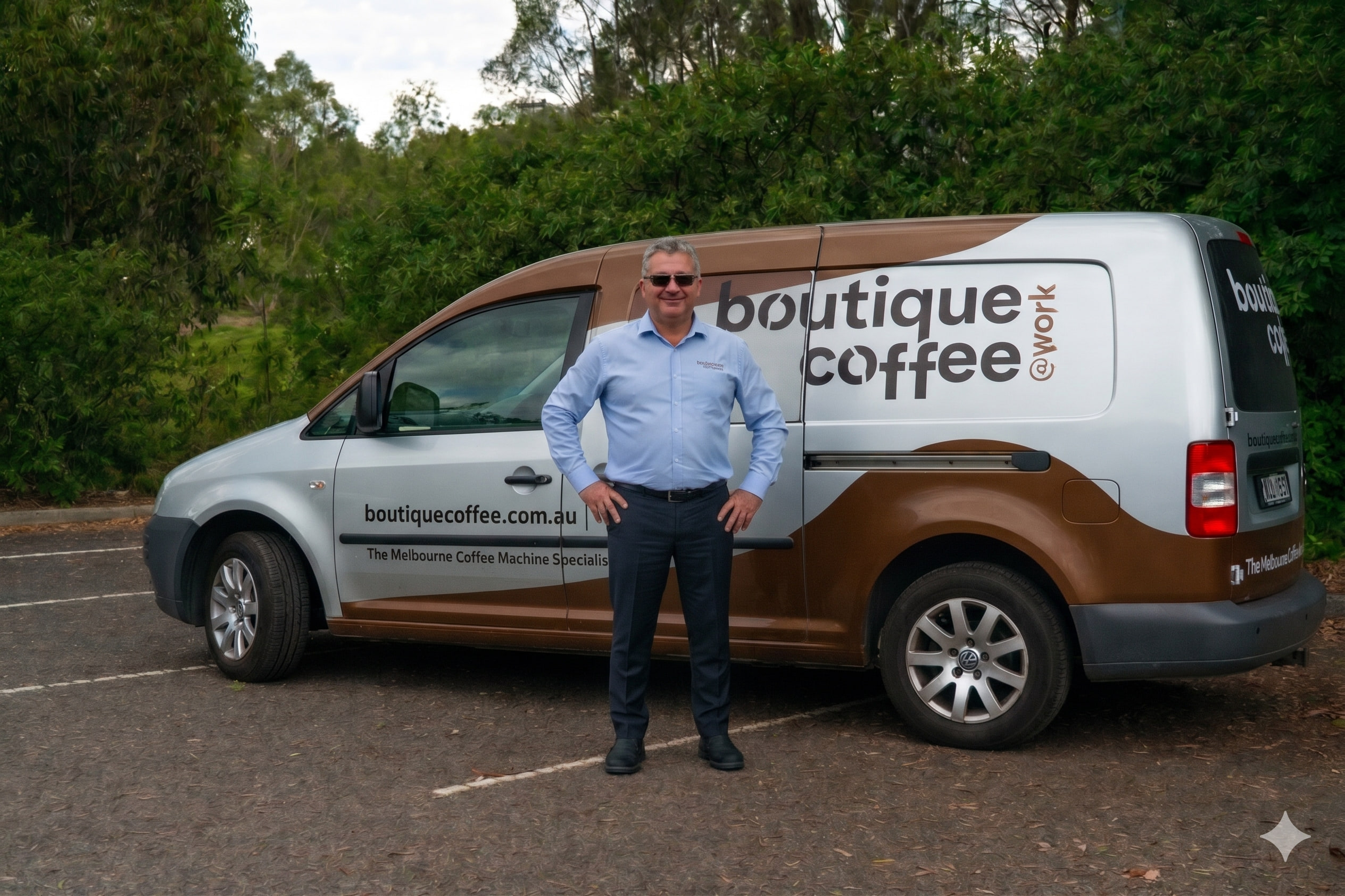
Chris
Chris
Keep reading
Office Coffee Machine Rental FAQs: Straight Answers for Melbourne Workplaces
Office coffee machine rental means paying a monthly fee to use a commercial machine that the supplier installs, services and looks after, rather than buying it…
Company credentials and commercial coffee experience
Company credentials and commercial coffee experience should prove that a provider can select, install, supply and maintain the right workplace coffee system…
Office Coffee Subscriptions vs Machine Rental: Which is Better?
An office coffee subscription is better when you already own suitable equipment and only need fresh beans delivered. Machine rental suits offices needing…