Melbourne businesses across professional services, medical and allied health, warehousing, manufacturing, education, and creative workplaces all rent commercial coffee machines, but each needs something different: corporates need peak-hour volume and polish, clinics need hygiene and simple operation, warehouses need durability, and community organisations need budget certainty. Boutique Coffee at Work has fitted machines into 200+ Melbourne workplaces since 2008.
When you're comparing coffee suppliers, the question underneath every enquiry is the same: does this business already understand workplaces like mine? A logo wall doesn't answer that. What matters is whether the supplier has actually installed, serviced and adjusted machines for a business your size, in your industry, dealing with your constraints.
I'm Chris Prokopiou, founder of Boutique Coffee at Work. I started this business in 2008 because the gap between the café quality on the street outside a Melbourne office and the instant coffee inside it never made sense to me. Seventeen years later, we look after 200+ Melbourne workplaces across professional services, healthcare, warehousing, education and creative industries. This article profiles what each of those industries actually needs from a coffee setup, based on what I've seen fitting machines into all of them, founder-led, always.
Key Takeaways
- Boutique Coffee at Work currently supplies 200+ active Melbourne workplace clients, with an average client relationship of 5+ years.
- Different industries have genuinely different requirements: hygiene and speed for clinics, durability for warehouses, café-quality for creative studios, budget certainty for community organisations.
- Every client gets one accountable person and one phone number, with no escalation paths or call centres.
- All rentals are month-to-month with one month's notice to exit and free machine pickup, never a lock-in contract.
- Machines are sized to actual headcount and realistic cups per day, not upsold to the highest spec available.
- Service calls are answered within 24 hours, across a 17-year, Melbourne-only client base.
Summary Table: What Each Industry Actually Needs
| Industry | Peak Demand Pattern | Priority Need | Typical Machine Fit |
|---|---|---|---|
| Professional services & corporate offices | Sharp 8-10am and post-lunch rush, client meetings | Volume plus presentation | Automatic bean-to-cup with dual milk capability |
| Medical, dental & allied health | Steady flow between short patient slots | Hygiene, speed, simple operation for rotating staff | Compact bean-to-cup with easy-clean, auto-rinse cycles |
| Warehouses, trades & manufacturing | Shift starts, smoko breaks, high daily throughput | Durability, minimal fuss under constant use | Heavy-duty commercial machine built for volume |
| Education, community & not-for-profit | Irregular, term-based or grant-cycle demand | Budget certainty, flexible terms | Mid-range machine on month-to-month rental |
| Creative, tech & hospitality-adjacent | All-day grazing, high staff expectations | Genuine café-quality results | Semi-automatic or full commercial espresso setup |
Why Industry Experience Matters More Than a Logo Wall
The difference between a 12-person design studio and a 90-person warehouse isn't just headcount. It's power supply, plumbing access, staff turnover, shift patterns, and how coffee fits into the working day. A machine that suits one will fail or frustrate the other, which is why genuine industry experience matters more than any client list.
A small studio usually has one power point behind a bench, a casual social coffee culture, and low volume but high expectations on quality. A warehouse might run three shifts, push through a far higher daily cup count than an office with the same headcount, and need a machine that survives rough handling and inconsistent cleaning routines. Neither business is wrong about what it wants. They just want completely different things.
This is exactly why the on-site visit matters before any machine gets recommended. In our process, that visit runs about 30 minutes and covers power, plumbing and bench space properly, before anyone talks machine models. Skip that step, and you end up with a beautiful machine that doesn't fit the bench, or doesn't have the water pressure it needs.
A logo wall shows who signed up. It doesn't show who's still happy five years later. Our average client relationship sits north of 5 years, across 200+ active Melbourne workplaces, and that number matters more to me than any single brand name I could put on a page.
Professional Services and Corporate Offices: Peak Hours and Meeting Room Standards
Corporate offices need a machine that handles a sharp 8am to 10am rush and a second wave after lunch, without a queue forming at the machine. It also needs to look right in a meeting room, because visitors judge a business partly on the coffee it serves them.
CBD and inner-suburb office fitouts are usually tight on bench space, and the coffee point often sits right off the boardroom, so appearance matters as much as output. Volume matters too: a 60-person office isn't making 60 coffees spread evenly across the day, it's making 25 of them in a 45-minute window.
One mid-size Melbourne office I worked with had an existing coffee setup that wasn't meeting the team's needs, and it showed in how staff talked about it. We upgraded them to a WMF commercial machine, with full install, staff training and ongoing service built into the rental from day one. The change was noticeable across the whole office. The site manager told me the team could make good coffee and hot chocolate easily every day, and the quality held for years afterwards, not just in the first month.
For most corporate offices, the right fit is an automatic bean-to-cup machine with dual milk handling, sized for the actual headcount rather than the biggest unit on the price list. If you want to understand the differences between machine types before you call anyone, our guide to the different types of office coffee machines runs through the options in plain terms.
Medical, Dental and Allied Health: Hygiene, Speed and Simplicity
Medical and dental clinics need a machine that's easy to keep clean between patients, simple enough for rotating reception and clinical staff to operate without training, and fast enough to make a coffee in a short gap between appointments.
Hygiene routines in a clinical setting aren't optional extras, they're part of how the whole practice runs. A machine with auto-rinse cycles and removable, easily sanitised milk components fits that environment far better than a domestic-style unit with hidden parts. The Australian Dental Association's infection control guidance sets a high bar for cleanliness across a practice, and a coffee machine sitting in a staff kitchen isn't exempt from that expectation, even if it's rarely the first thing on a practice manager's mind.
Staff breaks in clinics are short, sometimes five to ten minutes between patients, so one-touch operation matters more here than almost anywhere else. There's no time to fuss over a manual espresso setup, and staff rosters change often enough that anyone using the machine needs to get a decent coffee first try, no barista skill required.
When we onboard a clinic, we run what I call the Curated Coffee Plan: we ask about the team's actual drink preferences, whether that's mostly milk-based flat whites or straight espresso, start them on a well-matched blend, and adjust based on feedback within the first month. It's a small step that avoids handing every clinic the same generic bean regardless of what staff actually drink. Full installation detail, including what we check on-site before fitting anything, is in our installation guide, and the terms behind ongoing servicing are in our service contracts article.
Warehouses, Trades and Manufacturing: Built for Shift Work and High Throughput
Warehouse and trade environments need a machine built to survive dust, temperature swings and constant use across shift changes, not a delicate benchtop unit designed for a boutique café. Reliability matters more than finesse here, because a broken machine mid-shift causes real disruption.
Shift patterns push cup counts higher than headcount alone would suggest. Early starts, smoko breaks and three-shift operations mean a 40-person warehouse can push through more coffee in a day than a 60-person office running standard hours. The machine needs commercial-grade components that handle that volume without constant intervention.
A busy Melbourne workplace I look after used to lose real time every time their old machine went down mid-shift. Once we put in a properly maintained machine with regular scheduled servicing, and gave the site a direct line to me personally rather than a general enquiries number, that disruption stopped. The site lead told me reliable, regular service meant the team always had coffee when they needed it most, and the breakdowns that used to cause genuine havoc on the floor simply don't happen anymore.
Because downtime costs more on an industrial site than in an office, this is where our 24-hour service response matters most in practice. You can check exactly where we cover across Melbourne, including outer industrial precincts, on our service coverage and delivery areas page.
Education, Community and Not-for-Profit: Budget Certainty Without Lock-In
Schools, community organisations and not-for-profits need predictable monthly costs and the flexibility to change or cancel without penalty, because budgets are often tied to grant cycles or enrolment numbers that shift from year to year.
Budget certainty comes from a fixed monthly rental with no capital outlay, which is far easier for a finance committee or board to approve than a large upfront purchase. That's often the deciding factor for a community organisation weighing up whether coffee for staff and volunteers is even in scope this year.
Month-to-month flexibility is where our model actually differs from most of the market. Every rental we run comes with one month's notice to exit and free machine pickup if the arrangement doesn't work or the funding changes. No lock-in, ever. In an industry where equipment rental usually means a locked-in term to protect the supplier's revenue, that's a deliberate choice on our end, not a gap in our terms and conditions.
Staffroom sharing is common in this category too: one machine servicing a wide mix of teaching staff, admin, and volunteers, all with different preferences and different familiarity with the equipment. Simple, durable machines with straightforward operation work best, the same principle that applies in clinics, just for a different reason.
Creative, Tech and Hospitality-Adjacent Workplaces: Café-Quality Expectations
Creative studios, tech companies and hospitality-adjacent businesses employ people who buy coffee from a café every day around the corner. Anything less than café-quality in the office gets noticed immediately, so these workplaces need genuine espresso results, not a token gesture machine.
Staff in these industries know good coffee, because they're comparing the office machine directly against the $5 flat white they'd otherwise be buying next door. That comparison is unforgiving. Dialled-in beans, correct dosing and a machine capable of decent milk texture aren't nice-to-haves here, they're the baseline expectation.
A Melbourne business trading in a busy retail strip needed to serve consistently great coffee to staff and customers every single day, with no room for an off day given how visible the coffee was to the public. We supplied fresh beans on a regular delivery cycle and kept the machine fully maintained, managing both personally rather than outsourcing either. The owner told me it was the attention to detail on supply and upkeep that let them serve great coffee daily without interruption.
This category is where clients most often ask about running costs per cup, since coffee quality is directly tied to reputation. Our daily cost article breaks down what a properly specified setup actually costs to run once beans, servicing and rental are all accounted for.
How to Size and Specify a Machine for Your Workplace
Sizing a machine correctly starts with three numbers: headcount, realistic cups per day, and what power and water access exists at the site. Get those right, and the rest of the decision, which machine, what beans, follows naturally rather than being guesswork.
Headcount and cups per day aren't the same figure. An office of 60 with two work-from-home days a week and a lot of meetings offsite won't drink like an office of 60 that's fully in-house five days a week. Power and water access also matter more than most people expect: a plumbed-in machine needs a water line nearby, and higher-output machines need proper single-phase power, not a shared power board.
We run every new client through what I call the Six-Step Process, designed to take most Melbourne workplaces from first enquiry to an installed, working machine in 5 to 7 business days:
- Enquiry (about 2 minutes): you tell us basic team details.
- Phone call with me (15 to 20 minutes): we shortlist machines and talk rough pricing.
- On-site visit (30 minutes): we check power, plumbing and bench space in person.
- Install day (45 minutes): the machine is connected, the grinder is dialled in, and shots are tested before we leave.
- First brew and training (20 minutes): at least two staff are trained, and a cheat sheet is left on-site.
- Ongoing rhythm: weekly or fortnightly service visits, beans and consumables topped up so your team never goes without coffee.
We've run this process for teams as small as a handful of people and for a single office of 400+ people, our largest install to date. The sizing conversation is identical either way: what does this team actually need, not what's the biggest machine on the list. That's a point of integrity for us, not a sales tactic.
Seventeen Years of Driving to Melbourne Workplaces: What Actually Builds Trust
I get to spend my days driving across Melbourne, from CBD towers to suburban warehouses, checking machines are running properly and fully stocked. That's not a throwaway line, it's the actual job, and it's taught me more about what businesses need than any market research could.
A site manager I look after once told me his staff had specifically asked him not to change anything about the coffee. He said he told them, "no problem, just keep doing what you're doing." That's a small thing, but it's exactly the outcome I'm chasing with every install: the coffee moments that matter enough that people notice when they're right, and notice even more when they're wrong.
I found that out the harder way once too. I was on-site at a client's workplace when someone who used to work at a previous client's office approached me. He wasn't there for coffee, he was there to get my card, because he wanted to hand it to his new employer's senior management. Their current supplier, he said, made the worst coffee he'd had in a workplace, and he wanted me to come in and set up something better. That's the real test of this business. It's not the pitch, it's whether people go out of their way to bring you in the door.
Here's where I differ from most of the industry. Most corporate coffee suppliers route problems through helpdesks, ticket numbers and account managers you've never met. I don't. Every one of my 200+ Melbourne clients has one number, one person, me, accountable from the first site visit through every service call afterwards. No call centres, no corporate runaround. Most fixes take two minutes on the phone when the person answering already knows your machine and your setup. That's how we hold a 24-hour response time across the whole client base, not because of a service level agreement on paper, but because there's no internal runaround to navigate before someone actually deals with it.
I also don't lock anyone in. Every rental is month-to-month, with one month's notice to exit and free machine pickup if it doesn't work out. In 17 years, that policy has never cost me a client worth keeping. A long-term relationship kept by choice, and our average sits north of 5 years, is worth more than one kept by contract.
And I won't upsell you. A 12-person studio doesn't need a machine built for 90 people, and an 80-person office will break a machine built for a household kitchen within a month. I've fitted machines for teams as small as a handful and as large as 400+ people in a single office, and the sizing conversation is the same every time: what do you actually need, chosen on purpose, not what's the biggest thing I can rent you. That's café-quality, made practical, and it's the reason I'm not trying to be the biggest supplier in Melbourne, just the right coffee partner, not a supplier, for the workplaces we actually take on.
References
- Australian Bureau of Statistics (ABS), Counts of Australian Businesses, including Entries and Exits: https://www.abs.gov.au/statistics/economy/business-indicators/counts-australian-businesses-including-entries-and-exits
- Safe Work Australia, Code of Practice: Managing the Work Environment and Facilities: https://www.safeworkaustralia.gov.au/doc/model-code-practice-managing-work-environment-and-facilities
- Australian Competition and Consumer Commission (ACCC), Unfair contract terms: https://www.accc.gov.au/business/business-rights-protections/unfair-contract-terms
- Australian Dental Association (ADA), infection control guidance: https://ada.org.au
If you're comparing suppliers and want a straight answer rather than a sales pitch, call and describe your site and headcount. I'll tell you what actually fits, with no lock-in contract attached.
Frequently asked questions
Do you supply coffee machines for medical and dental clinics in Melbourne?
Yes. We fit clinics with compact, easy-clean machines suited to rotating staff and short breaks between patients, and we match the bean profile to what the team actually drinks through our Curated Coffee Plan.
What size coffee machine does a warehouse or trade business need?
It depends on headcount and shift pattern, not just floor size. Most warehouses need a heavy-duty commercial machine built for high daily throughput rather than a delicate café-style unit, and we confirm the exact fit during the on-site visit.
Is there a lock-in contract for commercial coffee machine rental?
No. Every rental with us is month-to-month, with one month's notice to exit and free machine pickup. We don't believe long-term contracts are necessary to keep a client worth keeping.
How long does installation take once we enquire?
Most Melbourne clients go from first enquiry to an installed, working machine in 5 to 7 business days, following our Six-Step Process from phone call through to first brew and staff training.
What happens if the machine breaks down?
You call one number and reach one person, me, not a call centre. Service calls are answered within 24 hours across our entire Melbourne client base, and most issues are resolved on the same call or with a next-day site visit.
Do you supply the coffee beans as well as the machine?
Yes. Bean supply and ongoing consumables are built into every rental, and we adjust the blend to your team's preferences within the first month rather than defaulting to one generic bean for every client.
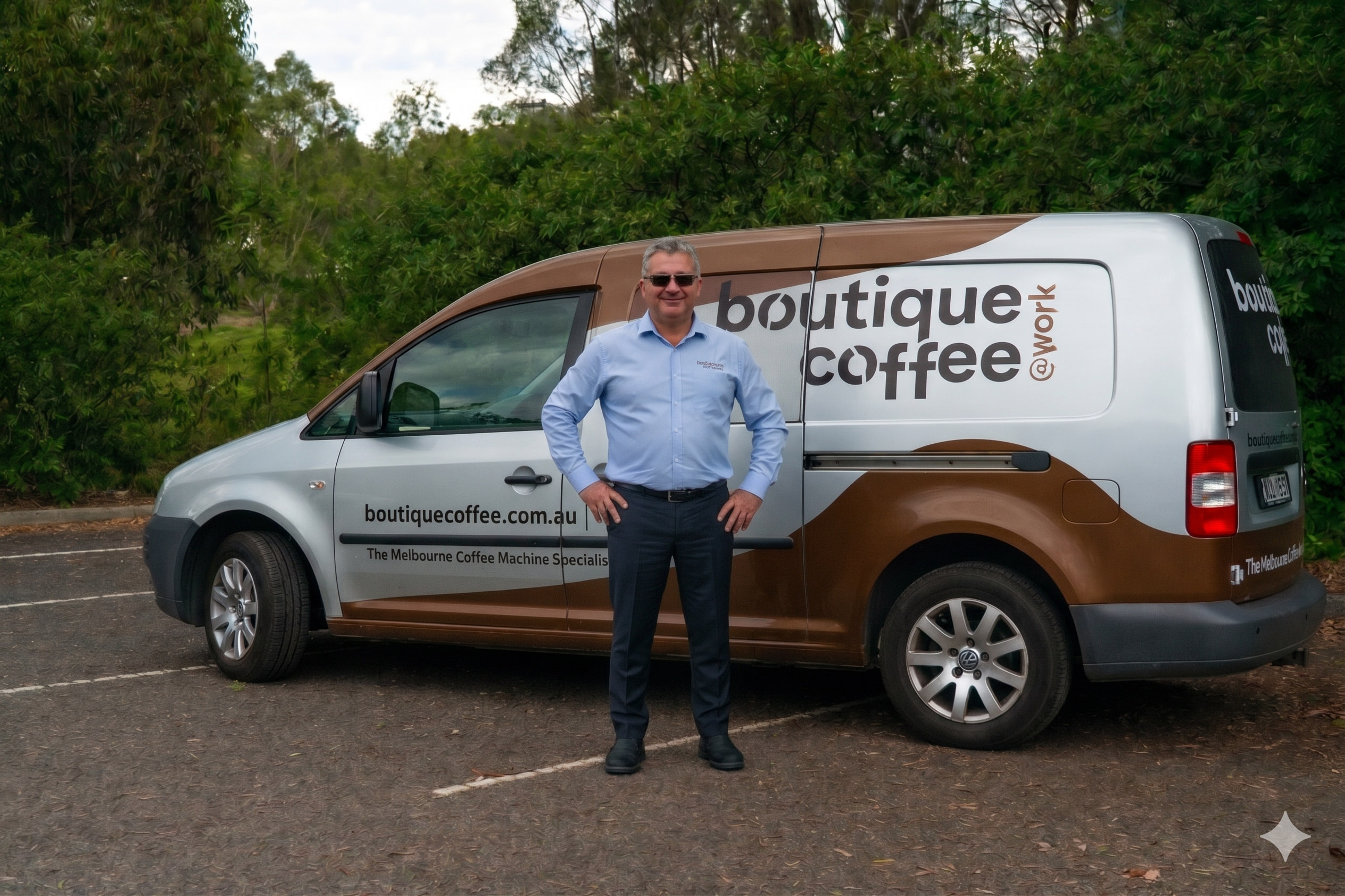
Chris
Chris
Keep reading
Office Coffee Machine Rental Services in Melbourne: How the Process Actually Works
An office coffee machine rental service in Melbourne supplies a commercial-grade machine, installs it properly, trains your staff, and keeps beans and…
Types of Office Coffee Machines: Finding the Right System for Your Australian Business
Office coffee machine types fall into four main categories: automatic bean-to-cup, traditional espresso, filter or batch brew, and pod or capsule systems. The…
Australian Corporate Coffee Trends: 2026 Statistics and Market Report
Key Statistics Summary According to McCrindle Research (https://mccrindle.com.au/article/blog/australias-changing-coffee-culture/), 75% of surveyed Australians…