Office coffee machine rental in Melbourne means paying a monthly fee for a commercial machine that comes installed, serviced and supplied with beans by one provider. At Boutique Coffee, rentals are month-to-month with one month's notice and free pickup, so the real decision is which question is holding you back.
Melbourne runs on good coffee. Your team walks past a café that pulls a proper shot on the way in, then reaches the office kitchen and faces instant or a tired pod machine. That gap never made sense to me. I'm Chris Prokopiou, founder of Boutique Coffee, and closing it has been my sole focus since 2008. That is 17 years working exclusively in workplace coffee, and only in Melbourne.
In my experience, most workplaces don't stall on whether they want better coffee. They stall on one specific question: cost, machine size, breakdowns, lock-in or whether staff will use it. This guide sorts those hesitations by topic and pairs each with a clear next step. It doesn't walk through the full process or repeat our FAQ page. It points you to the right place and gets you moving.
Key Takeaways
- Compare rental against what you already spend on pods, café runs and the time they take, not against zero.
- The right machine is set by headcount, usage peaks and bench space. Bigger is not better.
- One phone number and one accountable person means faults get fixed faster than any ticket system allows.
- Month-to-month rental with one month's notice and free pickup removes the lock-in risk entirely.
- Staff adoption comes down to proper installation, hands-on training and beans and milk your team actually likes.
- Our active client base is 200+ Melbourne workplaces, with an average relationship of 5+ years. These are the client base's own numbers, not third-party figures.
Find Your Question: Summary Table
| The question you're asking | What's really behind it | Your next step |
|---|---|---|
| What will it cost us? | Fear of paying more than the current setup | Request a quote |
| Which machine suits our team? | Worry about buying too big, too small or the wrong type | A short sizing call |
| What happens when it breaks? | Past experience of long waits and runarounds | One number, one person, from setup onward |
| We don't want to be locked in | Wariness of long contracts and exit fees | Month-to-month terms, one month's notice |
| Will staff actually use it? | Concern the machine becomes an expensive ornament | Proper installation, training and a matched blend |
| Do you cover us? | Uncertainty about location and workplace type | Check the service coverage page or ask on the call |
What will it cost us?
Rental replaces a large upfront purchase with a monthly fee covering the machine, installation, training and ongoing service. The honest comparison is not rental against nothing. It is rental against what you already spend on pods, café runs and the time they consume. Your quote is built around your team size and the machine that fits.
Most offices underestimate what the current setup costs because the spend is scattered. Pods get ordered by one person and expensed by another. Café runs sit in nobody's budget at all. Instant coffee looks free, but staff often leave the building for a decent coffee anyway, and that time has a cost too.
Here is a three-line sum you can do in ten minutes:
- Count pods or sachets used per day, multiply by the price per unit and by your working days.
- Count café runs per week, multiply by the number of people who go and the minutes each run takes.
- Add any machine maintenance, descaling or replacement you currently pay for.
That total is your real baseline. Then ask any supplier what is included in the monthly fee, because a low headline number that excludes service or beans is not a low number. With us, installation, training and ongoing service are part of the rental.
I won't quote a flat price here, and be wary of any supplier that does before asking your headcount. The fee depends on the machine, and the machine depends on your team. On our first call, I give you a machine shortlist and rough pricing based on what you tell me. We also have a separate guide on what drives rental pricing if you want to go deeper first.
Renting also protects you from buying the wrong machine. If you buy outright, you carry the capital outlay and arrange servicing yourself. If you rent, the fit is my responsibility to get right.
Your next step: request a quote. It takes a couple of minutes, and you'll get a real person, not a form response.
Which machine suits our team?
Match the machine to your headcount, your usage peaks and your available bench space. Too small and you get queues at 9am. Too large and you pay for capacity that sits idle. I size it on a short call, then confirm power, plumbing and bench space on site before anything is installed.
Headcount is the starting point, but it isn't the whole answer. A 12-person team doesn't need a $15,000 Eversys. An 80-person team will break a home-grade Jura within a month. Both mistakes are common, and both come from choosing a machine before understanding the workplace. The largest single client we have installed for is 400+ people, so I know what scale demands. I also know that most offices don't need it.
Usage peaks matter more than daily totals. Think about when your team actually drinks coffee:
- Arrival: a rush in the first half hour of the day.
- Mid-morning: a second wave, often tied to meetings.
- After lunch: a smaller but real peak.
- Meeting days: spikes when clients or visitors are in the building.
If forty people want a coffee within the same fifteen minutes, one slow machine is a bottleneck however good the coffee is. A team of the same size spread across staggered hours needs something different.
The drinks mix also shapes the choice. A team that mostly drinks black coffee puts different demands on a machine than one ordering flat whites and lattes all morning. If hot chocolate matters to your people, say so early. It affects what we recommend.
Space is the last piece. A commercial machine needs a bench, a power point and a water connection. We assess all three on the 30-minute site visit, which is why I don't finalise a recommendation from a phone call alone.
I recommend the machine that fits your team's actual size, even when that's the cheaper option. If the fit isn't right for us, I'll tell you that too. I'm not trying to be the biggest. I'm trying to be the supplier you're still using in five years. Our Machine Selection pages show the range in more detail.
Your next step: book a short call. It runs 15 to 20 minutes, and you leave with a shortlist sized to your team.
What happens when it breaks?
You ring one number and reach one person who already knows your setup. Our typical response to a service call is 24 hours. There are no call centres, no ticket queues and no escalation tiers. Many faults can be talked through over the phone in a couple of minutes. The rest get an on-site visit.
Most suppliers route faults through helpdesks, ticket systems and tiered support. It looks organised, but it means the first person you speak to knows nothing about your machine. You explain the problem, get a reference number, then wait while it moves up a chain. My view is the opposite: one person stays accountable from setup onward. When the person who answers knows your machine, most fixes are quick. Same-day or next-day attendance is only possible when there's no internal runaround to navigate first.
Consider what a breakdown actually costs a busy workplace. One Melbourne workplace I look after was disrupted whenever the machine went down during peak office hours. The fix wasn't a faster call centre. It was a reliably maintained machine, regular scheduled servicing and direct personal contact for any issue. The client told me that regular service meant the team always had coffee when they needed it most. A breakdown at peak time had been causing real havoc, and it stopped.
That points to the real answer on breakdowns: prevention. Weekly or fortnightly service visits, with beans and consumables topped up each time, catch most problems before your team ever notices them. A well-maintained machine fails less often, and when it does, the person who services it every fortnight is the one who answers.
When you compare suppliers, ask three things:
- Who answers the phone when something goes wrong?
- Does that person know my machine and my site?
- What does typical response time look like in practice, not on a brochure?
We have a separate guide on service and maintenance if you want the detail of what a visit covers.
Your next step: nothing complicated. From the day your machine is installed, you have one number and one person. Your team never goes without coffee for long.
We don't want to be locked in
Every Boutique Coffee rental is month-to-month, with one month's notice to leave and free machine pickup. There is no fixed term to outlast. Our average client relationship is 5+ years, which tells you month-to-month clients stay because they choose to, not because a contract holds them.
The usual argument for long contracts is that they protect supplier revenue, and for equipment rental that is standard practice. I disagree. In 17 years, the no-lock-in policy has never cost me a client worth keeping. A client who stays by choice is worth more than one who stays by contract, because the second kind is just waiting for the term to end.
The numbers back that up. We have 200+ active Melbourne workplace clients, and the average relationship runs past five years. All of them could have left on one month's notice at any point. These are our own figures across our active client base, but the logic holds for any supplier. If service is good, nobody needs a contract to keep them.
When you review any rental agreement, read these terms closely:
- Minimum term: how long are you committed, and what happens if you leave early?
- Exit fees: is there a charge to end the agreement?
- Pickup: is machine collection free, or billed?
- Renewal: does the agreement roll over automatically?
- Ownership: whose machine is it at the end?
The ACCC publishes guidance on unfair contract terms in standard form contracts, including for small businesses. It's worth reading before you sign any multi-year equipment agreement with anyone. Our separate lease versus month-to-month guide compares the two models side by side.
Month-to-month also solves a practical problem. Teams grow, shrink and move. If your headcount changes, you aren't stuck with a machine sized for last year's office. Tell me what has changed and we revisit the fit. That's no lock-in, ever, and it's how I'd want to be treated as a customer.
Your next step: ask about our terms on the first call. They are the same for everyone.
Will staff actually use it?
Staff use a machine that is installed properly, easy to operate and stocked with beans and milk they like. We assess your site, install the machine, dial in the grinder, test the shots and train at least two of your people. Then we adjust the blend to your team's feedback.
A machine only earns its place if people use it. Most failed office coffee setups fail for ordinary reasons: the machine was poorly positioned, nobody was shown how to use it, or the beans didn't suit the team. All three are fixable, and all three are avoidable.
Installation. On install day, the machine is connected, the grinder is dialled in and shots are tested before I leave. That takes around 45 minutes. Dialled-in beans matter because a machine with the wrong grind setting produces bad coffee on day one, and staff rarely give a second chance.
Training. The first brew and training session runs about 20 minutes. At least two staff are trained, so the machine never depends on one person being in. I leave a cheat sheet beside the machine for everyone else. Our installation and training guide covers what that looks like on the day.
Beans. I use what I call a Curated Coffee Plan rather than a one-size supply. I ask about your team's drink preferences (espresso versus milk-based, strength, any dislikes), start on a well-matched blend, and adjust based on feedback within the first month. A team that loves a bold, dark roast and a team that wants something softer shouldn't be given the same bag.
Milk. For a team that mostly drinks flat whites and lattes, milk quality decides the cup as much as the beans do. It's part of the same conversation, and our Coffee, Beans, Milk & Quality pages explain how we approach it.
Here is what this looks like in practice. A mid-size Melbourne office I work with had an existing coffee setup that wasn't meeting the team's needs or expectations. I upgraded them to a WMF commercial machine, with full installation, training and ongoing service included in the rental. The change was noticeable across the whole office. The site manager told me the machine was easy to use every day, and the coffee and hot chocolate were great. That service has stayed consistent for years. He also told me he'd said to his team, no problem, just keep doing what you're doing. That's the best feedback I can get.
Usage also varies by workplace. A retail floor serving both staff and customers has different needs to a quiet professional office. We have a separate guide on the industries we work with if you want to see how setups differ.
Your next step: tell me about your team on the first call. The drinks they like decide the blend.
Do you cover our part of Melbourne?
Boutique Coffee works in Melbourne only, and has done since 2008. That is deliberate. I spend my days driving around Melbourne looking after client machines, and staying local keeps response times honest. Check the service coverage page for your suburb, or simply ask when you call.
I've never wanted to service the whole country. A supplier that covers everywhere often ends up answering from somewhere else, and that's when the corporate runaround starts. Staying in one city means the person who installs your machine is the person who services it, and both are within reach of your site.
If you're outside our area, I'll tell you plainly rather than promise something I can't deliver. A straight answer on day one beats a poor service experience in month three.
Ready to move: what the first conversation covers
The first conversation is a 15 to 20 minute phone call with me. We cover your team size, your drinks mix, your space and what isn't working now. You leave with a machine shortlist and rough pricing. Most Melbourne clients go from first call to installed machine in 5 to 7 business days.
The call is not a sales pitch. Here is what I'll ask:
- How many people work on site, and how does that change across the week?
- Does your team drink mostly espresso, mostly milk-based coffee, or a mix?
- Where would the machine sit, and what bench, power and water is nearby?
- What do you have now, and what's frustrating about it?
- When would you like it running?
From there, the next steps are a 30-minute site visit to check power, plumbing and bench space, then installation, training and an ongoing service rhythm. You don't need to prepare anything. If you have the sums from the cost section, they help, but they're optional.
When you're ready, call or request a quote through boutiquecoffee.com.au. You'll speak to the same person who will look after your machine.
What Staff Say When the Supplier Isn't in the Room
The best test of a workplace coffee supplier is not the brochure or the quote. It is what staff say about the service when the supplier isn't there. People change jobs and carry those opinions with them, and that is how reputation actually travels in this industry.
I had a moment recently that taught me this. I was servicing a client's site when I came across someone who used to work at one of my previous clients. He had come specifically to meet me and ask for my card. He wanted to hand it to his senior management. He told me the coffee supplier his current workplace used provided the worst coffee he'd had, and he wanted me to meet them to set up new arrangements.
I hadn't asked for that introduction. It happened because someone remembered what it was like to have a supplier who showed up, kept the machine running and made the coffee good. Staff notice coffee. They notice who looks after it, and they remember.
That's why I disagree with two common habits in this industry. The first is upselling to a higher-specification machine because it raises the deal value. A bigger invoice isn't a better outcome for you, and it isn't a better relationship for me. The second is hiding behind helpdesks and contracts, because both put distance between the supplier and the customer. I think the distance is the problem.
You can test any supplier, including me, with two simple moves:
- Ring with a basic question and see who answers, and whether they know what you're talking about.
- Ask them to recommend the cheaper machine if it fits, and watch how they respond.
The supplier who answers the phone and tells you the smaller machine will do is usually the one still looking after you in five years. That is what I mean by a coffee partner, not a supplier.
References
- Boutique Coffee, Boutique Coffee at Work: office coffee machine rental in Melbourne
- ACCC, Unfair contract terms
Client figures in this article (200+ active Melbourne workplace clients, average relationship of 5+ years, 24-hour typical service response, 17 years of exclusive workplace coffee, largest installation of 400+ people) are Boutique Coffee's own data as of 2026.
Frequently asked questions
How much does office coffee machine rental cost in Melbourne?
It depends on the machine, and the machine depends on your team size and usage. A flat price would be a guess. On a first call, Boutique Coffee gives you a machine shortlist and rough pricing based on your headcount and drinks mix. Installation, training and ongoing service are included in the rental.
Can I rent an office coffee machine month-to-month?
Yes. Every Boutique Coffee rental is month-to-month, with one month's notice to leave and free machine pickup. There is no fixed term. The average client relationship is 5+ years, so clients are staying by choice, not by contract.
How quickly can an office coffee machine be installed?
Most Melbourne clients go from first call to an installed machine in 5 to 7 business days. That covers the phone call, a 30-minute site visit and a 45-minute install. Training follows, with at least two staff shown how to use the machine.
What happens if the machine breaks down?
You call one number and speak to one person who already knows your setup. Typical response to a service call is 24 hours. Many issues can be talked through over the phone, and anything else gets an on-site visit. There are no call centres or escalation tiers.
How big a team can one commercial coffee machine serve?
It depends on machine type, usage peaks and drinks mix, not headcount alone. The largest single client Boutique Coffee has installed for is 400+ people. A small team does not need a large machine. The right size is confirmed on a short call and on site.
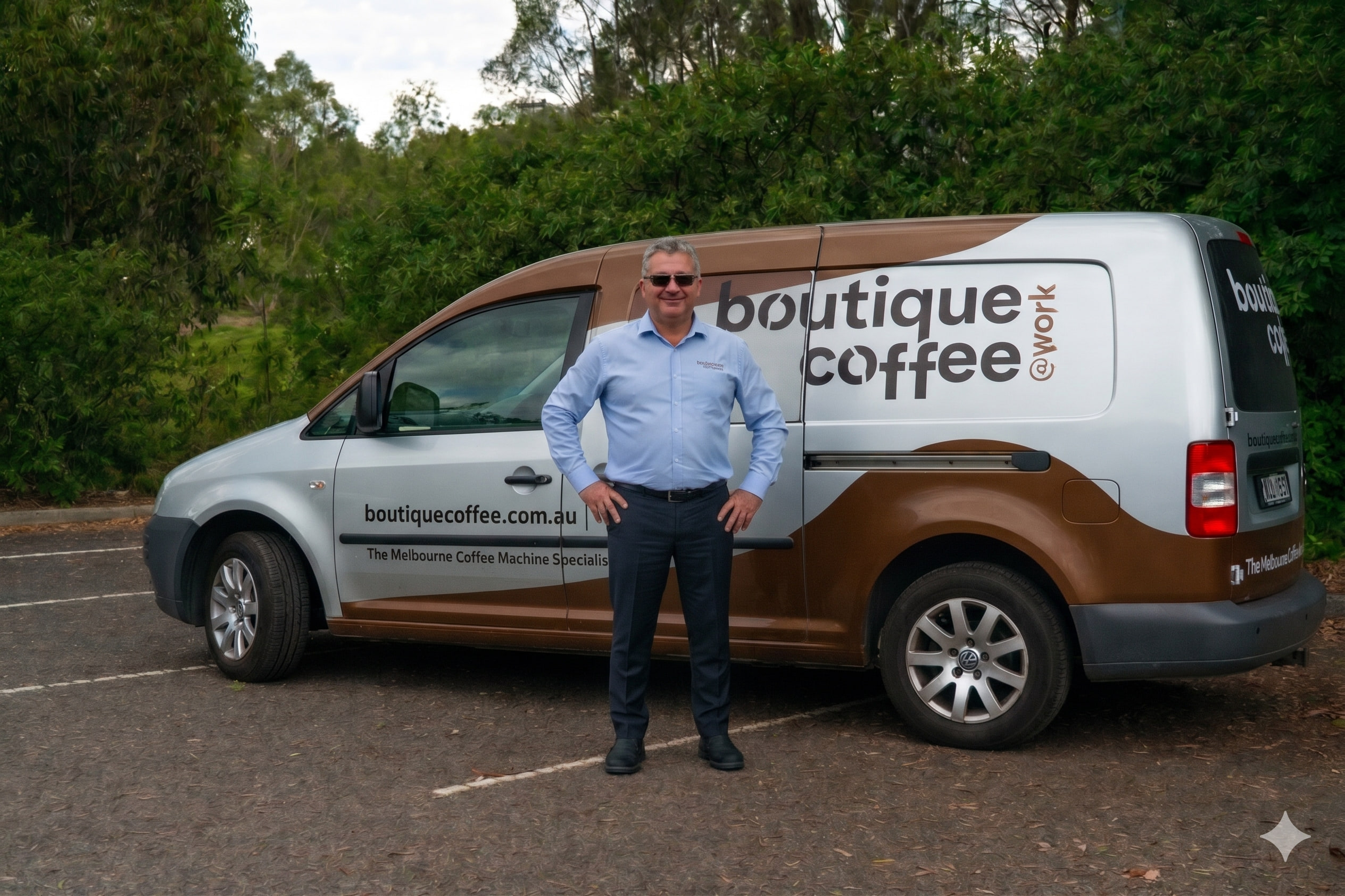
Chris
Chris
Keep reading
Office Coffee Machine Rental Pricing in Melbourne: Transparent Plans and What's Included
Office coffee machine rental in Melbourne is priced as a monthly fee driven mainly by headcount, daily cup volume, machine type, milk system and site setup. At…
Office Coffee Machine Rental FAQs: Straight Answers for Melbourne Workplaces
Office coffee machine rental means paying a monthly fee to use a commercial machine that the supplier installs, services and looks after, rather than buying it…
Office Coffee in Melbourne: The Complete Workplace Guide to Machines, Costs, Beans and Service
The best office coffee in Melbourne comes from a commercial bean-to-cup or espresso machine sized to your headcount, rented month-to-month with installation,…