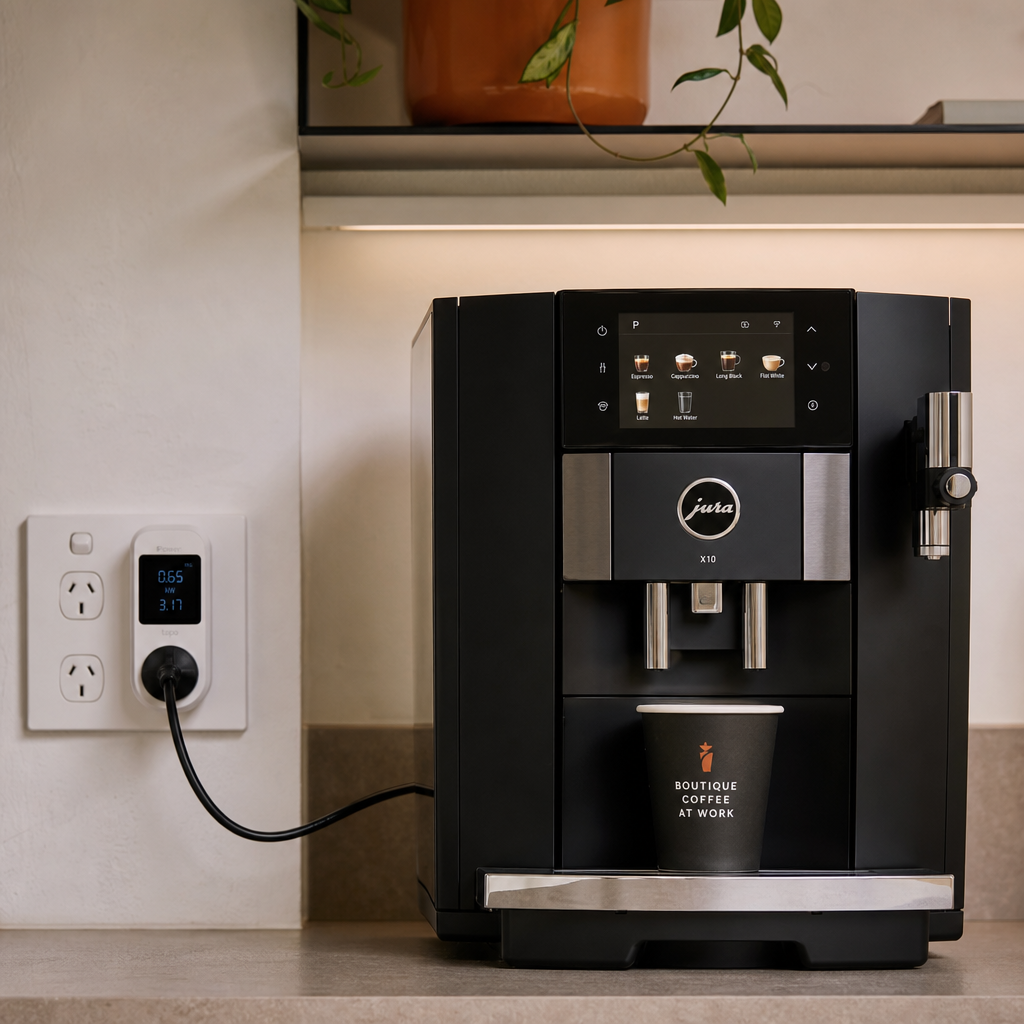
Most businesses focus on the cost of coffee beans and machine rental, but they completely ignore the electricity required to run the setup. Office coffee machine power consumption is a silent operational cost. If your business is running a commercial espresso machine or a fleet of thermal brewers, that power draw hits your electricity bill every single day.
I have spent the last 17 years installing and maintaining commercial coffee setups across Melbourne. Since founding this business in 2008, I have audited hundreds of office kitchens. I see the exact same mistakes repeated in break rooms everywhere. Businesses buy high-wattage machines they do not need, leave them powered on overnight, and then act surprised when their energy bills spike. An honest assessment of commercial espresso machine electricity usage changes how you manage your facility.
We are going to break down the hard numbers. This guide provides the exact calculations for Australian electricity tariffs, explains the difference between automatic espresso machines and thermal brewers, and outlines how you can implement auto-shutoff features to save money. If you want to upgrade to a more efficient setup, you can reach out to us directly for a tailored solution.
Key Takeaways
- Standby power consumption accounts for a significant portion of your machine's total energy draw. Heating elements cycle on and off all day to maintain temperature.
- Automatic espresso machines draw heavy wattage during initial heat-up but manage power differently during use compared to thermal brewers.
- Office coffee machine running costs depend heavily on your specific Australian electricity tariff. You need to calculate your cost per kilowatt-hour to understand your true expenses.
- Auto-shutoff features and strict power-down schedules directly lower your energy bills.
- Selecting energy efficient coffee machines in Australia requires matching the machine capacity to your actual team size. Oversizing wastes power.
Office Coffee Machine Power Consumption Comparison
| Machine Type | Average Wattage (W) | Typical Daily Energy Use (kWh) | Estimated Daily Running Cost | Best Suited For |
|---|---|---|---|---|
| Single-Group Automatic Espresso | 1200W - 1500W | 1.5 - 2.5 kWh | $0.60 - $1.00 | Small teams (5-15 people) |
| Commercial 2-Group Espresso | 2500W - 3500W | 3.5 - 5.5 kWh | $1.40 - $2.20 | Medium offices (20-50 people) |
| Pod / Capsule Machine | 800W - 1200W | 0.4 - 0.8 kWh | $0.16 - $0.32 | Occasional use environments |
| Thermal Brewer (Filter) | 800W - 1200W | 0.8 - 1.2 kWh | $0.32 - $0.48 | High volume, low-intensity consumption |
Note: Estimated daily running costs are based on an average Australian commercial electricity rate of $0.40 per kWh. Actual costs vary based on specific tariffs and machine usage patterns.
Why Office Coffee Machine Power Consumption Actually Matters
Electricity is a major operational expense for Australian businesses. The Australian Energy Market Operator (AEMO) continually tracks rising demand and pricing pressures across the National Electricity Market. In 2026, managing overheads is a basic commercial necessity. Ignoring office coffee machine running costs is equivalent to leaving commercial air conditioning running in an empty office over the weekend. It is pure waste.
When a business ignores commercial espresso machine electricity usage, they waste capital. The problem extends beyond the power bill. High-draw appliances contribute to peak demand charges on your commercial electricity invoice. If your office kitchen trips breakers regularly, your machine's wattage is the likely culprit. Understanding your electrical load dictates how we plan your installation.
The Physics of Heating Water: Why Espresso Machines Draw Heavy Amps
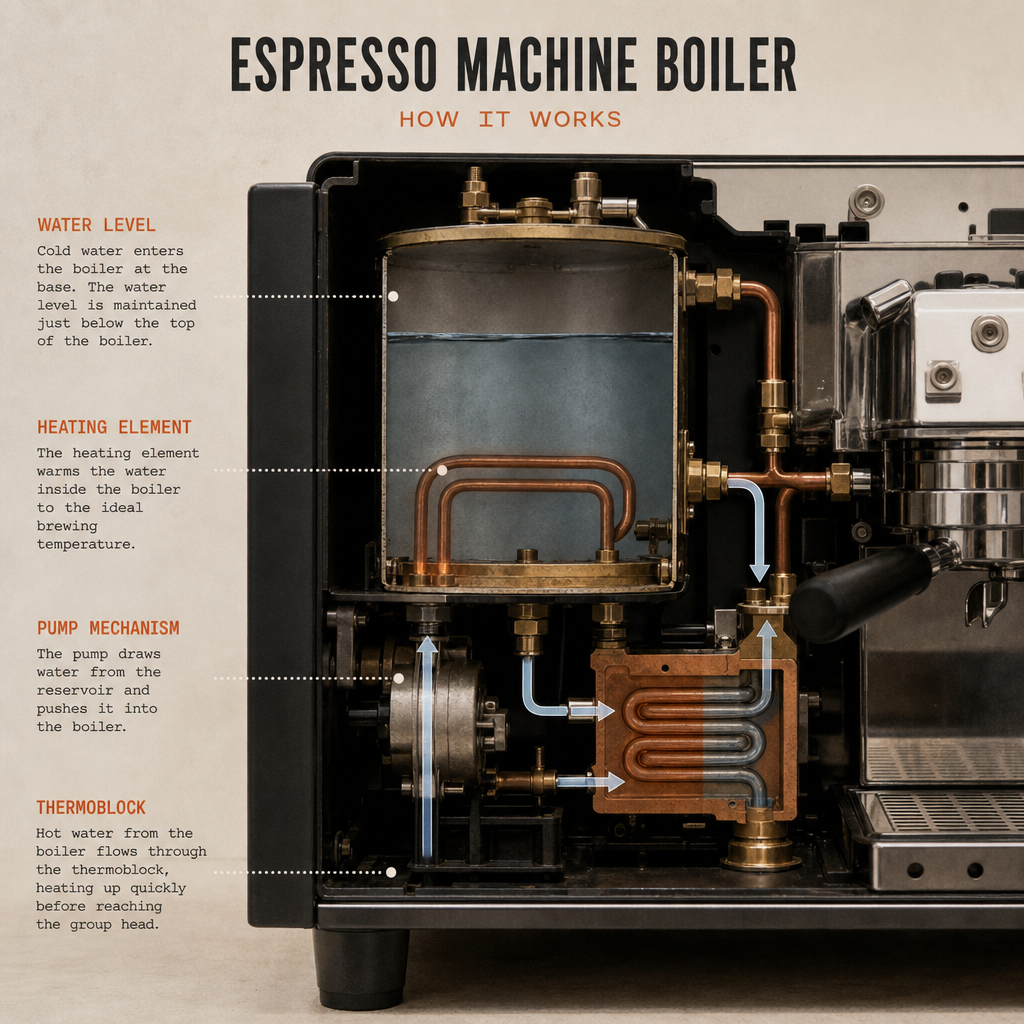
Heating water requires a massive amount of energy. It is basic physics. To force water through tightly packed, finely ground coffee at nine bars of pressure, an espresso machine needs high heat. It must maintain that heat consistently. This requires robust heating elements known as thermoblocks or boiler elements.
When you switch a commercial espresso machine on, it draws maximum wattage. It pulls this high amperage until the water in the boiler reaches the optimal 93 degrees Celsius. During this heat-up phase, a commercial two-group machine can draw up to 3500 watts. Once it reaches the target temperature, the machine's thermostat cycles the heating element off.
However, the machine does not stop consuming power. As it loses heat to the surrounding environment, or as you pour cold water into the boiler to replace the extracted coffee, the element fires up again. This constant battle to maintain thermal equilibrium is where commercial espresso machine electricity usage accumulates. The machine cycles on and off continuously from 8:00 AM to 5:00 PM, even if you only brew ten cups of coffee.
Automatic Espresso Machines vs Thermal Brewers: Power Usage Compared
There is a fundamental difference in how automatic espresso machines and thermal brewers handle electricity. To make an informed decision for your workplace, you must understand the mechanical differences.
Commercial Espresso Machines
Automatic espresso machines prioritise speed, pressure, and temperature stability. They run on either 10-amp or 15-amp circuits depending on their size. A standard commercial machine features a single boiler or dual boiler system. These boilers must remain fully heated to produce microfoam milk texture and authentic espresso.
Because they are performing heavy lifting, their energy use is intensive. If you have a large team, an automatic machine running constantly is non-negotiable for maintaining quality. The key to managing an espresso machine's power consumption lies in limiting the hours it remains idle at full temperature.
Thermal Brewers
Thermal brewers, often referred to as filter coffee machines, operate differently. A commercial grade thermal brewer heats a large volume of water once, passes it through a bed of coffee grounds, and drops the finished batch into an insulated thermal carafe.
Once the brewing cycle finishes, the heating element turns off completely. The thermal carafe relies on vacuum insulation to keep the coffee hot for hours without drawing a single watt of power. If your team prefers long blacks or consumes high volumes of basic coffee, a thermal brewer is one of the most energy efficient coffee machines in Australia. The daily energy use is minimal because the machine spends most of its life switched off.
Calculating Office Coffee Machine Running Costs
To accurately calculate your daily running cost, you need two numbers. You need the wattage of your coffee machine and your commercial electricity tariff.
In Australia, commercial electricity tariffs in 2026 average between 25 to 45 cents per kilowatt-hour (kWh), depending on your state, network distributor, and specific retail plan. For accurate accounting, let us use a conservative average of 40 cents per kWh.
The formula for calculating cost is: (Wattage x Hours Used Per Day) / 1000 = Daily kWh. Then, multiply the Daily kWh by your tariff.
Step-by-Step Calculation Example
Let us assume your business runs a standard two-group automatic espresso machine. The machine has a peak rating of 3000 watts. The machine sits idle at operating temperature for 8 hours a day. You program it to power down completely overnight.
The machine does not draw 3000 watts constantly. It averages a 30 percent duty cycle. This means the heating element is actively drawing power for roughly 30 percent of the time it is turned on.
- Calculate Average Watts: 3000W peak x 0.30 duty cycle = 900 average watts per hour.
- Calculate Daily kWh: (900W x 8 hours) / 1000 = 7.2 kWh per day.
- Calculate Daily Cost: 7.2 kWh x $0.40 (tariff) = $2.88 per day.
Running this specific espresso machine costs your business $2.88 per day in electricity. Over a standard 250-day working year, the machine costs $720 annually. If you left that same machine running 24 hours a day, the duty cycle would increase, and your annual cost would balloon to over $2,000. This is why office coffee machine running costs must be managed actively.
Standby Mode: The Hidden Energy Drain in Office Kitchens
Standby power is the silent killer of energy efficiency. When a commercial espresso machine sits idle but remains switched on, it maintains its boiler temperature. It is not actively pouring coffee, but the electronics, pumps, and heating elements are awake. This is standby mode.
Every minute your machine sits hot on the bench without pouring a shot, it bleeds electricity. Heat escapes through the group heads, the cup warmer tray, and the chassis. The internal thermostat detects this drop, fires the heating element, and brings the temperature back up. This cycle repeats endlessly.
Businesses waste thousands of dollars a year heating empty boilers overnight. Friday afternoon hits, the last person leaves the office, and the coffee machine stays illuminated and hot until Monday morning. If your business wants to manage commercial espresso machine electricity usage effectively, eliminating overnight standby mode is the first and most critical step.
Auto-Shutoff Features and How They Save Money
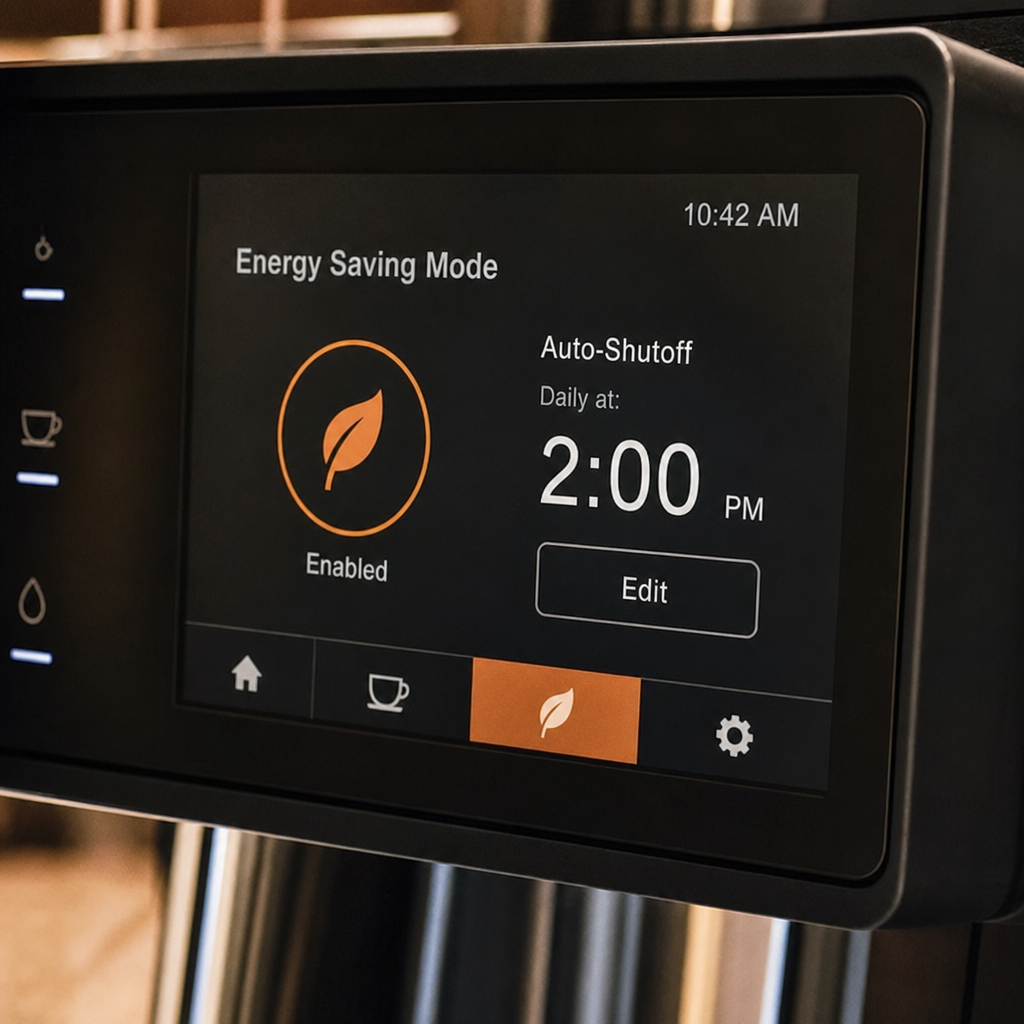
Modern commercial coffee machines feature built-in programming to manage power automatically. Auto-shutoff features are absolute necessities. These systems allow you to program specific operating hours into the machine's internal computer.
We install machines that automatically power down their primary heating elements at 6:00 PM and reactivate them at 7:00 AM. This guarantees the machine is hot and ready for the first employee arriving for work, but consumes zero electricity over the weekend.
Auto-shutoff saves money by attacking standby drain. It physically cuts power to the boiler. The machine drops to ambient room temperature. If your current machine lacks an auto-shutoff feature, the simplest operational change you can make is appointing a team member to physically switch the machine off at the wall every evening. That single action saves more money than buying a lower-wattage machine.
The Boutique Coffee at Work Approach: Honesty Over Upselling
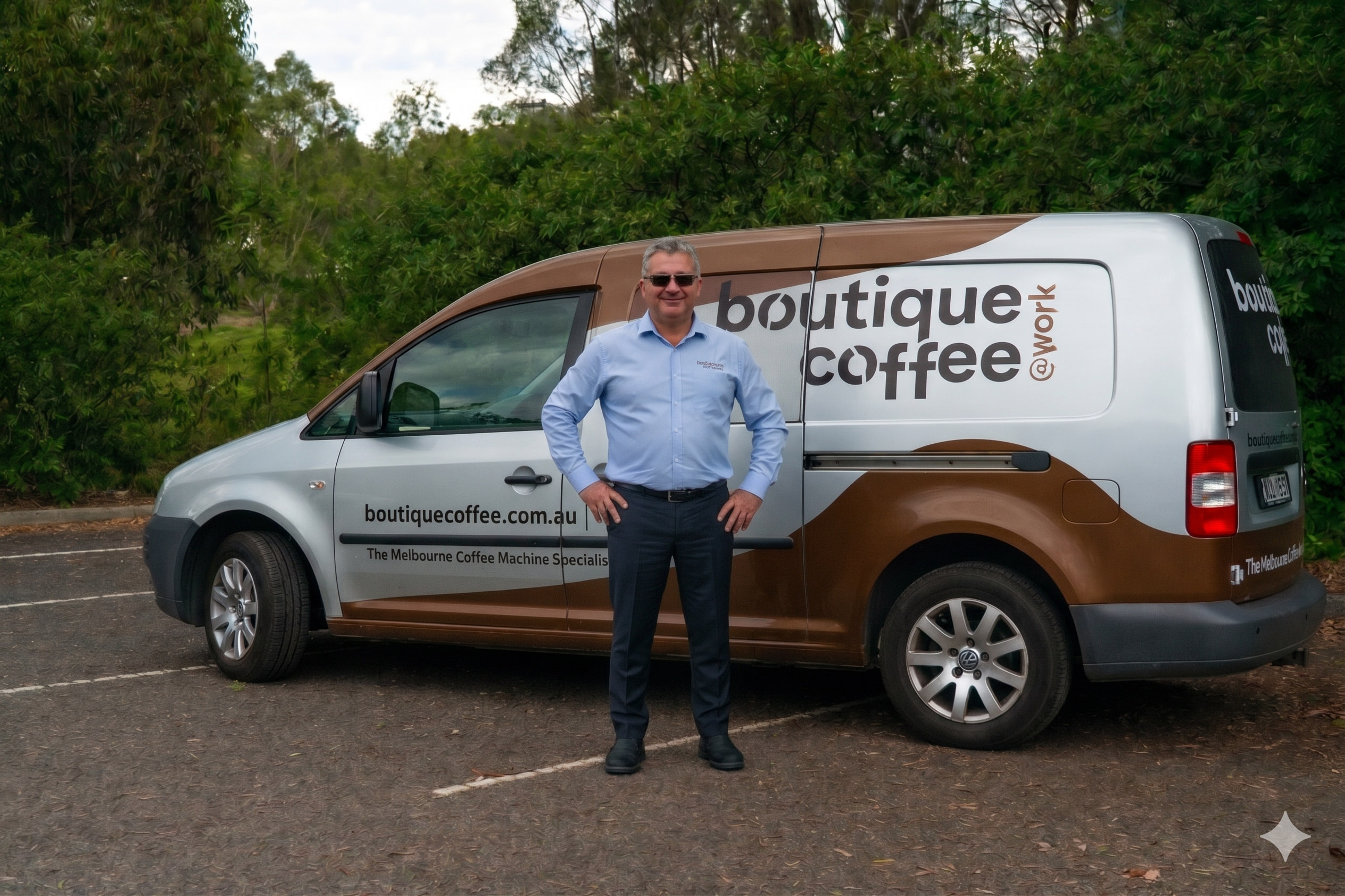
I am Chris Prokopiou, founder of Boutique Coffee at Work. I am not trying to be the biggest. I have spent the last 17 years focused on one thing. I help Melbourne businesses get café-quality, made practical in their own offices. I love what I do because I get to drive throughout Melbourne attending to my clients' coffee machine requirements. Making sure their coffee machines are operating smoothly and fully stocked with everything they need maintains a productive workplace. Good business practice means helping my clients keep staff happy with good quality coffee.
In the corporate coffee industry, most suppliers hide behind helpdesks, ticket systems, and tiered support teams. I operate differently. I believe one person stays accountable for every client, from setup to ongoing service. You get one number, one person. No call centres, no corporate runaround. Most fixes can be talked through in two minutes when the person who answers the phone actually knows your setup.
When it comes to office coffee machine power consumption, most suppliers will try to upsell you to a higher-specification machine. They claim it serves your future growth needs. That is garbage. I recommend the machine that fits the team's actual size, even if that is the cheaper option. A 12-person team does not need a heavy-duty machine that draws 3500 watts. An 80-person team will break a domestic machine within a month. Matching the right machine to your actual headcount is a point of integrity for me.
We build our service on long-term relationships, not contracts. We provide no lock-in, ever. All rentals are month-to-month with one month's notice to exit. In 17 years, this no-lock-in policy has never cost me a client worth keeping.
Matching the Machine to the Team
A great example of fitting the right machine to the team was our work with Pepperl+Fuchs Australia, a mid-size Melbourne office. They were running an existing coffee setup that was not meeting the team's needs or expectations. The intervention was straightforward. I upgraded the office to a properly sized WMF commercial machine, with full install, training, and ongoing service included in the rental.
The change was noticeable across the whole office. The client reported easy daily use, great coffee and hot chocolate quality, and consistent service maintained for years. We did not drop a massive, energy-hungry machine into their kitchen. We matched the boiler size and wattage to their actual daily consumption rate. That is how you keep office coffee machine running costs predictable.
At AJM-JV, another busy Melbourne workplace, they were experiencing disruption whenever their coffee machine went down during peak office hours. They needed reliable hardware. I provided a reliably maintained machine with regular scheduled servicing and direct personal contact for any issue. The client noted that reliable, regular service meant the team always had coffee when they needed it most, eliminating the havoc a broken machine caused. Your team never goes without coffee when the hardware is selected on purpose and maintained personally.
The Six-Step Process: From Power Audit to Installation
Every new client engagement follows what I call The Six-Step Process. This is designed to take most Melbourne clients from first call to installed machine in 5 to 7 business days. It ensures we never miscalculate power requirements.
- Enquiry: Takes 2 minutes. The client submits basic team details.
- Phone call with Chris: Takes 15 to 20 minutes. We discuss the machine shortlist and rough pricing based on team size.
- On-site visit: Takes 30 minutes. I personally assess the power, plumbing, and bench space. I check the amperage of your circuits to ensure we do not trip your breakers.
- Install day: Takes 45 minutes. The machine is connected, the grinder is dialled in, and shots are tested.
- First brew and training: Takes 20 minutes. At least two staff members are trained and a cheat sheet is left behind.
- Ongoing rhythm: Weekly or fortnightly service visits. Beans and consumables are topped up.
To see exactly how this applies to your business, review our process here.
Curated Coffee Plan: The Human Element of Efficiency
Power consumption is critical, but energy efficiency means nothing if the coffee tastes terrible and your staff refuse to drink it. A massive part of operational efficiency is ensuring the coffee consumed is actually enjoyed. This is where our Curated Coffee Plan comes in.
We do not default to a one-size supply. Bean selection matters. We ask about the team's drink preferences, whether they lean toward espresso or milk-based drinks, the preferred strength, and any specific dislikes. We then start the team on a well-matched blend based on that profile. Over the first month, we adjust based on actual team feedback. Having dialled-in beans means your staff use the machine properly. They do not waste water, electricity, and coffee pulling double shots to mask a bad roast.
I had an experience recently that highlights the value of this personal approach. I was attending to a client's site and came across a person who had moved from a previous client's office. He had specifically arranged to be there to meet me and ask for my card. He wanted to give it to his senior management because their current coffee supplier provided the worst coffee. The corporate supplier had optimised for their own margins, not for the office's satisfaction. That is why founder-led, always is my standard. When senior management tries bad coffee, they call the person who they know cares about the result.
Do Energy Efficient Coffee Machines in Australia Compromise on Quality?
There is a persistent myth in the corporate facility management space. The myth says energy efficient coffee machines in Australia produce weak, cold coffee. This is entirely false.
Energy efficiency does not mean underpowered. True efficiency comes from thermal stability and smart software. A well-engineered machine with heavy brass group heads and insulated boilers loses less heat to the atmosphere. Because it loses less heat, the heating element cycles on less frequently. It draws power for shorter bursts, but maintains a rock-solid 93 degrees for extraction.
Conversely, cheap domestic machines use thin-walled thermoblocks. They cannot hold heat. They constantly bleed thermal energy, forcing the element to fire repeatedly all day long. They work harder, draw more electricity, and still produce inferior espresso. When you invest in genuine commercial hardware, you get better coffee and lower long-term power consumption.
Practical Tips to Lower Your Office Coffee Machine Power Consumption
Implementing a few strict workplace habits will drastically reduce your office coffee machine running costs.
1. Program Strict Auto-Shutoff Times
Never let your machine run idle overnight. Program the machine to power down one hour after your office closes. Program it to wake up one hour before staff arrive. This single action eliminates the standby power drain entirely.
2. Use Standby Modes During Low Traffic Periods
Modern automatic machines feature half-mode or eco-mode. If your office experiences a quiet period between 10:00 AM and 2:00 PM, activate eco-mode. The machine drops the cup warmer temperature and lowers the boiler target by a few degrees, significantly reducing the duty cycle.
3. Turn Off the Cup Warmer
Cup warmers are heated metal trays on top of the machine. They consume an enormous amount of electricity just to warm ceramic cups. Unless your team is serving hundreds of coffees a day, the cup warmer is an unnecessary vanity feature. Switch the cup warmer off in the machine settings. Your coffee will taste exactly the same.
4. Select the Right Capacity Machine
Do not rent a three-group commercial espresso machine for an office of 15 people. A single group machine runs the same amount of time to pour a coffee, but has a much smaller boiler to keep hot. Sizing the machine accurately to your daily cup volume is the most effective way to optimise commercial espresso machine electricity usage.
5. Descale and Maintain Regularly
Scale build-up acts as an insulator. When calcium coats your heating element, the machine has to work harder, drawing more electricity, to transfer heat into the water. Routine descaling is a critical part of our maintenance schedule. Clean machines run efficiently and use less power.
The Commercial Reality of Coffee Machine Upgrades
In 2026, cutting operational waste is essential for business stability. Australian businesses cannot afford to ignore the silent drain of inefficient appliances. Your office coffee machine power consumption is highly measurable, highly manageable, and highly optimisable.
If you are pouring money into outdated hardware, you are compromising your bottom line. I have built my business on honest recommendations. We manage over 200 active Melbourne workplace clients. Our average client relationship lasts over 5 years because we provide hardware that actually works, power consumption that makes sense, and coffee that keeps staff productive.
A productive workplace depends on keeping people happy with good quality coffee. Do not let a poorly managed machine ruin the coffee moments that matter. If you want to get your power consumption and coffee quality sorted, I am ready to look at your setup. Contact us today to upgrade to a properly sized, energy-efficient machine.
References
- Australian Energy Market Operator (AEMO) - Electricity Demand and Forecasting Data
- Australian Energy Regulator (AER) - Default Market Prices and Commercial Tariffs
- Department of Climate Change, Energy, the Environment and Water (DCCEEW) - Appliance Energy Efficiency Standards
Frequently asked questions
How much power does an office espresso machine use?
A standard commercial two-group espresso machine used in an office draws between 2500W and 3500W during heat-up. It averages around 30 percent of that peak wattage during continuous daily use. This equates to roughly 3.5 to 5.5 kWh of electricity per day depending on usage volume and standby hours.
Does a coffee machine use a lot of electricity?
Relative to standard office appliances, yes. Heating water is energy-intensive. If left on 24 hours a day, a commercial espresso machine can add hundreds of dollars to your annual power bill. However, managed correctly with auto-shutoff features, the daily running cost is highly manageable.
How do I calculate my office coffee machine running costs?
Find your machine's wattage and estimate its daily hours of use. Multiply the wattage by the hours used, divide by 1000 to get kilowatt-hours (kWh). Multiply the kWh result by your commercial electricity tariff (average 40 cents in Australia) to get your exact daily cost.
Are bean-to-cup coffee machines energy efficient?
Modern bean-to-cup machines can be highly energy efficient. They feature precise digital temperature control and programmable standby modes. Because they automate the brewing process, they eliminate user error that wastes water and coffee. Their internal boilers are often heavily insulated, reducing heat loss.
Should I turn my office coffee machine off at night?
Absolutely. Turning your commercial coffee machine off at the wall overnight is the most effective way to reduce standby power consumption. Ensure the machine is switched off properly to allow internal components to cool, which also prolongs the lifespan of the hardware.
What is the most energy efficient coffee machine for a workplace?
Thermal brewers, or filter coffee machines, are typically the most energy efficient. They heat water once, drop the coffee into a vacuum-sealed thermal carafe, and switch the heating element off completely. For teams that drink high volumes of black coffee, thermal brewing requires very low ongoing power.
Will a higher wattage machine make coffee faster?
Yes, a higher wattage machine heats water faster during the initial start-up phase. However, once the water reaches the target extraction temperature, the machine stops drawing peak power. A higher wattage rating does not mean the machine consumes maximum power constantly, it simply means it has the capacity to heat the boiler rapidly.
Chris
Chris
Keep reading
Office Coffee in Melbourne: The Complete Workplace Guide to Machines, Costs, Beans and Service
The best office coffee in Melbourne comes from a commercial bean-to-cup or espresso machine sized to your headcount, rented month-to-month with installation,…
Office Coffee Machine Rental in Melbourne: Find Your Next Step by the Question You're Asking
Office coffee machine rental in Melbourne means paying a monthly fee for a commercial machine that comes installed, serviced and supplied with beans by one…
The Melbourne Office Coffee Guide: Start Here to Choose, Rent and Run a Proper Workplace Coffee Machine
The simplest way to get proper coffee into a Melbourne office is to rent a commercial machine month-to-month from a local supplier that installs it, trains…