
The main office coffee machine benefits are less time lost on café runs, convenient access to quality coffee, better shared breaks and a stronger workplace experience. Results depend on choosing reliable commercial equipment, matching capacity to the team and maintaining it properly. The machine alone is not enough. Service and supply determine its lasting value.
Introduction
Quality office coffee can support productivity, morale and client experience, but only when the complete setup works reliably. This guide explains where the benefits come from, how Australian employers can assess them and why machine fit, coffee quality, maintenance and supplier accountability matter more than a long list of features.
Melbourne employees already know what good coffee tastes like. The gap between the café outside and the instant coffee inside the office has never made sense to me. Since 2008, my focus has been closing that gap with café-quality coffee made practical for real workplaces.
Boutique Coffee at Work client book, 2026: 200+ active Melbourne workplace clients | 5+ year average client relationship | 24-hour typical service response | 17 years focused exclusively on workplace coffee
Key Takeaways
The strongest workplace coffee advantages come from convenience, reliability and perceived care rather than caffeine alone. Employers should treat coffee as a managed workplace amenity, measure the time and disruption surrounding the current setup, and select equipment based on actual demand rather than buying the most expensive machine available.
- An office machine can reduce unnecessary café trips and keep short breaks genuinely short.
- Good coffee creates a shared amenity that can support morale and everyday social connection.
- Reliable servicing matters because an unavailable machine produces no productivity or cultural benefit.
- Visitors often read workplace coffee as a small but visible sign of operational care.
- Rental can make costs more predictable, but inclusions, flexibility and support need close scrutiny.
- The right machine is determined by usage patterns, drink preferences and peak demand, not headcount alone.
Office Coffee Benefits at a Glance
The benefits of office coffee span operational, cultural and commercial areas. Productivity gains usually come from convenience and reduced disruption. Morale benefits come from quality and inclusion. Client benefits come from hospitality. Financial value depends on usage, reliability and whether the plan avoids unnecessary equipment, consumables and service costs.
| Area | Potential benefit | What creates the benefit | What can undermine it |
|---|---|---|---|
| Productivity | Less time spent leaving the workplace for coffee | Fast access, simple operation and adequate peak capacity | Queues, slow machines and breakdowns |
| Focus | Convenient access to caffeinated drinks for employees who choose them | Quality beans and drinks available at useful times | Treating caffeine as a substitute for rest or sensible workloads |
| Morale | A visible, regularly used staff amenity | Coffee people enjoy, plus tea, hot chocolate and suitable alternatives | Poor taste, limited choice or unreliable supply |
| Retention | A stronger overall employee experience | Consistent care across many daily workplace details | Expecting coffee to compensate for weak management or conditions |
| Client experience | Better hospitality during meetings and visits | Quick, consistent drinks presented professionally | A messy station or equipment staff cannot operate |
| Cost control | Predictable equipment and service arrangements | Correct machine fit and clear rental inclusions | Oversized equipment, hidden exclusions and long lock-ins |
Productivity Boost

An office coffee machine can support productivity by reducing off-site coffee trips, making breaks more convenient and keeping refreshments close to the work area. Caffeine may support alertness for many adults, but the practical gain usually comes from saved movement and reduced disruption. Reliability and speed are therefore more important than novelty features.
Reduce the real cost of café runs
A café trip rarely consists only of buying coffee. It can involve gathering colleagues, waiting for lifts, walking, ordering, queuing and returning. Those trips may still be valuable breaks, and employers should not try to eliminate them. The issue is whether every coffee requires leaving the workplace.
An internal machine gives employees another option. Someone facing a deadline can prepare a drink quickly. A team can continue an informal discussion near the coffee station. Visitors can be served without sending an employee outside.
The correct comparison is not "coffee break versus no break". It is an efficient on-site break versus an off-site trip that can expand unpredictably.
Fair Work Ombudsman notes that rest breaks and meal breaks depend on the applicable award or enterprise agreement. A coffee machine should support sensible breaks, not be used to discourage entitlements or healthy movement.
Caffeine can help alertness, within limits
Coffee is not a productivity system. It cannot repair poor planning, unreasonable workloads or inadequate sleep. It can, however, help employees who already choose caffeine feel more alert.
Einöther and Giesbrecht's review in Psychopharmacology examined caffeine as an attention enhancer and found the evidence strongest around basic attention-related performance. Food Standards Australia New Zealand also advises that sensitivity to caffeine varies between people. Employers should provide choice rather than assume everyone wants or tolerates coffee.
That means a useful workplace station may also include decaffeinated coffee, tea and hot chocolate. The productivity benefit comes from convenient refreshments chosen by employees, not pressure to consume caffeine.
Machine capacity controls queues
An undersized machine shifts the café queue into the office. If drinks are slow or the machine needs constant manual attention, the claimed efficiency disappears.
I recommend equipment based on the team's actual size and drinking pattern. A small team does not need a $15,000 Eversys. An 80-person team can quickly overwhelm a home-grade Jura. Both recommendations would be poor fits, even though one is excessive and the other appears cheaper.
Peak demand matters as much as total headcount. Consider when employees arrive, whether meetings start together and whether most people order milk-based drinks. A machine that performs well during quiet periods may struggle when several employees want coffee before the same meeting.
Reliability determines whether savings persist
A busy Melbourne workplace I support had experienced disruption whenever its previous coffee machine failed during peak office hours. Staff depended on the machine, so downtime created havoc rather than a minor inconvenience.
I supplied a commercial machine with scheduled servicing and direct personal contact for issues. The client reported that regular, reliable service meant the team had coffee when it needed it most. The important change was not simply installing another machine. It was removing recurring uncertainty through maintenance and accountability.
Across Boutique Coffee at Work's active client base, the typical response time for a service call is 24 hours, based on our 2026 business data. Most simple issues can be discussed quickly when the person answering already knows the client's machine and setup.
Employee Morale and Retention
A good coffee machine can improve the everyday employee experience by providing a useful amenity, encouraging informal interaction and showing that management pays attention to shared facilities. It may support morale and retention, but it should be viewed as one part of workplace culture. Coffee cannot offset poor leadership, weak conditions or unmanageable workloads.
Small amenities send repeated signals
Employees experience workplace culture through repeated details. They notice whether shared equipment works, whether consumables are replenished and whether management responds when something fails.
Coffee is unusually visible because people use it throughout the working week. A broken or badly stocked station sends a repeated negative signal. A clean, reliable station with coffee people enjoy sends a different one: somebody has thought about the daily employee experience.
This does not make coffee more important than fair pay, safe work or capable management. It makes coffee a practical test of whether an organisation follows through on the smaller promises it makes.
Shared coffee supports informal connection
The coffee station is one of the few places where employees from different functions naturally cross paths. Those conversations can help people maintain relationships, ask quick questions and learn what other teams are doing.
The machine should therefore be positioned thoughtfully. Hiding it in an isolated utility area may solve plumbing requirements but weaken its usefulness as a shared space. Putting it beside a narrow walkway can create congestion. The best location balances access, bench space, water, power, cleaning and room for short conversations.
Hybrid workplaces make these coffee moments more important on office days. When employees travel into a central workplace, the physical environment should offer something useful that cannot be recreated through another video call. Good hospitality is one part of that proposition.
Quality must match employee expectations
Melbourne workers are surrounded by capable cafés. Providing weak instant coffee and calling it a premium benefit is unlikely to impress them.
A mid-size Melbourne engineering office came to me with an existing coffee setup that was not meeting the team's needs. I upgraded the workplace to a WMF commercial machine, completed the installation, trained employees and included ongoing service in the rental.
The site manager reported that employees appreciated the coffee, the machine was easy to use, and both the coffee and hot chocolate remained consistently good over years of service. His feedback to me was simple: "No problem, just keep doing what you're doing."
That testimonial matters because it identifies the complete experience. The machine was easy to use, the drinks were appreciated and the service remained consistent. Staff satisfaction would have fallen if any one of those elements had failed.
Coffee can become part of employer reputation
I once met an employee who had moved from a workplace I previously serviced to another Melbourne business. He was waiting to ask for my card so he could give it to senior management. He told me the new supplier's coffee was poor and wanted management to consider another arrangement.
That is not proof that coffee determines retention. It does show that employees remember everyday amenities and compare them between workplaces. Coffee becomes one of many signals people use to judge whether an employer understands the working environment it is trying to create.
The sensible position is neither "coffee does not matter" nor "coffee retains employees". Good coffee supports the overall experience. Poor coffee can undermine a benefit an employer believes it has already provided.
Client and Visitor Experience
Office coffee shapes client perceptions because it is a direct expression of workplace hospitality. A consistent, well-presented drink can make meetings more comfortable and demonstrate attention to detail. The benefit is strongest when staff can prepare drinks quickly and confidently without interrupting the meeting or explaining why the machine is unavailable.
Hospitality starts before the formal discussion
Offering a visitor water, tea or coffee creates a natural opening to a meeting. It gives people time to settle and provides a small gesture of care before commercial discussion begins.
The drink does not need elaborate presentation. It needs to taste good, arrive promptly and come from a clean station. Clients may never comment on those basics, but they notice obvious friction: a dirty milk system, empty beans, confusing controls or an employee struggling to operate the machine.
A commercial bean-to-cup setup can help standardise the result. Different employees can prepare a consistent drink without needing barista skills. Training still matters, particularly for daily cleaning, refilling and basic troubleshooting.
Customer-facing workplaces need operational consistency
A Melbourne business in a busy retail environment needed quality coffee available every day for both employees and customers. I supplied fresh beans and a fully maintained machine, then handled supply and upkeep personally.
The client credited attention to detail with keeping coffee service consistent without interruption. That reliability mattered because coffee was not merely an internal perk. It formed part of the customer experience.
Where visitors are served frequently, decision-makers should ask operational questions before comparing machine brochures:
- How many drinks may be required close together?
- Who cleans the milk system and how long does that take?
- Can employees prepare common drinks without specialist training?
- What happens if the machine displays an error before a client meeting?
- Are beans and consumables replenished before they run out?
- Is there one accountable contact who knows the site?
These details determine whether office coffee strengthens the visitor experience or creates another task for reception and facilities teams.
Cost-Benefit Analysis
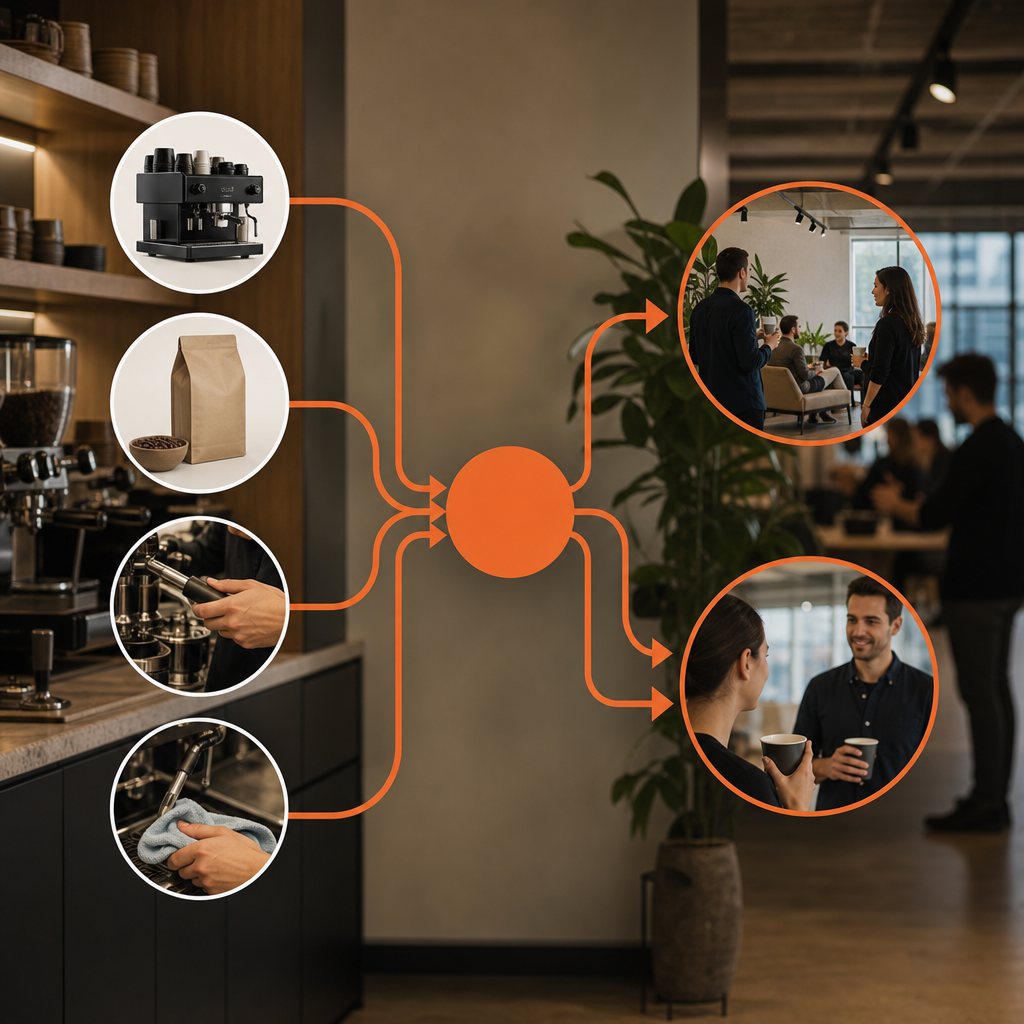
The financial case for an office coffee machine should compare total service cost with saved café-trip time, existing coffee spending, equipment downtime and the value of a better staff and visitor experience. Do not judge the proposal on machine price alone. Include installation, beans, consumables, cleaning, repairs, training and exit terms.
Calculate the current-state cost first
Before requesting quotes, document how coffee works now. Record what the business directly pays, what employees purchase themselves, how often people leave the premises and what administrative effort goes into ordering supplies or fixing equipment.
Avoid pretending every minute outside the office becomes productive billable time. That assumption exaggerates the return and ignores the purpose of breaks. Instead, look for preventable friction, such as repeated long queues, employees travelling off-site solely because internal coffee is poor, or facilities staff spending time managing faults.
A practical decision formula is:
Net workplace value = avoided off-site disruption + replaced existing coffee costs + avoided breakdown costs + staff and visitor value - total managed coffee cost.
Some inputs are measurable. Others require judgement. Keeping them separate makes the business case more credible.
Compare purchase and rental properly
Purchasing provides ownership but leaves the organisation responsible for capital outlay, maintenance planning, repairs and eventual replacement. Rental spreads costs and may include service, but inclusions and exit conditions vary widely.
Ask every prospective provider to state:
- whether pricing includes or excludes GST
- what installation work is included
- whether scheduled servicing and breakdown labour are covered
- who pays for replacement parts
- whether beans or minimum orders are compulsory
- how quickly support is normally available
- whether the agreement can change as the team grows
- what happens when the organisation wants to leave
My position is no lock-in, ever. Boutique Coffee at Work rentals are month-to-month, with one month's notice and free machine pickup. Based on our 2026 client book, the average active relationship lasts more than five years. Long-term clients retained by choice are worth more than clients retained by a contract.
Avoid false economy at both ends
The cheapest machine can become expensive if it breaks under real workplace demand. The most expensive machine can also waste money if its capacity and features are unnecessary.
Machine selection should consider team size, expected daily use, peak demand, drink mix, plumbing, power, bench space and cleaning responsibility. A recommendation should be designed around your culture and budget, not the supplier's preferred invoice size.
That is why an on-site assessment matters. Brochures do not show whether cupboard doors block access, whether the power point is suitable or whether staff will need to carry water through a meeting room.
Businesses comparing options can review the available workplace coffee solutions and understand how installation and ongoing service work before deciding.
Measure the result after installation
Review the setup after employees have used it under normal conditions. Useful questions include:
- Are employees using the machine consistently?
- Has demand created queues during peak periods?
- Are coffee, milk and other consumables being replenished reliably?
- Do employees like the selected blend?
- Are cleaning responsibilities clear?
- Have off-site coffee trips changed in a useful way?
- Can visitors be served without disruption?
- Are faults resolved with minimal internal administration?
The Curated Coffee Plan helps with taste rather than assuming one blend suits every office. I ask whether the team prefers espresso or milk-based drinks, discuss strength and dislikes, start with a suitable blend, then adjust from feedback during the first month. Dialled-in beans matter because unused coffee is never good value.
The Real Benefit Is Accountability, Not the Machine
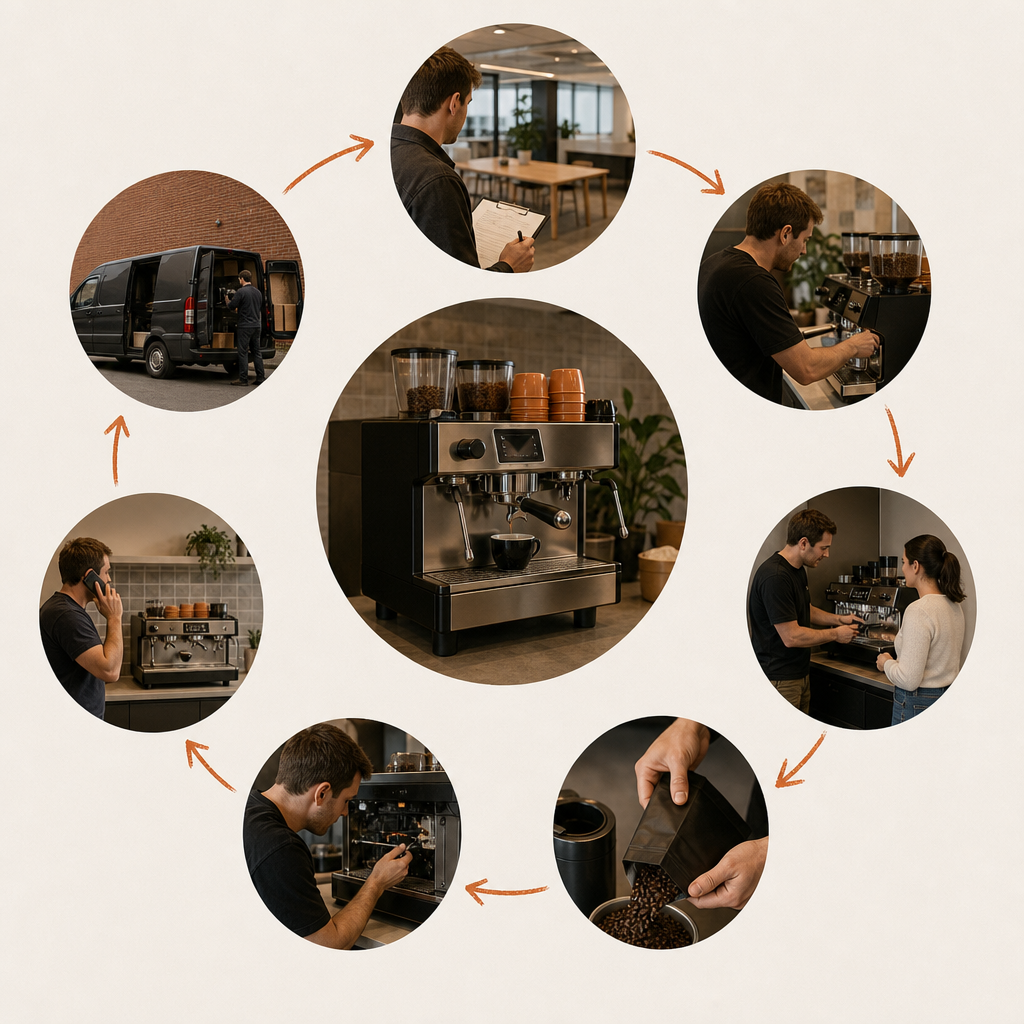
The machine is only the visible part of workplace coffee. The less visible benefit is having one person accountable for site assessment, installation, bean supply, training, maintenance and faults. Without that ownership, even premium equipment can become an expensive appliance that employees avoid because problems remain unresolved or supplies arrive late.
Most corporate suppliers separate sales, installation, account management and technical support. That structure may suit scale, but it often forces the client to repeat the same issue through tickets and escalation paths.
My approach is founder-led, always: one number, one person. Most minor issues can be talked through quickly when I know the machine, the site and the employees using it. When an on-site visit is required, there is no internal runaround before somebody accepts responsibility.
This is the part many office coffee benefit lists miss. They focus on taste, caffeine and morale as if the machine creates those outcomes automatically. In practice, the benefit chain looks like this:
Correct fit leads to reliable operation. Reliable operation leads to regular use. Regular use creates convenience and shared coffee moments. Those repeated experiences create the productivity, morale and hospitality value.
Break the chain anywhere and the return falls.
The Six-Step Process is designed to protect that chain. A typical Melbourne engagement starts with a two-minute enquiry and a 15-20 minute call. I then complete a 30-minute site visit to assess plumbing, power and bench space. Installation generally takes 45 minutes, followed by 20 minutes of training for at least two employees. Ongoing visits then keep beans and consumables stocked weekly or fortnightly.
Most Melbourne clients can move from the first call to an installed machine within 5-7 business days through this process. Those timings come from Boutique Coffee at Work's operating model, not an industry benchmark, and site requirements can affect them.
With more than 200 active Melbourne workplace clients and installations supporting teams of more than 400 people, our 2026 client book shows that there is no single correct office machine. The constant is accountability. I am not trying to be the biggest. The aim is to remain a coffee partner, not a supplier.
If you are unsure whether the benefit will justify the cost, arrange a free trial. It is a better test than choosing from a specification sheet. To discuss your team, site and budget directly, contact Boutique Coffee at Work.
References
These sources support the article's discussion of caffeine, workplace breaks and attention. Operational figures, service timings and client outcomes are identified separately as Boutique Coffee at Work business data or first-hand client feedback supplied for this article, rather than being presented as independent industry benchmarks.
- Food Standards Australia New Zealand, "Caffeine", https://www.foodstandards.gov.au/consumer/generalissues/Pages/Caffeine.aspx
- Fair Work Ombudsman, "Breaks", https://www.fairwork.gov.au/employment-conditions/hours-of-work-breaks-and-rosters/breaks
- Einöther, S.J.L. and Giesbrecht, T., "Caffeine as an attention enhancer: reviewing existing assumptions", Psychopharmacology, https://doi.org/10.1007/s00213-012-2917-4
- Boutique Coffee at Work, active client book and operating data supplied for this article, 2026.
FAQ_SCHEMA_JSON
Frequently asked questions
What are the main benefits of an office coffee machine?
The main benefits are convenient on-site refreshments, fewer unnecessary cafe trips, more consistent coffee quality, informal employee interaction and improved hospitality for visitors. These benefits depend on reliable equipment, suitable capacity, good beans, regular cleaning and responsive technical support.
Does an office coffee machine improve productivity?
It can support productivity by reducing time spent travelling to cafes and giving employees a convenient break option. Caffeine may improve alertness for many adults, but coffee does not fix poor management, excessive workloads or inadequate rest.
Can free office coffee improve employee morale and retention?
Quality coffee can support morale because it is a visible, frequently used employee amenity. It can also create opportunities for informal interaction. It should complement fair conditions, good leadership and meaningful work rather than be treated as a standalone retention strategy.
Is it better to rent or buy an office coffee machine?
Rental can suit businesses wanting predictable costs, included servicing and flexibility. Purchasing may suit organisations prepared to own, maintain and eventually replace the equipment. Compare installation, repairs, parts, consumables, response expectations, GST treatment and exit conditions.
How do I choose the right machine for my office?
Choose according to peak demand, drink preferences, team size, plumbing, power, bench space and cleaning capacity. Do not rely on headcount alone. An on-site assessment helps identify the capacity and installation requirements accurately.
How often should an office coffee machine be serviced?
Service frequency depends on the machine, drink volume, milk system and manufacturer requirements. Daily user cleaning is separate from scheduled technical maintenance. The provider should establish a service rhythm based on actual workplace use.

Chris
Chris
Keep reading
Office Coffee Machine Installation Guide: What Australian Businesses Need to Know
Installing an office coffee machine starts with matching the equipment to your team, then confirming power, potable water, drainage, bench space, ventilation…
Understanding the Daily Cost of a Commercial Coffee Machine in an Australian Office
The cost of a commercial coffee machine per day equals daily beans, milk, electricity, water filtration, cleaning, rental or equipment ownership, and…
Comprehensive Corporate Coffee Solutions: Elevating Australian Workplace Experiences
Corporate coffee machine solutions combine commercial equipment, installation, fresh beans, staff training, maintenance and responsive support in one workplace…