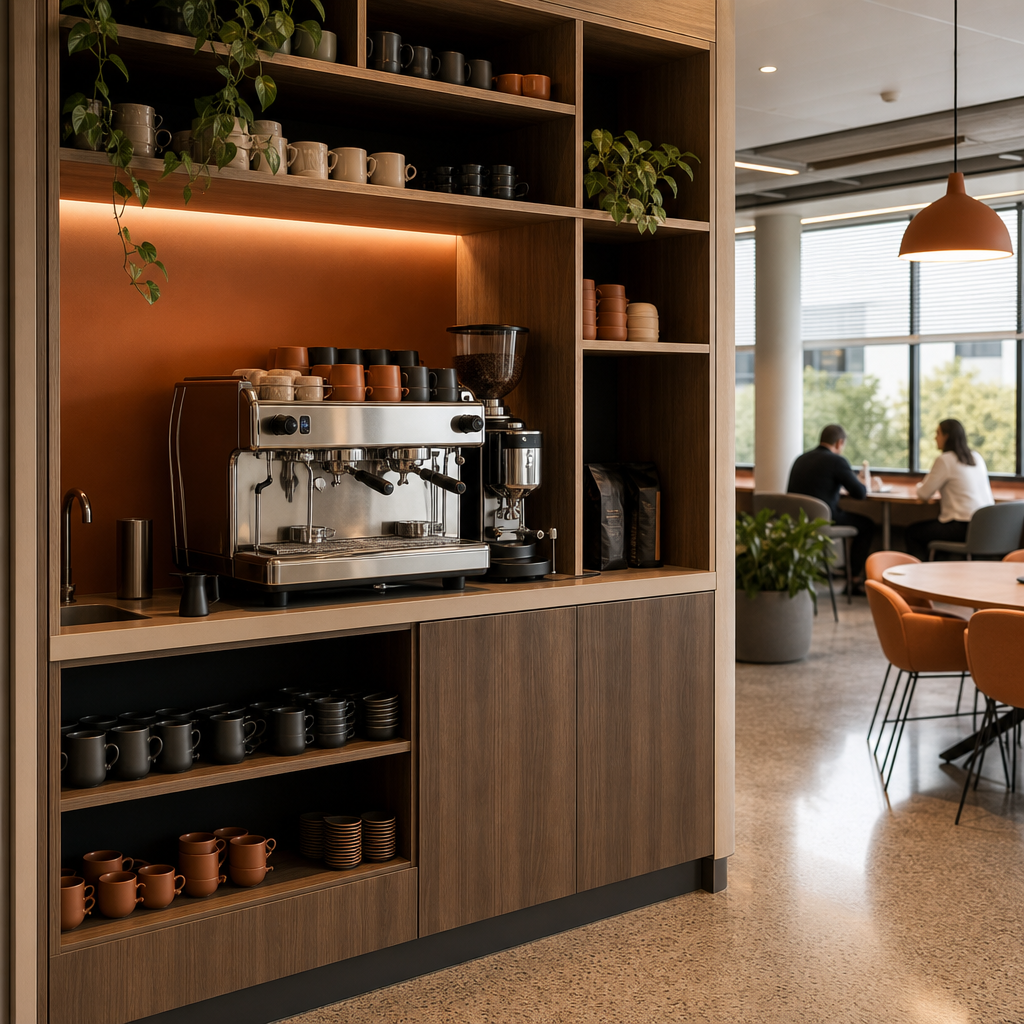
The best office coffee station combines commercial equipment, clear workflow, suitable power and plumbing, accessible storage and a finish that belongs in the workplace. Place it near a breakout area without blocking traffic, match capacity to actual demand, and plan cleaning, restocking and servicing before selecting cabinetry or decorative details.
A good-looking coffee bar can still fail if queues form, milk sits unrefrigerated or the machine repeatedly trips a circuit. The practical decisions need to come first. The finishes can then support the workplace's broader design.
Boutique Coffee has focused exclusively on Melbourne workplaces since 2008. This guide explains how to plan placement, utilities, equipment, storage and service, including the details that generic coffee bar inspiration pages usually miss.
Key Takeaways
A successful office coffee station is designed as an operating system, not treated as a spare bench with a machine placed on top. The equipment, room layout, team behaviour and service model must work together. These are the decisions that have the greatest effect on daily reliability and employee use.
- Position the station near natural staff movement, but outside narrow corridors and focused work zones.
- Confirm electrical load, water, drainage, ventilation and bench strength before ordering equipment.
- Separate drink preparation, milk, waste and collection to reduce congestion.
- Choose commercial equipment for the real team size rather than buying on appearance or maximum specification.
- Integrate beans, cups, cleaning supplies and waste into the cabinetry plan.
- Treat maintenance response as part of the design because an unusable machine is wasted breakout space.
Office Coffee Station Planning Summary
The right office coffee bar setup depends on how employees move through the workplace and what they drink. A compact pantry station may suit a smaller team, while a busy office needs more separation between brewing and collection. Use this table as a planning comparison rather than a substitute for a site assessment.
| Planning area | Weak approach | Better office coffee station idea |
|---|---|---|
| Placement | Machine added wherever bench space remains | Station positioned beside a breakout area and away from circulation bottlenecks |
| Equipment | Domestic machine chosen for its appearance | Commercial machine matched to team demand and preferred drinks |
| Utilities | Power board and portable water container added later | Power, water, drainage and isolation access confirmed before installation |
| Workflow | Cups, milk, waste and collection share one point | Preparation and collection areas are separated |
| Storage | Beans and cleaning products sit on the bench | Daily supplies are accessible, with bulk stock concealed nearby |
| Appearance | Standalone equipment conflicts with the fit-out | Cabinetry, splashback and hardware connect the station to the office palette |
| Service | Faults enter a generic support queue | One accountable contact manages equipment, stock and service |
Where Should an Office Coffee Station Be Located?
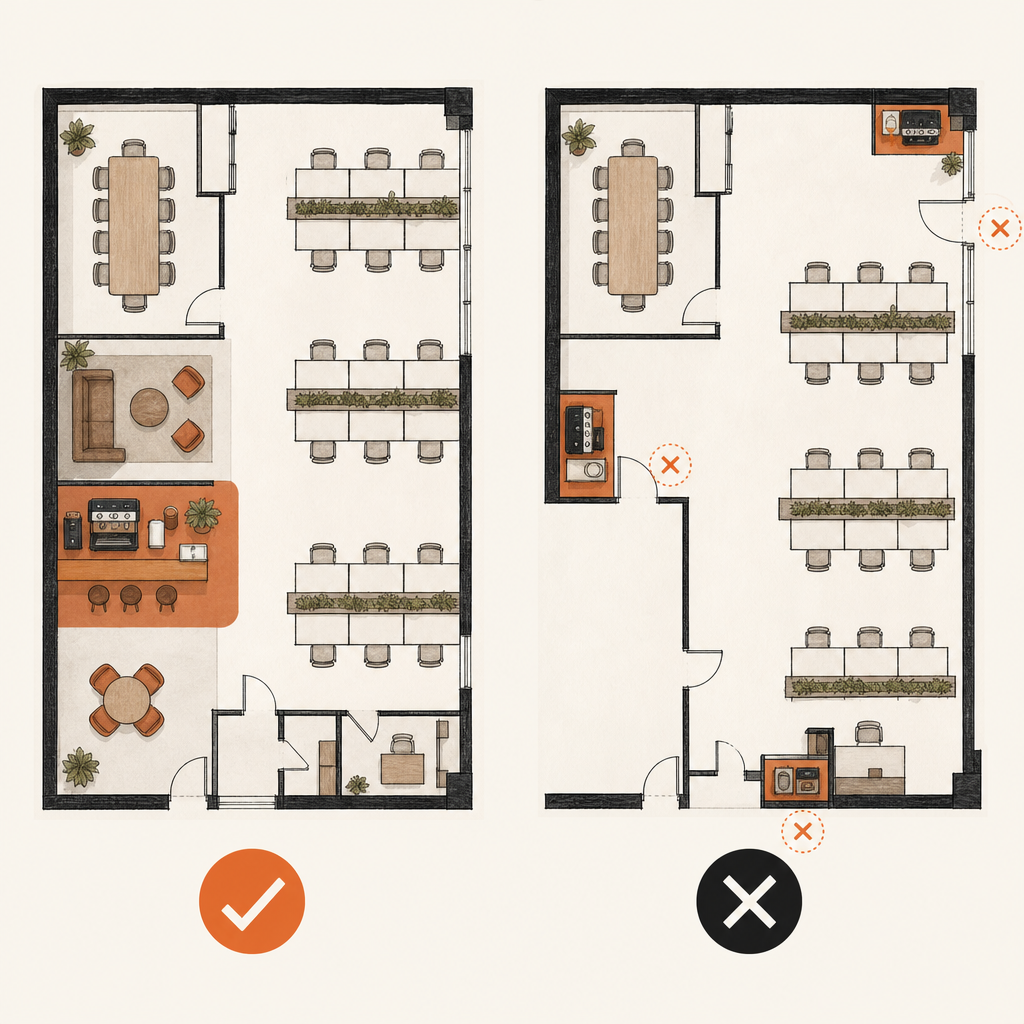
Place the coffee station beside a pantry, breakout space or informal meeting area where employees already pause. It should be visible enough to encourage use, but removed from quiet desks, reception queues and narrow walkways. The best position supports conversation without making noise and congestion everyone else's problem.
Start by mapping the likely path between desks, the machine, refrigeration, waste and seating. If those paths cross a doorway or force people to turn around while carrying hot drinks, the layout needs work.
A workplace breakout area coffee station usually performs better than a machine hidden inside a closed kitchen. It makes the amenity part of the employee experience and allows quick conversations to happen naturally. However, visibility should not come at the expense of function.
Avoid these common locations:
- Directly outside meeting room doors, where coffee queues interrupt arrivals.
- Against the only available route between work areas and amenities.
- Beside focused workstations where grinding, steaming and conversation create disruption.
- In reception unless serving visitors is a deliberate part of the operating plan.
- On unsupported furniture that was never designed for commercial equipment.
Safe Work Australia's Model Code of Practice for Managing the Work Environment and Facilities requires workplace facilities to remain accessible, hygienic and suitable for the work being performed. That principle matters here. A stylish station is not successful if employees using mobility aids cannot approach it or if open doors block access.
For larger floorplates, one central station is not automatically the best answer. Consider whether smaller service points would reduce walking and queues. The decision should follow actual occupancy patterns, not an architectural preference for symmetry.
How Should the Coffee Bar Workflow Be Designed?
Design the workflow from left to right, or in another clear sequence, so employees can collect a cup, prepare the drink, add milk or extras and leave without doubling back. Keep waste and cleaning access out of the collection path. This matters more during short, concentrated breaks than the station's decorative styling.
A practical office coffee bar setup contains distinct functional zones:
Cup and preparation zone
Place cups where someone can collect one without reaching across the person using the machine. If employees regularly bring reusable cups, provide an open landing area rather than filling the entire bench with accessories.
Brewing zone
The machine and grinder belong on the strongest, most serviceable section of the bench. Technicians need access to water connections, electrical isolation and removable panels. Building cabinetry tightly around the machine may look neat, but it can make routine service unnecessarily difficult.
Milk and finishing zone
Position refrigeration close enough that milk is returned immediately. Sugar, spoons and alternative drink ingredients can sit beyond the machine, moving people away from the brewing position while another drink begins.
Collection zone
Automatic machines still need a clear collection point. Employees often pause to add lids, stir drinks or speak with colleagues. Give that behaviour somewhere to happen without blocking the next user.
Waste and return zone
Coffee grounds, packaging, used spoons and spills require a defined destination. Use bins that can be removed without disrupting the machine. Keep cleaning chemicals separate from food, cups and consumables, following relevant food safety guidance from Food Standards Australia New Zealand.
The strongest modern office pantry design accepts that people will gather around coffee. It gives them room to do so while protecting the working path around the machine.
What Power, Plumbing and Bench Requirements Matter?
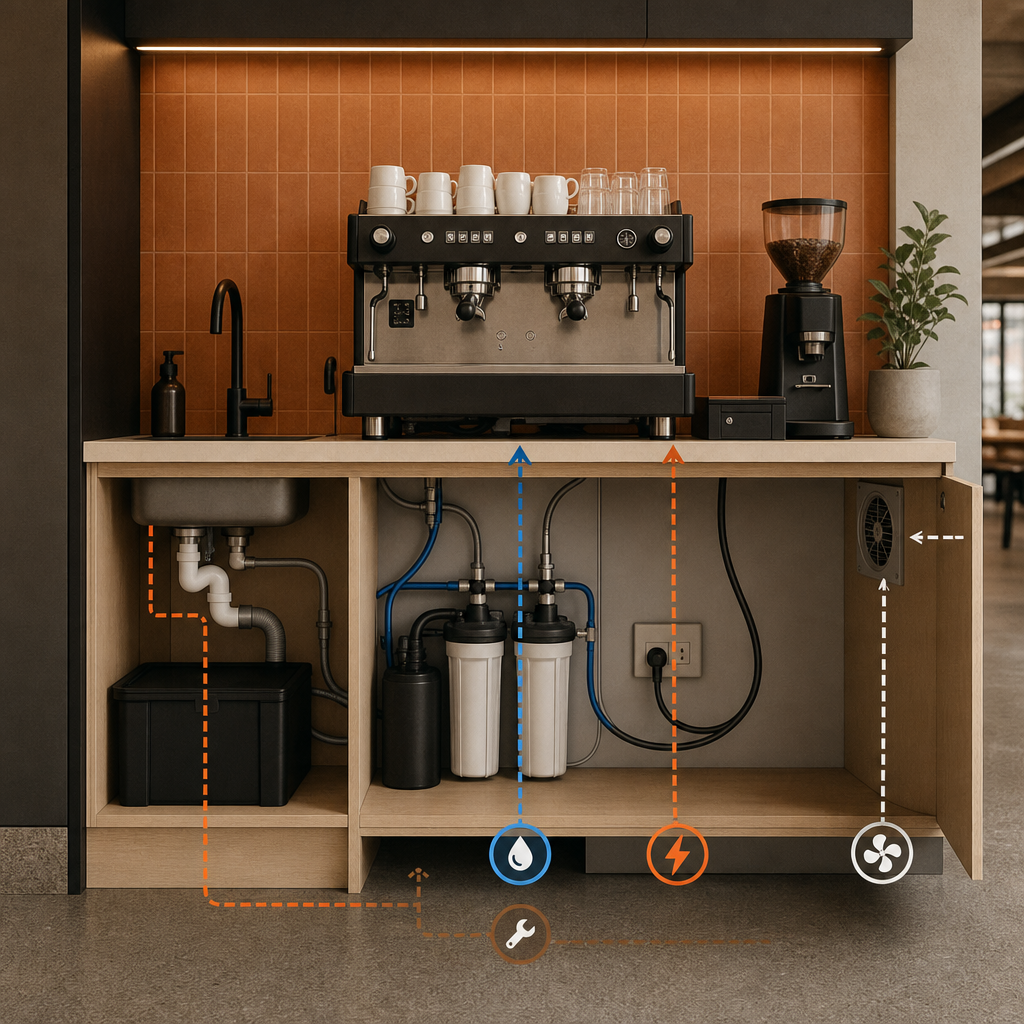
Check the selected machine's technical specification before finalising electrical or joinery work. Commercial machines can require different electrical connections, water feeds and drainage arrangements. A licensed electrician and plumber should confirm the site. Do not assume an existing socket, extension lead or pantry tap is suitable simply because it is nearby.
The site assessment should cover:
- The machine's stated electrical requirements and whether the circuit serves other appliances.
- Access to the isolation switch without moving heavy equipment.
- A suitable potable water connection where the machine is plumbed.
- Drainage requirements and a route that avoids exposed hoses across cupboards or floors.
- Water filtration based on local conditions and manufacturer requirements.
- Bench depth, strength and clearance for refilling, ventilation and servicing.
- Refrigeration power and airflow if milk storage sits below the bench.
- Splash protection around walls, joins and nearby power points.
Electrical work in Victoria must be completed by appropriately licensed people. Energy Safe Victoria provides the state's electrical safety and licensing guidance. Plumbing work must also meet Victorian Building Authority requirements and the applicable plumbing rules.
Do not design the cabinetry around a brochure image. Get the exact machine specification and allow access for maintenance. A removable panel beneath the bench is usually more useful than a permanently sealed finish.
Water filtration is also operational infrastructure, not an optional accessory. It can affect flavour, scale accumulation and equipment reliability. The correct filter depends on the machine, water conditions and usage, so it should be selected during installation rather than bought as generic pantry equipment.
Boutique Coffee's Six-Step Process includes an on-site visit where power, plumbing and bench space are assessed before installation. According to the company's operating process, the visit usually takes about 30 minutes. That short inspection can prevent expensive electrical, plumbing or cabinetry corrections later.
Which Coffee Machine Suits the Office?
Choose the machine according to real daily demand, drink preferences, peak usage and the amount of staff interaction you can support. A home-grade appliance may struggle in a busy workplace, while an oversized commercial system wastes money and bench space. Capacity, reliability and ease of use should lead the decision.
This is where honest advice matters. Boutique Coffee's fitting guidance is direct: a 12-person team does not need a $15,000 Eversys, while an 80-person office is likely to overwhelm a home-grade Jura. Those examples come from the company's own equipment-matching approach, not a universal equipment rule.
Consider three broad machine formats:
Automatic bean-to-cup machines
These suit workplaces that prioritise speed, consistency and straightforward use. Employees select a drink without manually grinding, dosing or steaming. They still require daily cleaning, milk management and regular servicing.
Traditional commercial espresso machines
These can produce excellent coffee when users are trained and willing to manage the process. They make sense where coffee preparation is part of the culture. They are a poor fit if nobody wants responsibility for dialling in the grinder, steaming milk and cleaning the group heads.
Capsule and portion systems
These can be simple to operate, but waste handling, drink cost, milk quality and peak throughput need careful consideration. They may suit low-volume or secondary locations rather than a main station serving a busy workplace.
Bean choice should follow team preferences rather than one person's favourite espresso. Boutique Coffee uses its Curated Coffee Plan to ask whether the team mainly drinks espresso or milk-based coffee, how much strength they prefer and what flavours they dislike. The starting blend is then adjusted using staff feedback during the first month.
That is what dialled-in beans means in practice. The blend, grinder and machine need to work together.
How Can the Station Fit a Modern Office Pantry Design?
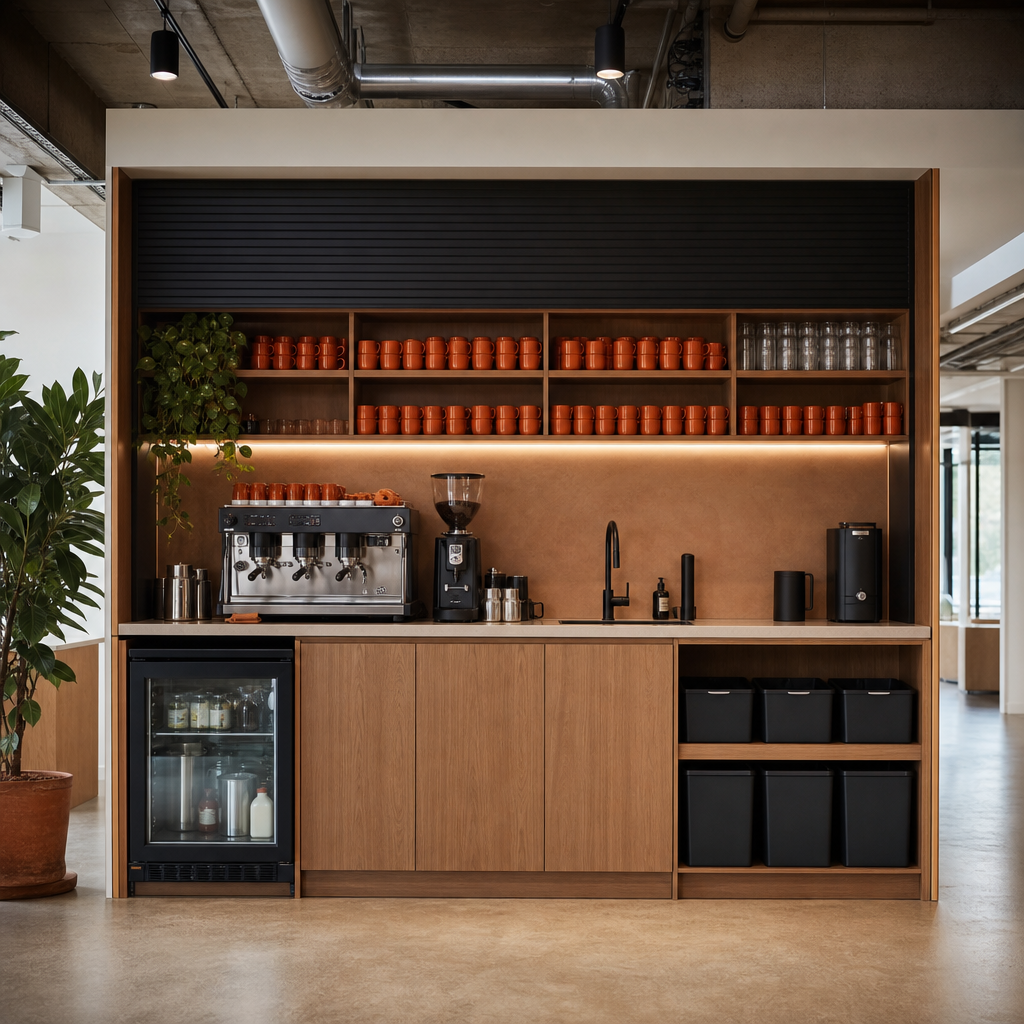
Integrate the coffee station by repeating materials, cabinet lines and hardware already used in the workplace, while preserving access for refilling and service. The machine should look chosen on purpose rather than dropped onto spare furniture. Good aesthetic integration conceals clutter without hiding the station or compromising daily operation.
Useful design approaches include:
- Full-height cabinetry for bulk beans, cups and cleaning stock.
- Open shelves for frequently used cups, provided they stay clean and accessible.
- A durable splashback that continues the pantry's existing material palette.
- Under-bench refrigeration positioned beside the milk finishing zone.
- Integrated waste sorting with clear labels for employees and cleaners.
- A pinboard or simple menu panel that explains drinks and cleaning expectations.
- Acoustic finishes in adjoining breakout areas where conversation carries into work zones.
Avoid treating the station like a residential styling exercise. Decorative trays and mug hooks can work in a small office, but commercial workplaces need cleanable surfaces and efficient restocking. Open displays become visual noise when packets, spare lids and cleaning cloths accumulate.
Colour can connect the station to the organisation's identity without covering every surface in branding. Cabinet fronts, a restrained menu panel or reusable cups may be enough. The priority remains café-quality, made practical.
Plan lighting so employees can see controls, spills and cup levels clearly. Do not rely on decorative pendant lighting that leaves the machine face or preparation bench in shadow.
What Makes an Office Coffee Station a Genuine Employee Perk?
Coffee becomes a meaningful employee perk when it is consistently good, available when people need it and supported by a comfortable place to pause. The benefit comes from repeated daily use, not the announcement of a new machine. Reliability, drink quality and the surrounding breakout experience determine whether employees value it.
The 3P Digital case study supplied for this brief reports improved staff retention following breakout upgrades. That is directionally useful, but it should not be stretched into a claim that coffee alone retained employees. Breakout design, management quality, flexibility, pay and team culture can all affect retention.
A more credible evaluation tracks several signals before and after the upgrade:
- Employee feedback about coffee quality and pantry usability.
- Machine usage and recurring stock consumption.
- Reported faults and periods when the station cannot be used.
- Participation in informal team breaks.
- Relevant retention or engagement measures already used by the organisation.
Do not create a survey that invites praise for the new machine. Ask specific questions about reliability, taste, queueing, cleanliness and missing drink options. Open comments often reveal practical fixes that a satisfaction score misses.
The strongest evidence from Boutique Coffee's own work is operational. At a mid-size Melbourne office, an existing setup was not meeting the team's expectations. I upgraded it to a WMF commercial machine and included installation, training and ongoing service. Site manager Paul Bruno reported easy daily use, strong coffee and hot chocolate quality, and service that remained consistent over years.
That example does not prove a retention percentage. It shows the conditions required for coffee to contribute positively to workplace experience: suitable equipment, drinks people enjoy and service that keeps the station operating.
The Missing Design Layer Is Accountability
Most coffee station articles stop at cabinetry, cups and styling. I think the service model belongs in the design brief. If the supplier uses a ticket queue and nobody owns the full setup, a minor fault can disable an expensive amenity. The better model is one number, one person, from installation onwards.
At another busy Melbourne workplace, machine downtime created havoc during peak office periods. Regular scheduled servicing and direct personal contact gave the team reliable access when it mattered. Client Chrissie Straw specifically identified service consistency as the reason employees had coffee when they needed it.
This is why I describe the relationship as a coffee partner, not a supplier. Most fixes can be talked through quickly when the person answering already knows the machine and site. If a visit is required, there is no call centre or corporate runaround.
Boutique Coffee's own active-client data records more than 200 Melbourne workplace rentals as of 2026, an average active-client relationship longer than five years and a typical service-call response within 24 hours. The business has installed for individual workplaces serving more than 400 people. These are internal operating figures, not industry benchmarks.
The commercial position is equally important: no lock-in, ever. Rentals operate month-to-month with one month's notice and machine pickup included. Equipment is matched to the current team rather than upsold for hypothetical growth.
That changes the design conversation. Instead of asking which machine looks most impressive, ask who remains accountable when beans run low, the grinder drifts, staff need retraining or a component fails.
From Site Visit to First Coffee
A structured installation prevents the machine, utilities and workplace layout from being planned separately. Boutique Coffee's Six-Step Process moves from team requirements to a site inspection, installation, staff training and recurring service. According to the company's operating process, most suitable Melbourne sites move from first call to installation within 5-7 business days.
The process is:
- Enquiry, with basic team and site details submitted in about two minutes.
- A 15-20 minute call with Chris to shortlist machines and discuss rough pricing.
- A 30-minute site visit covering power, plumbing and bench space.
- A 45-minute installation, including connection, grinder adjustment and shot testing.
- A 20-minute first brew and training session for at least two employees, with a cheat sheet left onsite.
- Weekly or fortnightly service visits, with beans and consumables replenished as required.
These durations are Boutique Coffee's own process targets. Site readiness, building access and required trade work can change the schedule.
Start by reviewing the available workplace coffee solutions. If the practical fit looks right, a free coffee machine trial can help the team assess taste and usability before settling into an ongoing arrangement.
For a station design consultation, contact Boutique Coffee with your team size, Melbourne suburb, preferred drinks and any photos or plans of the proposed location.
References
The external references below cover workplace facilities, food safety and Victorian trade requirements. Equipment specifications must still come from the selected machine's manufacturer. Boutique Coffee operating figures and process timings used above are identified as internal business data supplied for this article rather than independent industry statistics.
- Safe Work Australia, Model Code of Practice: Managing the Work Environment and Facilities
- Food Standards Australia New Zealand, Food Safety
- Energy Safe Victoria
- Victorian Building Authority
- Boutique Coffee at Work internal operating data and Six-Step Process, supplied for this article, current as of 2026.
FAQ_SCHEMA_JSON
Frequently asked questions
What should an office coffee station include?
Include a commercial machine suited to demand, a grinder where required, cups, accessible milk refrigeration, beans, drink ingredients, waste handling and cleaning supplies. The station also needs suitable power, water and drainage where specified, plus clear preparation and collection space.
Does an office coffee machine need plumbing?
Some commercial machines require a fixed potable water connection and drainage, while others use refillable tanks or different configurations. Check the exact machine specification before designing cabinetry and use a licensed plumber for required plumbing work.
How much bench space does an office coffee station need?
Bench requirements depend on the machine, grinder, milk system, clearances and service access. Add separate space for cups, drink finishing and collection so employees do not crowd the machine controls.
Where should milk be stored at an office coffee bar?
Store milk in suitable refrigeration close to the machine so employees can return it promptly. Avoid layouts that require users to cross a walkway while carrying open milk containers.
How do we stop queues forming at the coffee machine?
Choose equipment with suitable peak capacity and separate cup collection, brewing, finishing and waste. Move sugar, lids and stirring away from the controls. Large workplaces may need an additional service point.

Chris
Chris
Keep reading
Understanding the Daily Cost of a Commercial Coffee Machine in an Australian Office
The cost of a commercial coffee machine per day equals daily beans, milk, electricity, water filtration, cleaning, rental or equipment ownership, and…
Comprehensive Corporate Coffee Solutions: Elevating Australian Workplace Experiences
Corporate coffee machine solutions combine commercial equipment, installation, fresh beans, staff training, maintenance and responsive support in one workplace…
Office Coffee Machine Troubleshooting: Common Errors & Quick Fixes
Office coffee machine troubleshooting should start with basic checks: confirm power, water, beans, waste levels and removable parts. Follow the displayed…