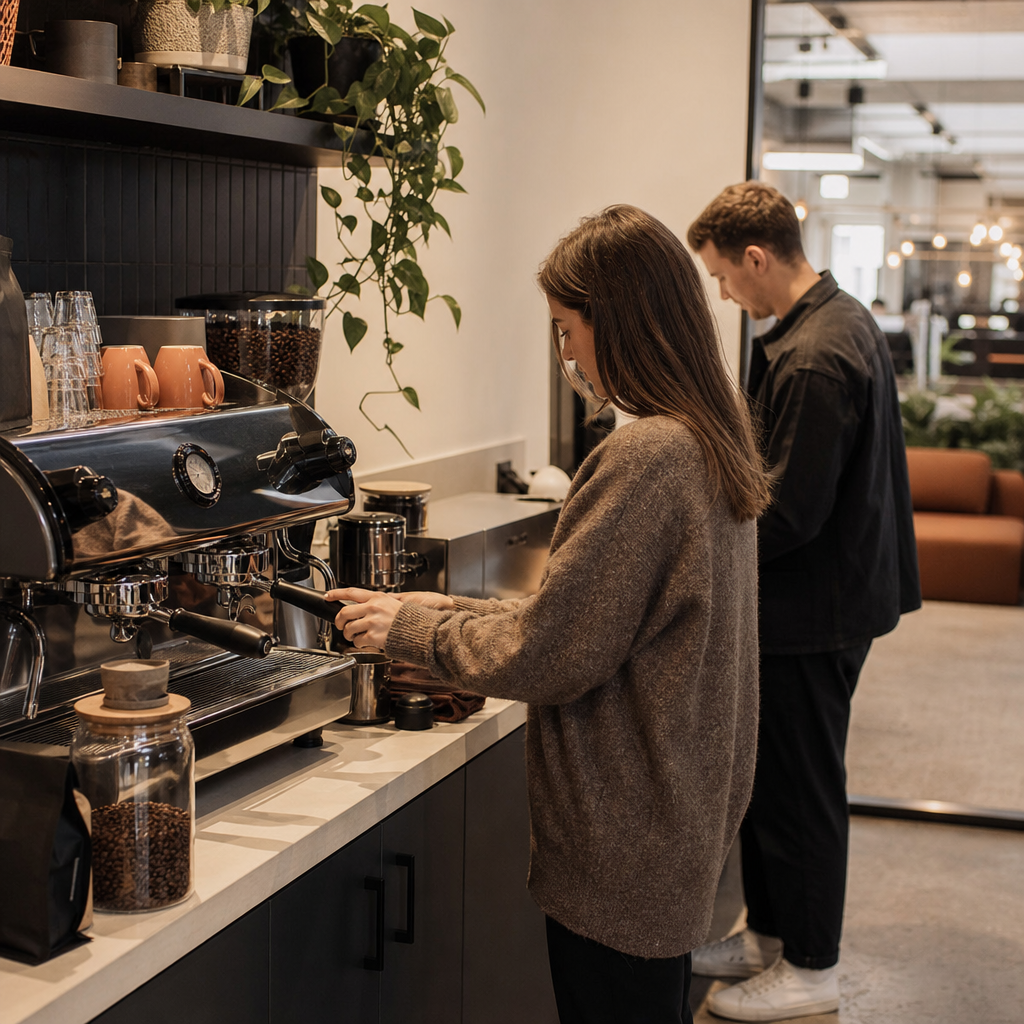
Corporate coffee machine solutions combine commercial equipment, installation, fresh beans, staff training, maintenance and responsive support in one workplace programme. The right solution is matched to team size, drink preferences, available space and budget. It should deliver reliable café-quality coffee without forcing the business to manage equipment faults, stock or multiple suppliers.
Instant coffee inside an office has never made sense when Melbourne workers can buy excellent coffee outside the door. Since 2008, Boutique Coffee at Work has focused on closing that gap with commercial machines, dialled-in beans and direct service.
This guide explains what a complete workplace coffee programme includes, where service models differ and how to choose a coffee partner based on accountability rather than sales promises.
Boutique Coffee at Work at a glance
The following figures come from Boutique Coffee at Work's internal client records, current in 2026.
| Measure | Current position | Source |
|---|---|---|
| Active Melbourne workplace clients renting | 200+ | Boutique Coffee at Work internal client records, 2026 |
| Average active client relationship | 5+ years | Boutique Coffee at Work internal client records, 2026 |
| Typical response time on service calls | 24 hours | Boutique Coffee at Work internal service records, 2026 |
| Time focused exclusively on workplace coffee | 17 years | Boutique Coffee at Work business records, 2026 |
| Largest workplace team supported | 400+ people | Boutique Coffee at Work installation records, 2026 |
Key takeaways
- Corporate coffee solutions should cover the machine, beans, installation, training, maintenance and replenishment.
- Machine selection must reflect actual daily demand, not the highest specification a supplier can sell.
- Fresh beans and correct grinder settings matter as much as the machine itself.
- Direct accountability reduces delays when equipment needs adjustment or repair.
- Flexible rental limits commitment while allowing equipment to change as the workplace grows.
- A useful partner monitors the full coffee experience instead of disappearing after installation.
Summary table
| Component | Basic machine supply | Full-service workplace programme | What to confirm |
|---|---|---|---|
| Equipment | Machine delivered or sold | Commercial machine selected for demand and site conditions | Capacity, plumbing, power and bench space |
| Installation | May be charged separately | Connection, testing and grinder calibration included | Who organises trades and commissioning |
| Coffee supply | Ordered when someone remembers | Beans matched to team preferences and replenished regularly | Roast profile, freshness and delivery rhythm |
| Training | Manual or short demonstration | First-brew training and practical instructions | Training for new staff and cleaning responsibilities |
| Maintenance | Reactive repair arrangement | Scheduled servicing and direct fault support | Response process, inclusions and replacement options |
| Commercial terms | Purchase or fixed contract | Flexible rental can include equipment and service | Notice period, collection costs and ownership |
| Accountability | Sales and service handled separately | One person responsible from site visit onwards | Who answers when the machine stops working |
Defining corporate coffee machine solutions
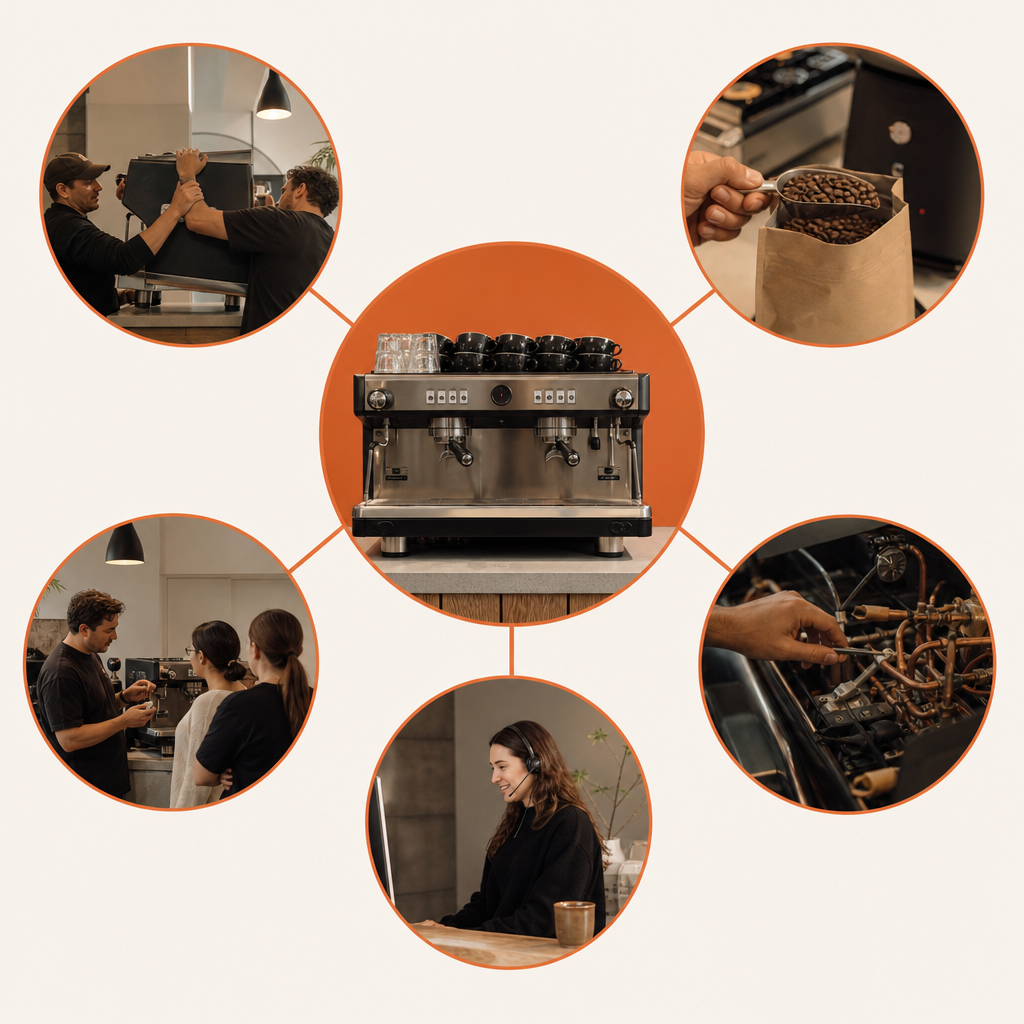
A corporate coffee machine solution is a managed workplace service, not simply an appliance purchase. It combines suitable commercial equipment with site assessment, installation, coffee supply, grinder calibration, cleaning guidance, preventive maintenance and responsive support. The purpose is consistent coffee availability without creating another facilities management burden.
A machine on a bench is only one component. If the grinder is poorly adjusted, the beans are unsuitable or nobody owns servicing, an expensive machine can still produce disappointing coffee.
A complete solution starts by examining how the workplace actually operates:
- How many people use the machine?
- Are drinks concentrated around morning and lunch periods?
- Does the team prefer espresso, long black or milk-based drinks?
- Will customers also be served?
- Is plumbing available?
- How much bench and overhead space exists?
- Who will perform simple daily cleaning?
- What happens when usage increases?
These questions determine whether the office needs a compact automatic machine, a higher-capacity commercial unit or a different arrangement entirely.
Machine fit is a point of integrity. A 12-person team does not need a $15,000 Eversys simply because it is available. An 80-person team should not receive a home-grade Jura that cannot tolerate sustained workplace demand. The right recommendation sits between under-capacity and needless expense.
That is also why comparing solutions only by weekly rental price is misleading. A low advertised price may exclude installation, beans, scheduled maintenance, call-outs, consumables or staff training. Compare the complete operating model and the person responsible for delivering it.
Beyond the machine: integrated services
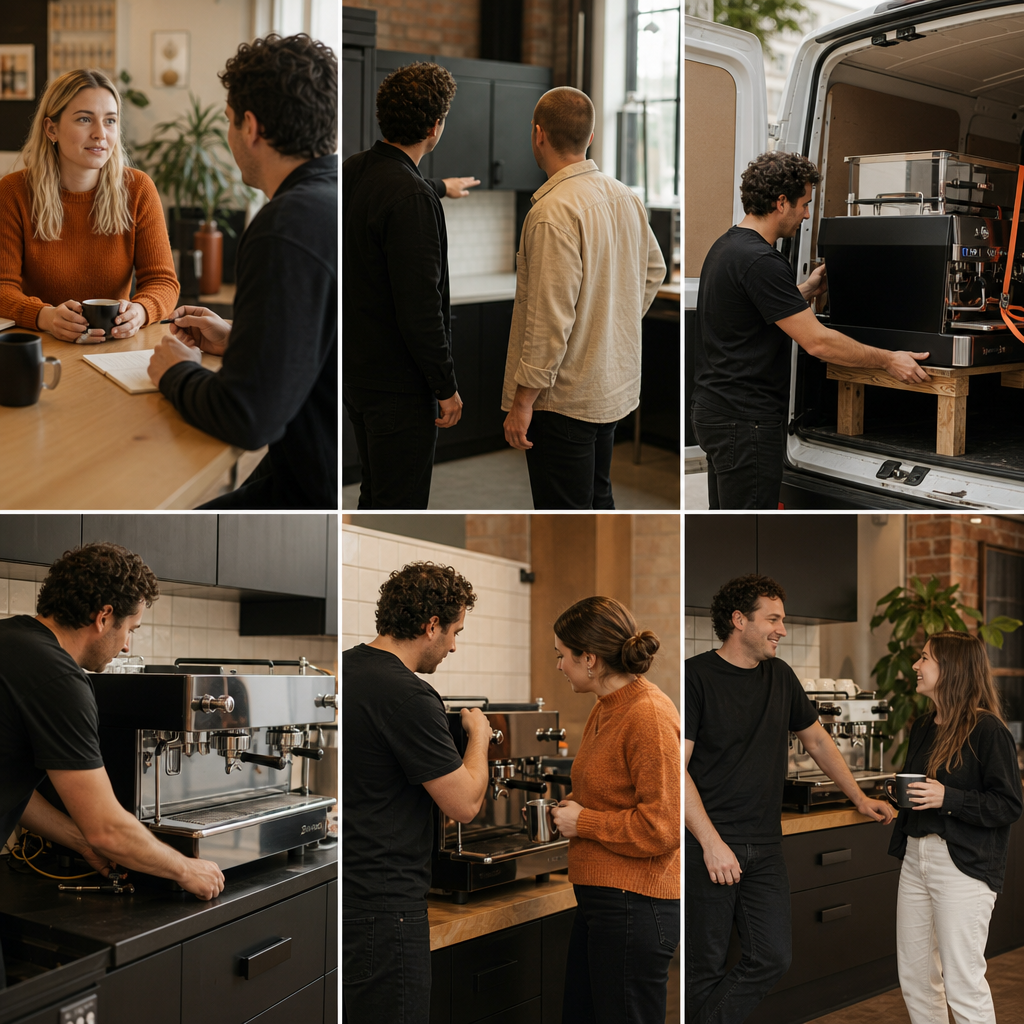
Full-service office coffee in Australia should integrate site planning, machine commissioning, bean supply, training, preventive maintenance and fault response. Each service affects the others. A supplier that controls only the hardware cannot reliably protect coffee quality, equipment uptime or stock availability across the life of the arrangement.
Site assessment and installation
Commercial machines have practical requirements. Power access, water connection, drainage, bench strength and clearance all need checking before installation. Guessing from office photographs creates avoidable problems.
Boutique Coffee at Work uses a Six-Step Process designed to take most Melbourne clients from first call to installed machine in 5-7 business days:
- Enquiry: The client submits basic team and workplace details. This usually takes about 2 minutes.
- Phone call with Chris: A 15-20 minute discussion narrows the machine options and establishes rough pricing.
- On-site visit: A 30 minute inspection checks plumbing, power, bench space and expected demand.
- Install day: The machine is connected, the grinder is dialled in and test shots are assessed. Installation usually takes around 45 minutes.
- First brew and training: At least two staff members receive around 20 minutes of practical training, supported by a cheat sheet.
- Ongoing rhythm: Weekly or fortnightly visits keep beans, consumables and servicing on schedule.
These timings are based on Boutique Coffee at Work's operating process, not an industry-wide guarantee. Site access, plumbing work or unusual electrical requirements can extend the schedule.
Bean matching and replenishment
Premium corporate coffee service requires more than labelling beans as premium. Roast profile, strength and extraction must suit the drinks people make.
The Curated Coffee Plan starts by asking whether the team mainly drinks espresso or milk-based coffee, how strong they prefer it and what flavours they dislike. A suitable blend is selected, then adjusted using team feedback during the first month.
This avoids the usual one-size supply model. A darker blend may work well through milk but overwhelm people drinking long blacks. A lighter blend can taste balanced as espresso yet disappear in a large milk drink. Selection should be chosen on purpose.
Replenishment also needs an owner. Facilities teams should not discover an empty bean hopper during a meeting day. Regular visits allow usage to be reviewed and supply frequency adjusted before shortages become routine.
Maintenance and direct support
Preventive servicing protects consistency and reduces avoidable faults. It should include inspection, cleaning where required, grinder checks and attention to wear before a small issue becomes a shutdown.
Support structure matters just as much. The Boutique Coffee at Work model is one number, one person. There are no call centres, no corporate runaround and no escalation path between the person who knows the site and the person authorised to help.
Boutique Coffee at Work's internal service records show a typical response time of 24 hours across active clients in 2026. Many minor problems can be diagnosed over the phone when the person answering already knows the machine, installation and service history.
Benefits for employees and the business
A well-managed coffee programme gives employees convenient, consistent drinks while reducing hidden work for facilities and administration teams. Its business value comes from reliability, easier hosting, fewer supply tasks and a workplace experience that respects employee expectations. Coffee does not create culture by itself, but poor coffee can undermine everyday moments.
Good workplace coffee supports the small interactions that happen around a shared machine. It also gives staff a practical reason to pause without leaving the premises whenever they want a better drink.
The business case should not rely on vague claims about productivity. The more defensible benefits are operational:
- One managed service replaces separate equipment, coffee and repair arrangements.
- Scheduled replenishment reduces emergency purchasing.
- Training limits misuse and inconsistent drinks.
- Commercial equipment can handle concentrated workplace demand.
- Direct service reduces the time internal staff spend chasing support.
- Consistent presentation improves coffee offered to customers and visitors.
Workplace coffee should complement appropriate breaks rather than replace them. Break entitlements depend on applicable awards, enterprise agreements and employment arrangements. Fair Work Ombudsman guidance should be checked where employers need advice on workplace breaks.
Caffeine also affects people differently. A complete programme should provide clear choices, including decaffeinated coffee and non-coffee options where appropriate. Food Standards Australia New Zealand provides consumer guidance on caffeine and individual sensitivity.
Case study: upgrading an underperforming Melbourne office setup
A mid-size Melbourne office had an existing coffee arrangement that did not meet the team's needs or expectations. I assessed the workplace and upgraded it to a WMF commercial machine, including installation, staff training and ongoing service within the rental.
The result was not a manufactured productivity percentage. It was a reliable daily experience that staff noticed. The site manager reported that the machine was easy to use, the coffee and hot chocolate were consistently good, and service quality had been maintained over several years.
His feedback captured the outcome clearly: "No problem, just keep doing what you're doing."
That is what a successful implementation looks like in practice. The machine suits the team, people can use it without confusion and support remains consistent after the initial setup.
Case study: preventing peak-hour coffee disruption
A busy Melbourne workplace experienced disruption whenever its machine failed during peak office hours. Staff relied on the machine, so a breakdown quickly became a facilities issue rather than a minor inconvenience.
I provided a reliably maintained machine, regular scheduled servicing and direct personal contact for faults. The client's workplace contact said the regular service meant the team had coffee when it mattered, avoiding the havoc caused by an out-of-service machine.
This case highlights an important distinction. Buying better hardware may reduce some faults, but maintenance discipline and response ownership determine what happens across years of daily use. Reliability is a service outcome, not merely a product specification.
Customisation and scalability

Tailored workplace coffee programs adapt machine capacity, drink options, bean profile, supply frequency and service schedules to each site. Scalability means changing those elements as headcount or usage changes, without forcing the business to replace everything prematurely. The starting point should be present demand, supported by a practical upgrade path.
Team size alone does not tell the whole story. A small customer-facing business may place more daily demand on a machine than a larger hybrid office. A workplace with concentrated start times may need stronger peak capacity than one with staggered attendance.
Customisation should cover four layers.
Equipment capacity
Assess drinks per busy period, not just total headcount. The machine must recover quickly enough during peak use and provide an interface the team can operate confidently.
Machine configuration should also reflect available facilities. Plumbed units reduce manual refilling, but they require suitable water and drainage arrangements. Tank-fed equipment may be practical where plumbing is impossible, provided capacity still suits demand.
Coffee preferences
A coffee plan should account for strength, roast preference, milk-based drinks, espresso consumption and decaffeinated demand. Initial selection is a starting point. Feedback after real workplace use is more useful than opinions formed during a single tasting.
Service frequency
Supply and servicing should follow usage. A busy office may need frequent replenishment, while a smaller site may need less stock to preserve freshness. Weekly or fortnightly visits can be adjusted as attendance patterns become clear.
Workplace growth
Scalability should not be used as an excuse to oversell. Buying for hypothetical growth can leave a smaller office paying for unused capacity. It is usually better to fit the current team honestly, then review the equipment when demand changes materially.
Boutique Coffee at Work has installed solutions for teams of more than 400 people, according to internal installation records current in 2026. The same selection principle still applies at that scale: observe actual demand, model peak use and provide enough capacity without padding the recommendation.
Month-to-month rental supports this approach. Boutique Coffee at Work rentals have one month's notice to exit and free machine pickup. No lock-in, ever. Equipment can therefore be reviewed without treating the original recommendation as permanent.
Choosing a full-service office coffee partner
Choose a full-service partner by examining accountability, machine fit, inclusions, maintenance, bean quality and commercial terms. Ask who will visit the site, who handles faults and what happens if the arrangement no longer fits. A polished proposal matters less than a clear operating process and an identifiable person responsible for results.
Start with these questions:
- Who selects the machine, and what usage information informs that recommendation?
- Is an on-site assessment included before installation?
- Are connection, grinder setup and test drinks included?
- Who trains staff, and what happens when new staff join?
- Are beans selected for the team's preferences or supplied as a default blend?
- How often are supplies checked and replenished?
- Is preventive maintenance included in the rental?
- Who answers the phone when the machine fails?
- Are call-outs, parts or replacement equipment excluded?
- Can the business leave or change machines without a long fixed commitment?
Read the commercial terms rather than relying on phrases such as "fully managed" or "all-inclusive". The Australian Competition and Consumer Commission provides guidance on unfair contract terms for small businesses. While that guidance is not specific to coffee machine rental, it is relevant when reviewing standard-form agreements, renewal clauses and exit conditions.
A genuine full-service provider should also be willing to say when the fit is wrong. If the team is too small, the site is unsuitable or another approach would be better, an honest referral protects both parties.
You can review Boutique Coffee at Work's workplace coffee solutions and Six-Step Process before comparing options. Businesses that want to test coffee quality in their own workplace can request a free trial.
Why accountability beats a larger support structure
The strongest corporate coffee service is not necessarily the supplier with the largest fleet or support department. It is the provider where responsibility stays visible. One person who understands the site can resolve minor issues quickly, make better equipment decisions and recognise changes in usage before they become recurring problems.
Most corporate suppliers divide sales, installation, account management and technical support across separate teams. That structure may suit national scale, but every handover creates room for lost context.
My position is different: founder-led, always. I stay responsible from the initial site visit through installation, bean supply and ongoing servicing. I'm not trying to be the biggest. I am trying to ensure every client knows who owns the outcome.
This model has produced an average active client relationship of more than 5 years across Boutique Coffee at Work's current client base, according to internal records for 2026. The business currently supports more than 200 Melbourne workplace clients.
Those figures do not prove that personal accountability is the only workable model. They do show that long relationships can be built without using fixed contracts to trap dissatisfied clients.
In 17 years, the no-lock-in policy has not cost a client worth keeping. Long-term clients retained by choice are more valuable than clients retained by paperwork. That changes how recommendations are made. There is no benefit in upselling the wrong machine if the relationship depends on the client remaining satisfied month after month.
The practical test is simple. Before signing, call the service number and ask who would handle a fault after installation. If the answer involves a ticket queue, multiple departments or an unclear response path, factor that friction into the decision.
For a site assessment and a recommendation designed around your culture and budget, contact Boutique Coffee at Work. The aim is straightforward: the correct machine, dialled-in beans and service that ensures your team never goes without coffee.
References
- Australian Competition and Consumer Commission, Contracts and unfair contract terms.
- Fair Work Ombudsman, Breaks.
- Food Standards Australia New Zealand, Caffeine.
- Safe Work Australia, Model Code of Practice: Managing the work environment and facilities.
- Boutique Coffee at Work internal client, installation and service records, current in 2026.
FAQ_SCHEMA_JSON
Frequently asked questions
What is included in a corporate coffee machine solution?
A complete solution should include machine selection, site assessment, installation, grinder calibration, coffee beans, staff training, planned maintenance and fault support. Consumables, milk systems, cleaning products and replacement equipment vary between providers, so each inclusion should be confirmed in writing.
Should an office rent or buy a commercial coffee machine?
Rental suits businesses that want predictable access to commercial equipment with service support and flexibility to change. Purchasing may suit organisations prepared to manage maintenance, repairs and replacement risk internally. Compare total responsibilities, not just the machine's purchase price or weekly rental amount.
How do I choose the right machine for our team size?
Assess peak demand, drink types, office attendance, customer use, plumbing and available space. Headcount is only the starting point. A supplier should inspect the site and understand when drinks are made before recommending capacity.
How quickly can a workplace coffee machine be installed?
Boutique Coffee at Work's Six-Step Process is designed to take most Melbourne clients from enquiry to installation in 5-7 business days. Plumbing changes, electrical work, restricted site access or specialised equipment can extend the schedule.
What happens when a rented coffee machine breaks down?
The provider should diagnose simple issues by phone, then arrange an on-site visit when required. Confirm who performs repairs and whether call-outs or parts carry extra charges. Boutique Coffee at Work's typical service response is 24 hours across its active client base, based on 2026 internal records.
Can a workplace coffee programme change as our business grows?
Yes. Machine capacity, bean supply, service frequency and drink options should be reviewed when headcount or usage changes. Flexible rental makes equipment changes easier because the business is not forced to preserve an unsuitable original setup.
Chris
Chris
Keep reading
Office Coffee Machine Troubleshooting: Common Errors & Quick Fixes
Office coffee machine troubleshooting should start with basic checks: confirm power, water, beans, waste levels and removable parts. Follow the displayed…
Office Coffee Machine Installation Guide: What Australian Businesses Need to Know
Installing an office coffee machine starts with matching the equipment to your team, then confirming power, potable water, drainage, bench space, ventilation…
Understanding the Daily Cost of a Commercial Coffee Machine in an Australian Office
The cost of a commercial coffee machine per day equals daily beans, milk, electricity, water filtration, cleaning, rental or equipment ownership, and…