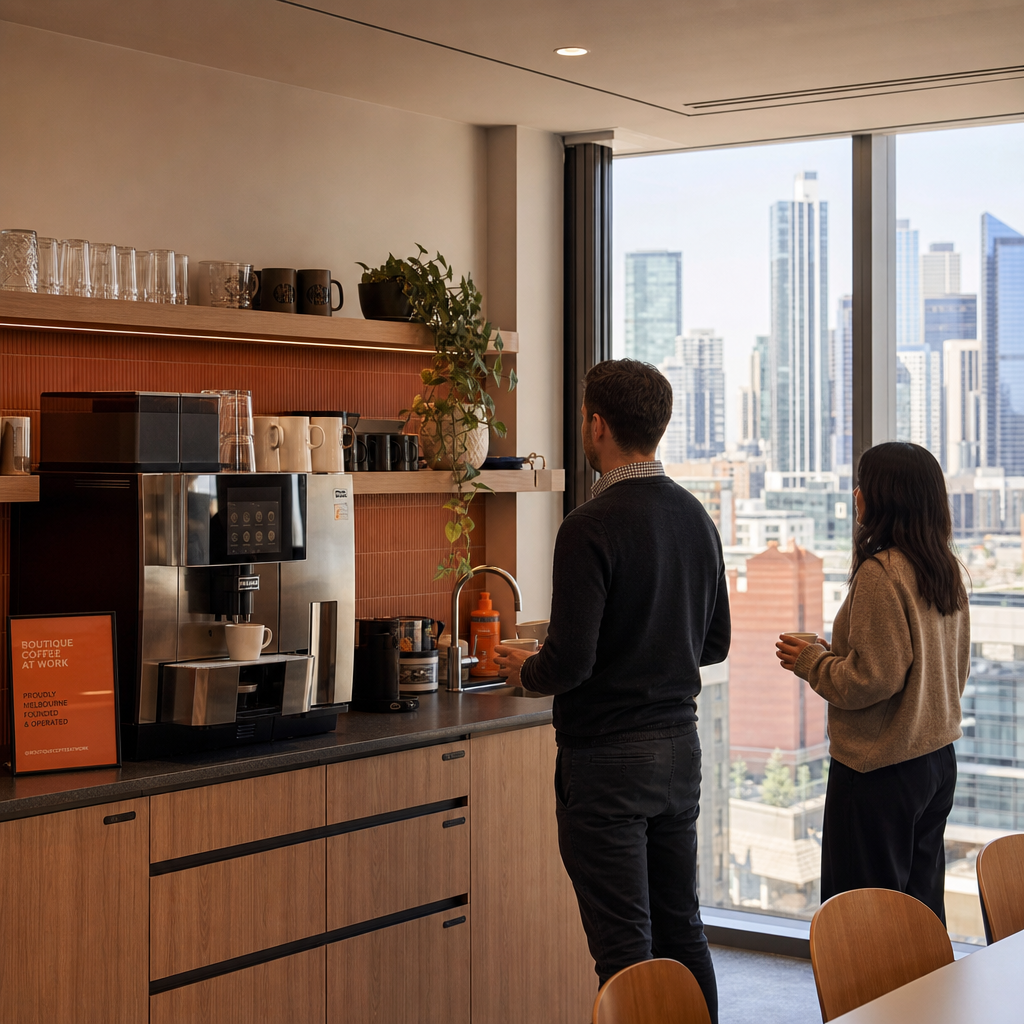
Getting the right size office coffee machine is not about finding the most expensive equipment. It is about matching the machine's capacity to your team's actual behaviour. Buy too small, and your staff spend 15 minutes standing in a queue at 9:30 AM. Buy too big, and you waste money on capacity you will never use.
I am Chris Prokopiou, founder of Boutique Coffee at Work. Since 2008, I have driven throughout Melbourne installing and maintaining commercial coffee machines for over 200 active workplace clients. The gap between the café quality outside the door and the instant coffee inside the office never made sense to me. Closing that gap is my entire focus.
When people ask me what size coffee machine they need for their office, they usually expect a simple answer based on staff numbers. The reality is more complex. You need to understand peak usage times, commercial espresso machine group heads, and hourly output capacity. You also need a supplier who prioritises the right fit over a quick upsell. Whether you manage a 12-person team or a 400-person enterprise, this office coffee machine size guide will break down exactly how to calculate your requirements.
Key Takeaways
- Calculate machine size based on peak demand, not just total headcount.
- A group head is the brewing unit. More group heads mean more simultaneous cups.
- Coffee machine capacity per hour is the most critical metric for high-traffic environments.
- Automatic machines suit fast-paced queues, while traditional espresso machines suit hospitality settings.
- Honest equipment sizing prevents staff frustration and wasted money.
Office Coffee Machine Sizing Summary
| Team Size | Machine Type | Group Heads | Capacity Per Hour | Best Environment |
|---|---|---|---|---|
| 1-15 people | Single Group Automatic | 1 | 30-40 cups | Small office, low peak demand |
| 15-40 people | Dual Group Automatic | 2 | 80-100 cups | Medium office, morning rush |
| 40-100 people | Three Group Automatic | 3 | 150-200 cups | Large corporate floor |
| 100+ people | Heavy-Duty Three Group | 3 | 200+ cups | Factory, large enterprise |
How to Calculate What Size Coffee Machine You Need
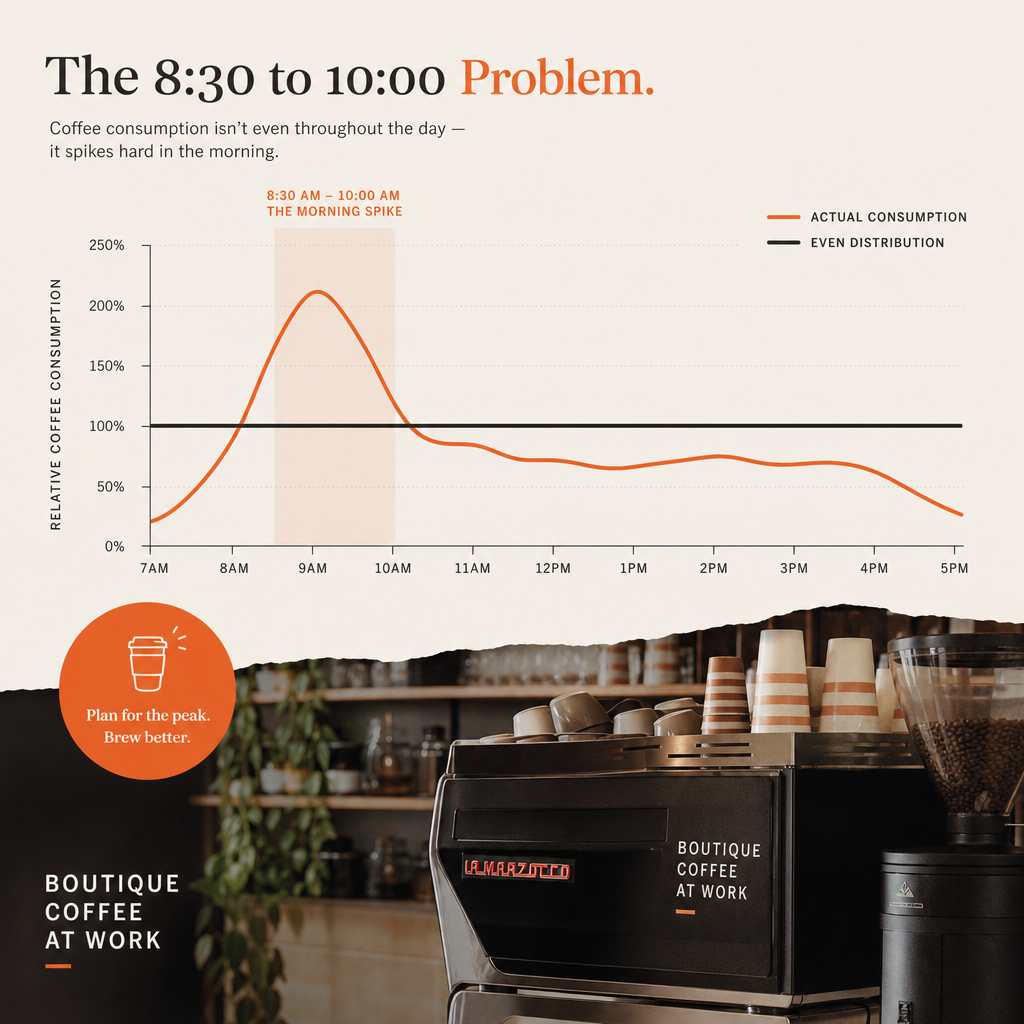
Figuring out what size coffee machine for your office requires looking at three variables: total staff, daily consumption, and peak usage times. Most Melbourne offices follow a predictable pattern. The bulk of your coffee gets consumed between 8:30 AM and 10:00 AM, and again for a brief spike after lunch.
If you have 50 staff and assume each drinks three cups a day, your total daily requirement is 150 cups. That does not mean you need a machine that can pump out 150 cups over eight hours. You need a machine that can comfortably handle 50 of those cups inside a single 45-minute window. If the machine cannot clear the queue before the morning stand-up meeting, staff will get frustrated and walk down to the local café.
We analyse this peak period closely. We look at the physical limit of the machine, the boiler size, and the recovery time between shots. This is exactly what we address during our initial assessment. When my team at 3P Digital recently consulted on a digital marketing agency's internal facilities, we applied these same capacity metrics to their office amenities. In that case, machine sizing and layout optimisation reduced wait times by 25%. The same logic applies to coffee. You build the system around the peak load, not the daily average.
Total Staff vs Peak Demand
Do not look at your total employee count in isolation. A company of 80 people where everyone starts work at 9:00 AM has a completely different capacity requirement to a company of 80 people split across early and late shifts.
Look at your maximum concurrent users. If 30 people try to make a flat white at exactly 9:15 AM, a small single-boiler machine will choke. The steam wand will lose pressure, the coffee will taste bitter because the water temperature is fluctuating, and the queue will back up.
The Role of Workflow and Cup Traffic
Machine size is also dictated by workflow. A traditional espresso machine requires grinding, tamping, and manual milk texturing. A fully automatic machine handles this at the push of a button. For a corporate boardroom or a client-facing boardroom where you want the theatre of making coffee, a manual machine works well. For a busy staff kitchen where people want to get back to their desks, you need an automatic machine with high capacity per hour.
Understanding Commercial Espresso Machine Group Heads
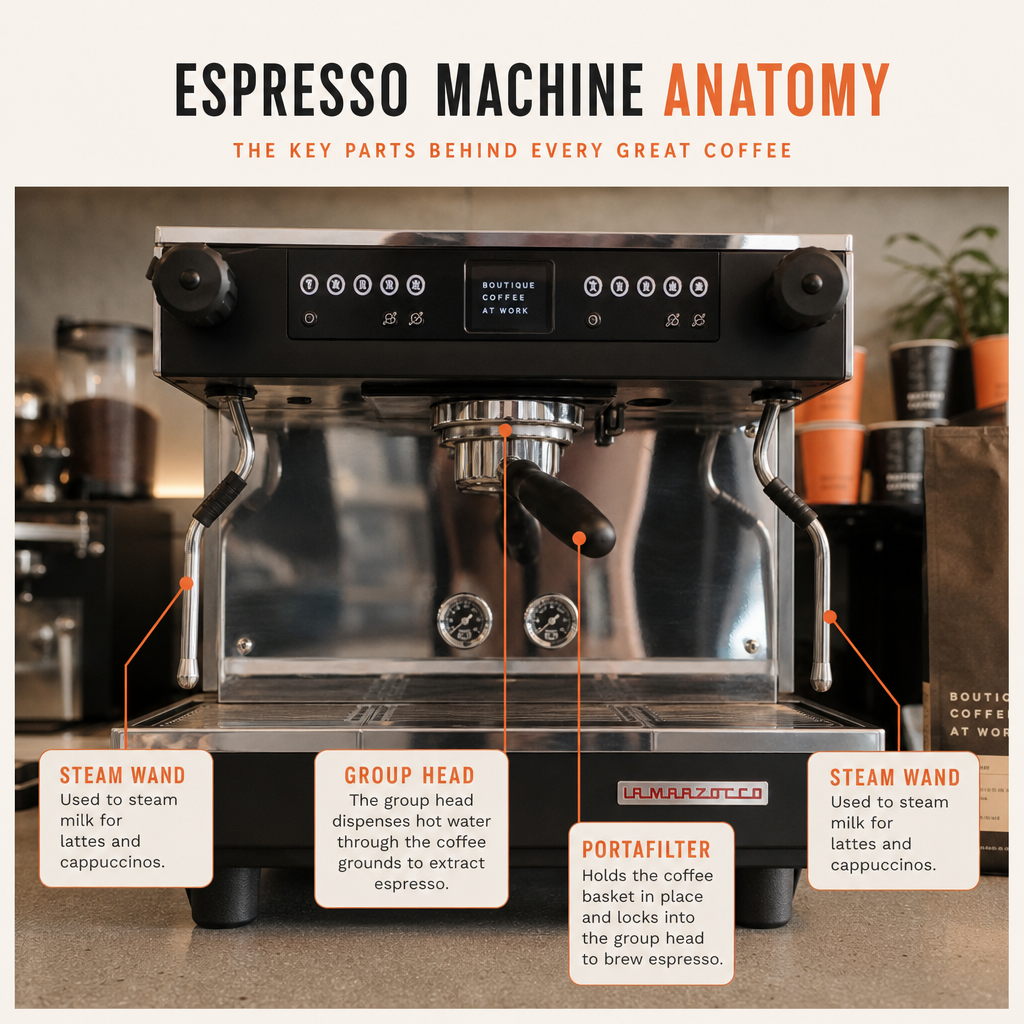
When you start looking at commercial equipment, you will hear the term group head. The group head is the part of the espresso machine where the portafilter locks in. It is the delivery system for the hot water passing through the coffee grounds.
The number of group heads dictates how many shots you can pull at exactly the same time. Understanding commercial espresso machine group heads is essential for getting your office sizing right.
One Group Head Machines
A single group head machine is compact and designed for low volume. It pulls one shot at a time.
These are perfect for small offices of up to 15 people. They take up minimal bench space and run on a standard 10-amp power circuit, meaning you can plug them into any standard wall socket without needing an electrician. However, if you try to serve 40 people with a single group machine, the boiler will struggle to maintain temperature and pressure during the morning rush.
Two Group Head Machines
A two group head machine is the workhorse of the Australian café industry, and it is the most common recommendation for medium to large offices.
With two group heads, you can lock in two portafilters simultaneously. While one shot is pouring, you can be preparing the milk for the next cup. For an office of 15 to 40 people, a dual group machine provides plenty of headroom. It clears queues fast and maintains thermal stability. Most commercial two group machines require a 15-amp or 20-amp power circuit, which requires a dedicated line run by a licensed electrician.
Three Group Head Machines
Three group head machines are heavy-duty units designed for high volume. You see these in busy Melbourne CBD cafés pumping out hundreds of coffees an hour.
In an office context, you only need a three group machine if you have 40 or more staff, or if the machine sits in a large staff canteen serving a whole floor. They require significant bench space and usually run on three-phase power due to the massive boiler requirements. If you have a 12-person team, a three group machine is a complete waste of money and bench space. An 80-person team will break a home-grade machine within a month. Honest fit advice builds the long-term client relationships that are worth more than one inflated first invoice.
Coffee Machine Capacity Per Hour: The Real Metric
While group heads dictate how many shots you can pour simultaneously, coffee machine capacity per hour dictates how much volume the machine can sustain over time without failing.
Capacity depends heavily on the boiler system. Espresso machines need to do two things at once: brew coffee at exactly 92 degrees, and steam milk at over 100 degrees. If the machine pulls water from a single small boiler for both tasks, the temperature will crash when you turn on the steam wand. The result is a terrible, sour espresso.
Heat Exchange Boilers
Mid-range commercial machines use a heat exchange system. There is one main boiler that keeps water hot for brewing, and a tube running through it that flash-heats fresh water for the espresso shot. This allows you to brew and steam at the same time without cross-contamination of water. A good heat exchange machine with twin boilers can comfortably sustain 80 to 100 cups an hour.
Multi-Boiler Systems
High-end machines use separate boilers for brewing, steaming, and hot water dispensing. This provides ultimate thermal stability. If you have a large team and need to pump out 200 cups in an hour during a corporate morning tea, a multi-boiler commercial espresso machine is the only reliable choice.
The Impact of Milk Frothing on Capacity
Do not forget the milk. Frothing milk takes time. If your machine only has one steam wand, the capacity per hour drops significantly because the milk texturing becomes the bottleneck. Dual steam wands allow two people to froth milk simultaneously, massively increasing your overall output. In busy Melbourne workplaces, I always recommend automatic machines with integrated milk frothing systems to bypass this bottleneck entirely.
Bean-to-Cup vs Traditional Espresso Machines for Offices
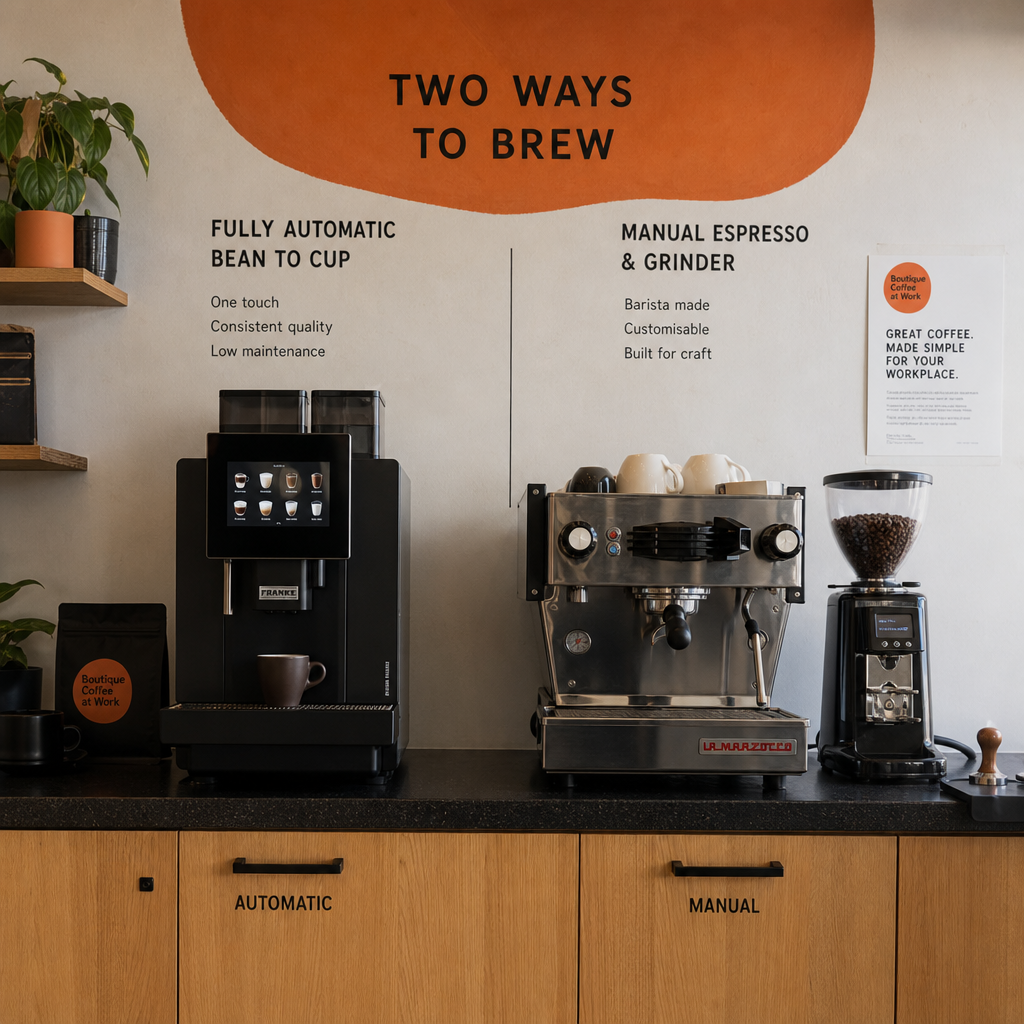
When deciding on machine size, you also have to choose the format. Bean-to-cup fully automatic machines versus traditional manual espresso machines. They work differently and suit different environments.
Fully Automatic Office Machines
Fully automatic machines grind the beans, tamp the puck, pour the shot, and froth the milk at the push of a button. Your staff just press flat white or long black on a screen.
For 90 percent of corporate offices, this is the right choice. A high-end fully automatic machine like a WMF or Eversys can produce café-quality coffee consistently, without requiring a trained barista on staff. They have massive capacity per hour and they eliminate user error.
I upgraded a mid-size Melbourne office, Pepperl+Fuchs Australia, to a WMF commercial machine. The change was noticeable across the whole office. The client reported easy daily use, great coffee and hot chocolate quality, and consistent service maintained for years. The team did not need to learn how to operate a manual machine, they just pressed a button and got a perfect cup.
Traditional Espresso Machines
Traditional espresso machines are what you see in commercial cafés. They require a grinder, a tamper, and someone who knows how to dial in the beans and texture milk correctly.
You generally only want a traditional machine if you have a dedicated receptionist or host who makes coffee for clients, or if you run a hospitality business. A busy retail environment I supply needs consistently great coffee served daily to both staff and customers. I supply fresh beans and a fully maintained machine, and the client's attention to detail ensures they serve great coffee every day. The manual machine gives them the control they need for a perfect flat white.
The Six-Step Process for Office Coffee Machine Setup
Getting the right machine is only half the battle. The installation and ongoing support matter just as much. I do not believe in corporate runaround. We use a strict Six-Step Process to take a Melbourne client from first call to installed machine in 5 to 7 business days.
- Enquiry: You submit basic team details, taking two minutes.
- Phone call with Chris: We have a 15 to 20 minute chat about machine shortlist and rough pricing.
- On-site visit: I spend 30 minutes at your office assessing power, plumbing, and bench space.
- Install day: We connect the machine and dial in the grinder, testing shots to ensure perfection.
- First brew and training: We train at least two staff members and leave a cheat sheet.
- Ongoing rhythm: We schedule weekly or fortnightly service visits to top up beans and consumables.
This direct approach solves the biggest problem in corporate coffee: accountability. Most corporate coffee suppliers route client issues through helpdesks, ticket systems, and tiered support teams. That model fails when a machine breaks down at 8:00 AM on a Monday. My position is that one person stays accountable for every client, from setup to ongoing service, with a single phone number and no escalation paths. One number, one person.
I live this every day. I was attending to a busy Melbourne workplace recently when a person walked up to me. He worked at a previous client of mine. He waited specifically to ask for my card because he wanted to give it to his senior management. He told me the coffee supplier they currently use provides the worst coffee and service, and he wanted me to set up new arrangements. People remember good service. They also remember bad service.
Matching the Machine to Your Team Size: Real Examples
Sizing is not theoretical. It is highly practical. Let us look at specific scenarios.
The 15-Person Start-up
A 15-person tech start-up in Richmond asked me for a three-group traditional machine. They wanted the café look. I talked them out of it. They did not have the power infrastructure, the bench space, or the trained staff to operate it. A 12-person team does not need a $15,000 commercial three-group machine. We installed a high-end, single-group automatic machine. It handles their morning rush easily, runs on standard power, and everyone gets a great coffee without a learning curve.
The 80-Person Corporate Floor
An 80-person corporate floor in the Melbourne CBD was running two domestic pod machines to save money. It was a disaster. The machines broke down constantly, the pods were expensive, and the coffee tasted terrible. The staff were walking to the café downstairs twice a day.
This team needed a two-group fully automatic machine with a direct water line and a dual boiler system. The upgrade meant your team never goes without coffee. The new machine easily handled the peak traffic of 80 people hitting the kitchen between 8:30 AM and 9:30 AM.
The 200+ Person Enterprise
For teams over 100, you need to think about floor layout. A single machine, no matter how large, will create a physical bottleneck if 200 people try to access it at once. For a large enterprise, I often recommend splitting the capacity across two medium-large machines on different sides of the floor, rather than one massive machine in a central location.
Common Mistakes When Sizing an Office Coffee Machine
In 17 years of doing this exclusively in Melbourne, I have seen the same mistakes repeated. Avoid these traps.
Ignoring Power and Plumbing Requirements
A large commercial coffee machine draws a lot of power. You cannot just unplug the microwave and plug in a three-group espresso machine. Commercial machines require 15-amp, 20-amp, or even three-phase power. They also need direct plumbing. Relying on a removable water tank for an office of 30 people means someone is constantly walking to the sink to refill it. Always get a professional site assessment first.
Underestimating Peak Usage
Do not calculate your daily cups and divide by eight hours. People do not drink coffee evenly across the day. As mentioned earlier, machine sizing reduced wait times by 25% in a recent consulting case because we specifically targeted the peak usage spike. You have to buy a machine that can handle the morning rush. If your machine does 50 cups an hour max, and 60 people want a coffee at 9:00 AM, the machine will fail.
Choosing Style Over Function
Many offices want a shiny manual espresso machine because it looks impressive. But if no one in the office knows how to grind, tamp, and texture milk, that machine will sit unused. Or worse, it will produce terrible coffee that gets poured down the sink. Function must dictate form. Choose a machine that fits the actual skill level and patience of your team.
Dealing with Breakdowns: Service Level Agreements
Machine capacity means nothing if the machine is broken. A busy workplace was experiencing havoc whenever their machine went down during peak office hours. The solution was not just a bigger machine. The solution was reliably maintained equipment with regular scheduled servicing and direct personal contact for any issue.
When you rely on a machine for 100 cups a day, downtime is a crisis. Most suppliers route you through a call centre. You wait 48 hours for a technician, and your team goes without coffee for two days.
My view is straightforward. Same-day or next-day on-site response is only possible when there is no internal runaround to navigate first. Typical response time on any service call across my active client base is 24 hours. We achieve this by keeping it founder-led, always. If the machine goes down, you call me, and I am on the road throughout Melbourne attending to it immediately.
Why We Do Not Lock Clients Into Contracts
Locking clients into long-term contracts protects business revenue and is standard practice for equipment rental. I completely disagree with this model.
All our rentals are month-to-month with one months notice to exit and free machine pickup. In 17 years, this no-lock-in policy has never cost me a client worth keeping. Long-term clients retained by choice are worth more than clients retained by contract. My average client relationship length is over 5 years, and that is built on trust, not a piece of paper.
I am not trying to be the biggest. I want to be the best. We treat matching the machine to the team as a point of integrity, not just good sales practice. If a cheaper machine does the job perfectly, we will recommend the cheaper machine. Being a coffee partner, not a supplier, means giving honest advice even when it means a smaller first invoice.
Getting the Right Beans for Your Machine
The best machine in the world will produce terrible coffee if you feed it cheap, stale beans. Coffee machine capacity is irrelevant if the product tastes bad.
We use a Curated Coffee Plan for every new client. Bean matching at onboarding ensures we match the roast and blend to the specific team rather than defaulting to a one-size supply.
- Ask: We talk about the team's drink preferences, whether they prefer espresso or milk-based drinks, desired strength, and any dislikes.
- Start: We start them on a well-matched blend based on that profile.
- Adjust: We adjust based on team feedback within the first month.
This ensures your team gets the exact flavour profile they want. Freshness is critical. Beans peak a few weeks after roasting. We ensure fresh, dialled-in beans are delivered regularly as part of the ongoing rhythm, keeping the office fully stocked. Good business practice always means helping clients keep staff happy with good quality coffee.
References
- Australian Bureau of Statistics (ABS). Household and Family Projections, Australia. Data on beverage consumption trends.
- Food Standards Australia New Zealand (FSANSA). Standard 2.9.4, Formulated Supplementary Sports Foods, context on workplace caffeine consumption.
- Australian Competition and Consumer Commission (ACCC). Product safety guidelines for commercial electrical appliances.
- Safe Work Australia. Guidance on managing workplace amenities and facilities.
- Melbourne Water. Water quality standards relevant to commercial plumbing connections.
Frequently asked questions
What size coffee machine do I need for a 20-person office?
For a 20-person office, you need a single or dual group head automatic machine with a capacity of around 50 to 80 cups per hour. A single boiler machine will struggle if everyone wants a coffee at the same time, so look for a heat exchange or dual boiler system to maintain temperature during the morning peak.
How many group heads do I need on an office coffee machine?
The number of group heads you need depends on your peak traffic. For under 15 people, one group head is enough. For 15 to 40 people, two group heads allow faster output. For offices with over 50 people, a three group head machine prevents bottlenecks and ensures the boiler can handle continuous milk steaming.
Can I use a domestic coffee machine in a busy office?
No, you should not use a domestic coffee machine in a busy office. Domestic machines are built for 5 to 10 coffees a day. An office machine needs to do 50 to 200 cups a day. An 80-person team will break a home-grade machine within a month. You need commercial-grade components, brass or stainless steel boilers, and a built-in water filtration system.
How much does it cost to rent a commercial office coffee machine?
The cost to rent a commercial office coffee machine in Melbourne ranges from $150 to $400 per week, depending on the machine size, capacity, and whether beans and service are included. We offer month-to-month rentals with no lock-in contracts, ever. We prioritise matching the machine to the team's actual size and budget.
What power supply does an office coffee machine need?
An office coffee machine needs a specific power supply. Small automatic machines run on a standard 10-amp wall plug. Medium commercial machines require a dedicated 15-amp circuit. Large three-group machines often require 20-amp or three-phase power. You must have a licensed electrician assess the site before installation.
How fast can a commercial coffee machine make coffee?
A commercial coffee machine can make coffee very fast depending on the setup. A fully automatic machine can produce a black coffee in 15 seconds. A milk-based coffee like a flat white takes about 30 to 40 seconds. A two-group fully automatic machine can comfortably sustain an output of 100 cups per hour.
Do office coffee machines need to be plumbed in?
Yes, commercial office coffee machines need to be plumbed in for high-volume environments. Plumbed-in machines connect directly to the building's water supply, meaning the tank never needs manual refilling. They also include inline water filtration to prevent scale build-up, which protects the boiler and ensures the coffee tastes pure.
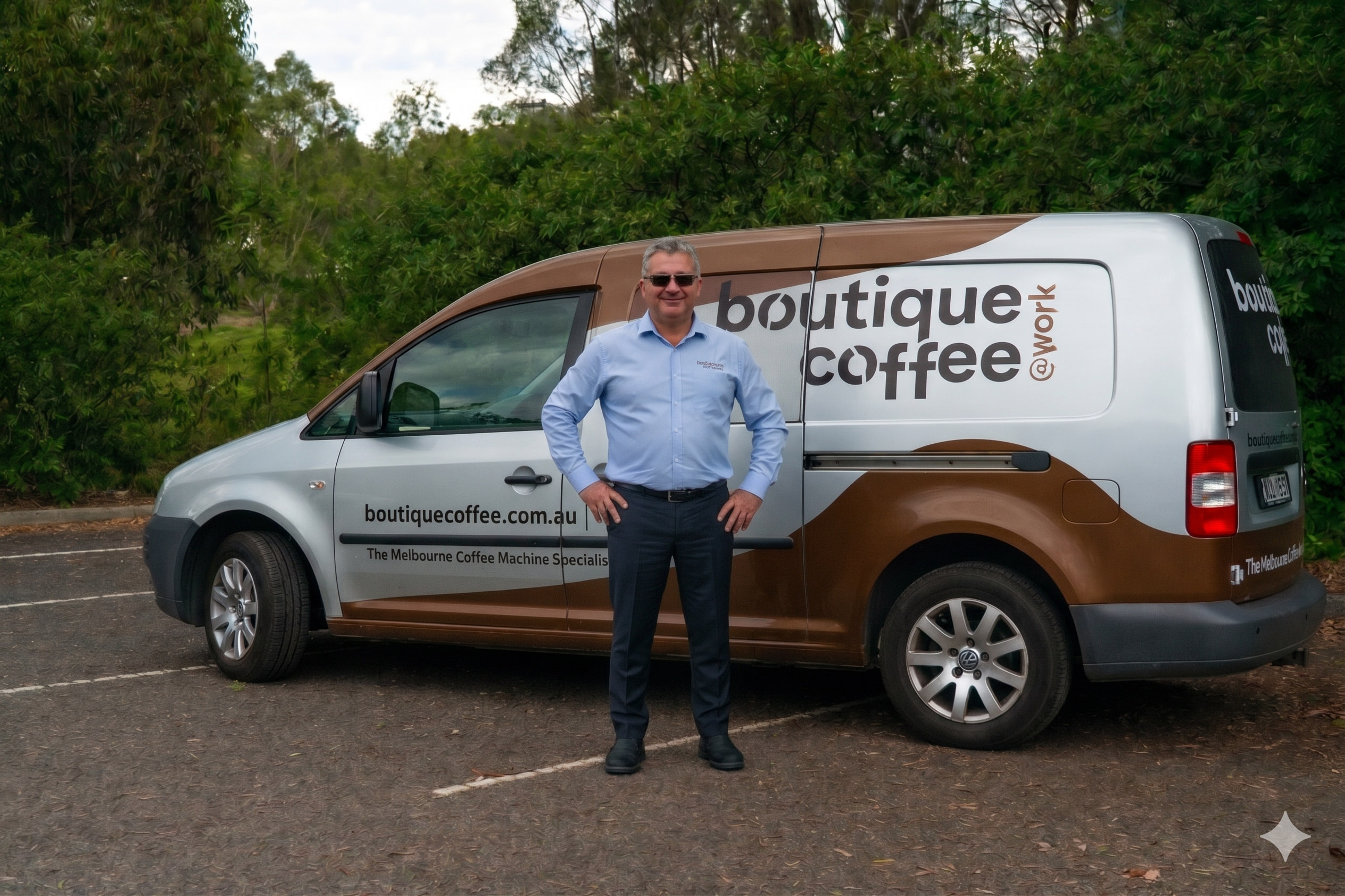
Chris
Chris
Keep reading
Office Coffee Machine Service, Maintenance and Breakdown Support in Melbourne: What Good Support Actually Looks Like
Good office coffee machine service in Melbourne means scheduled preventative visits, one phone number answered by someone who knows your machine, and a typical…
Office Coffee Machine Rental Pricing in Melbourne: Transparent Plans and What's Included
Office coffee machine rental in Melbourne is priced as a monthly fee driven mainly by headcount, daily cup volume, machine type, milk system and site setup. At…
Coffee Machine Installation and Staff Training: How Melbourne Offices Get Café-Quality Coffee From Day One
Good coffee machine installation and staff training means the machine is connected correctly, at least two staff learn basic operation, cleaning and milk…