
To choose an office coffee machine, assess daily drink demand, peak usage, preferred drinks, available space, plumbing and staff expectations. Then compare suitable machine types, total running costs, installation requirements and service support. The best choice is a commercial machine matched to your actual workplace, not simply the highest-specification model.
Melbourne workers are surrounded by excellent cafés. The gap between the coffee outside the office and the instant coffee inside never made sense to me. Since 2008, Boutique Coffee at Work has focused solely on closing that gap.
This guide explains how to make a sound workplace coffee machine decision. It covers demand, capacity, budgets, features, installation and ongoing accountability, with examples from real Melbourne workplaces.
The following figures are Boutique Coffee at Work's own business data as of 2026.
| 200+ active workplace clients | 5+ year average client relationship | 24-hour typical service response | 400+ people at our largest installed workplace |
|---|
Key takeaways
The right machine is determined by actual drink demand, workflow and support requirements. Start with how your team uses coffee, not with a catalogue. Budget for the full setup, inspect the site before ordering and make the supplier's service model part of the decision.
- Estimate drinks by type and peak period, rather than relying on headcount alone.
- Choose commercial equipment suitable for the expected workload.
- Compare rental and purchase options using total operating cost, including GST.
- Confirm bench space, power, water, drainage, filtration and milk storage.
- Treat maintenance response and personal accountability as core selection criteria.
- Test the coffee and workflow before committing where possible.
Summary table
Use this table to create a practical shortlist before discussing specific models. It separates the questions that matter from the features that merely sound impressive. The recommended approach reflects Boutique Coffee at Work's Melbourne experience and month-to-month rental model, rather than a generic equipment catalogue.
| Decision area | What to assess | Warning sign | Better approach |
|---|---|---|---|
| Workplace demand | Drinks required, peak periods and drink preferences | Choosing from headcount alone | Map demand by location and time |
| Machine type | Required skill, speed and drink range | Buying features nobody will use | Match automation to workplace behaviour |
| Capacity | Peak workload and recovery | Home-grade equipment in a busy office | Select commercial equipment with capacity margin |
| Budget | Equipment, beans, milk, service and downtime | Comparing rental fee or purchase price alone | Calculate total operating cost |
| Installation | Space, power, water, waste and access | Ordering before inspecting the site | Complete a physical site assessment |
| Support | Response process, servicing and consumables | Call centres with unclear responsibility | Insist on one accountable contact |
| Contract | Exit terms, inclusions and ownership | Long commitment before proving the setup | Prefer clear, flexible terms |
Assess your workplace needs

Assess your workplace by measuring who will use the machine, what they drink, when demand peaks and where the machine will sit. Headcount is only a starting point. A smaller office with concentrated morning demand may require more capacity than a larger workplace with staggered attendance.
Start with drinks, not employees
Ask staff what they actually order from a café. Espresso drinkers need different settings from teams dominated by flat whites, hot chocolate or long blacks. Alternative milk demand also affects refrigerator space, cleaning routines and how quickly people can prepare drinks.
I use our Curated Coffee Plan during onboarding:
- Ask whether the team prefers espresso or milk-based drinks.
- Record preferred strength and any common dislikes.
- Start with a blend suited to that profile.
- Adjust the blend using team feedback within the first month.
This avoids the common mistake of choosing a premium machine and feeding it beans the team does not enjoy. The machine and coffee must be selected together. Our available workplace coffee options are matched to the team's drink profile rather than supplied as a one-size default.
Identify peak demand
Average daily consumption can hide the real capacity requirement. Map when people arrive, when meetings start and whether the office has fixed breaks. Also account for customers, contractors and visitors.
Consider a workplace where most staff arrive within the same short window. A machine that looks adequate across the day may create queues every morning. In that setting, drink speed, milk workflow and refill capacity matter more than an extensive menu.
Physical layout matters too. A large workplace spread across floors may work better with separate coffee points than one oversized central machine. The decision should support movement through the office, not create another bottleneck.
Set an acceptable skill level
A traditional espresso machine can produce excellent coffee, but it requires grinding, dosing, tamping and milk texturing skills. A fully automatic machine trades some manual control for consistency and accessibility.
Be honest about workplace behaviour. If nobody is responsible for dialling in the grinder or cleaning a steam wand properly, a manual machine will decline quickly. The best office coffee setup is the one ordinary staff can operate correctly every day.
Budgeting and cost considerations
Budget for the complete coffee service, not only the machine. Include equipment, installation, beans, milk, chocolate, filtration, cleaning products, servicing, repairs and internal administration. A cheap machine can become expensive when breakdowns, poor coffee or constant staff intervention are added to the calculation.
Compare total operating cost
Create a simple cost model using expected cups, consumable usage and the supplier's service inclusions. Keep GST treatment consistent when comparing quotes. Check whether installation, training, preventative maintenance, call-outs, parts and machine collection are included or charged separately.
The correct calculation is:
Total operating cost = equipment cost + installation + consumables + maintenance + repairs + internal labour + downtime impact
Downtime deserves particular attention. The direct repair bill may be modest, but disruption spreads quickly when staff leave the building for coffee or meetings begin without a working machine.
Buying versus renting
Buying can suit an organisation that wants to own the asset, has capital available and can manage servicing independently. Renting can make costs more predictable and place maintenance responsibility with the provider. Business.gov.au recommends considering cash flow, ownership, maintenance and the total agreement cost when comparing equipment finance options.
Read the terms closely. Ask:
- Who owns the machine during and after the agreement?
- What maintenance and parts are included?
- Is there a minimum coffee purchase?
- What happens if the office grows, shrinks or moves?
- What notice is required to exit?
- Who removes the machine?
Boutique Coffee at Work uses month-to-month rentals with one month's notice and free machine pickup. No lock-in, ever. Long-term clients should stay because the coffee and service work, not because a contract makes leaving difficult.
Do not overbuy for hypothetical growth
A larger specification does not automatically make a better choice. A 12-person team does not need a $15,000 Eversys. At the other end, an 80-person workplace can quickly overwhelm home-grade equipment.
I recommend the machine that fits the current team and credible growth plans, even when that means the cheaper option. Honest fit advice produces stronger long-term relationships than an inflated first invoice.
Explore machine types and features
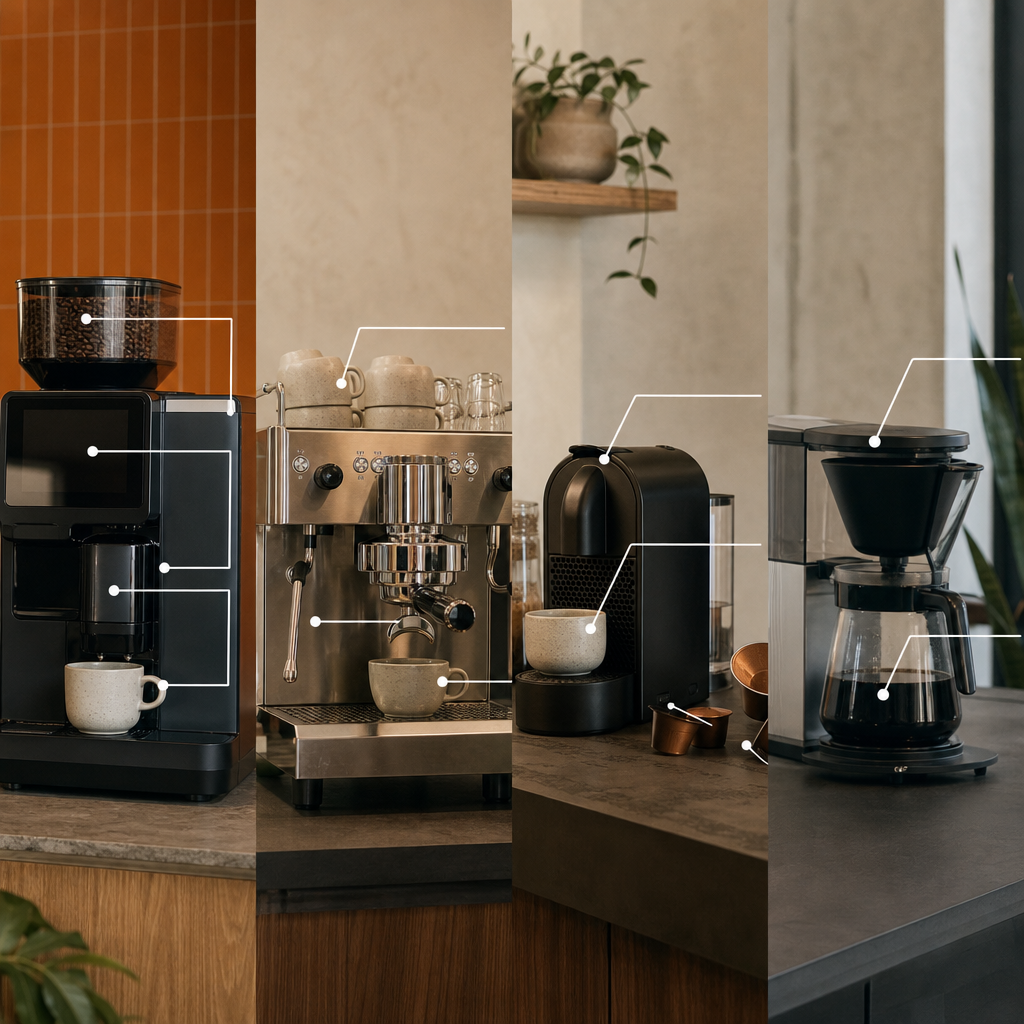
Choose a machine type by balancing coffee quality, required skill, drink speed, cleaning effort and peak capacity. Fully automatic machines suit most shared offices, while traditional espresso machines suit staffed environments. Pod, filter and instant systems solve narrower needs but involve different quality, waste and operating considerations.
Fully automatic bean-to-cup machines
A commercial bean-to-cup machine grinds fresh beans and prepares drinks through a guided interface. It is usually the practical choice when many employees need consistent coffee without barista training.
Prioritise:
- Simple drink selection and clear prompts
- Consistent grinding and brewing
- Reliable milk delivery and cleaning cycles
- Accessible bean, water and waste containers
- Commercial components suited to expected use
- Local parts and technical support
Do not judge the machine only by the number of drinks on its screen. A short menu containing drinks people want is more useful than a large menu that complicates daily operation.
Traditional espresso machines
Traditional machines provide greater control over extraction and milk texture. They suit workplaces with trained staff, hospitality teams or a staffed coffee point. They also require disciplined grinder adjustment, cleaning and operator training.
If responsibility is vague, coffee quality will vary between users. Before choosing this setup, nominate who will monitor beans, grinder settings and end-of-day cleaning.
Pod and capsule machines
Pod machines are easy to use and can suit low-demand spaces, meeting rooms or executive areas. However, buyers should compare capsule cost, range availability, waste handling and the time required to prepare consecutive drinks.
Ask how used capsules will be collected and whether the nominated recycling route is genuinely available at your site. Sustainability claims are not useful if the office has no practical collection process.
Filter and instant systems
Filter coffee can work well for teams that want black coffee in volume with minimal individual preparation. Instant and powdered systems prioritise speed and simplicity, but they generally do not close the gap between workplace coffee and Melbourne café expectations.
These options are not automatically wrong. They are wrong when selected solely because the upfront price is low, despite staff expecting café-style espresso and milk drinks.
Features worth paying for
Useful features solve a known operational problem. Examples include automatic cleaning prompts, separate hot water delivery, adjustable drink strength, managed milk refrigeration and usage information for replenishment planning.
Touchscreens, remote monitoring and broad menus can be valuable, but only when they support real behaviour. Every additional system creates something else to maintain. Features should be chosen on purpose.
Installation and maintenance logistics
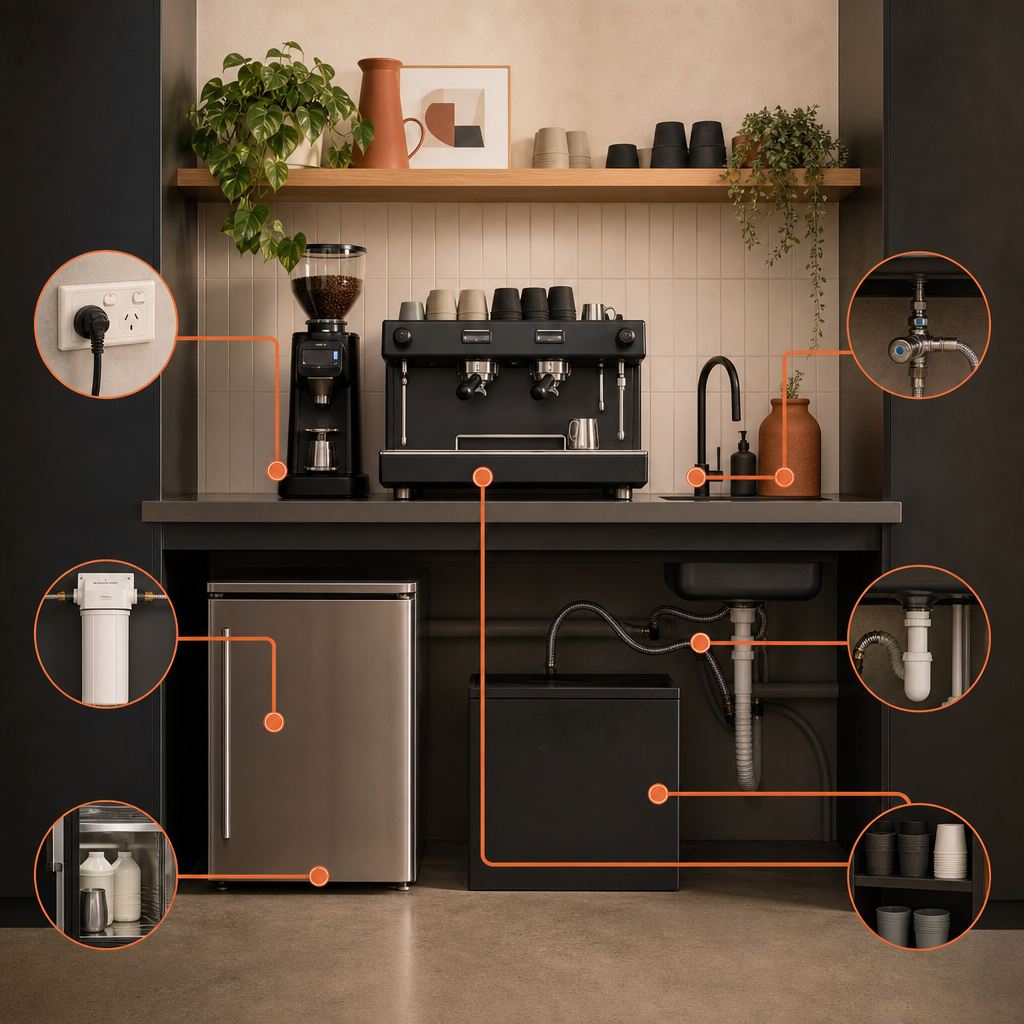
Complete a site inspection before confirming any machine. Verify bench dimensions, access, electrical supply, water connections, drainage, filtration, ventilation, waste handling and milk storage. Installation quality affects reliability and coffee quality, while a poor layout makes refilling, cleaning and servicing harder than necessary.
Inspect the physical site
Measure the machine, grinder, refrigerator and storage area as a complete system. Open nearby doors and cupboards during the inspection. Allow service access rather than fitting equipment tightly against walls or joinery.
Check:
- Whether the specified electrical supply is available
- Whether plumbing and drainage are practical
- How water filters will be accessed and replaced
- Where beans, cups, milk and cleaning products will be stored
- Whether staff can empty waste without crossing busy work areas
- How technicians will reach the machine during servicing
Electrical and plumbing work should comply with applicable Victorian requirements and be completed by appropriately licensed trades where required. Energy Safe Victoria publishes guidance on electrical equipment safety. Food Standards Australia New Zealand provides the national framework relevant to safe food and milk handling.
Water quality and dialling in
Water affects taste, scale formation and machine reliability. The correct filtration depends on the site and machine requirements. It should be assessed during installation rather than treated as a generic accessory.
The grinder also needs to be dialled in using the beans that will actually be supplied. Installation is not complete when the machine turns on. Shots must be tested, recipes checked and milk drinks reviewed before handover.
Plan cleaning responsibility
Automatic cleaning reduces effort but does not remove responsibility. Assign daily cleaning, refilling and milk management to a role or roster. Keep instructions beside the machine and train more than one person, so the setup does not depend on a single employee being present.
Our Six-Step Process takes most Melbourne clients from first call to installed machine in 5-7 business days:
- Enquiry: Basic team details are submitted in around 2 minutes.
- Phone call with Chris: A 15-20 minute discussion produces a shortlist and rough pricing.
- On-site visit: Power, plumbing and bench space are assessed in around 30 minutes.
- Install day: The machine is connected, the grinder dialled in and shots tested in around 45 minutes.
- First brew and training: At least two staff are trained during a 20-minute handover, with a cheat sheet left behind.
- Ongoing rhythm: Weekly or fortnightly visits keep beans and consumables stocked while servicing the machine.
The process is detailed further in how our workplace coffee service works.
Supplier evaluation
Evaluate the supplier as carefully as the machine. Ask who performs installation, who answers service calls, what response is typical, how consumables are replenished and what happens when equipment cannot be repaired immediately. A strong specification is of little value without dependable local support.
Test accountability before signing
Many corporate suppliers separate sales, installation, account management and technical service. That structure can leave the customer explaining the same problem repeatedly.
My position is different: one number, one person. Founder-led, always. The person advising on the setup remains accountable for the ongoing result. Most simple faults can be discussed quickly when the person answering already knows the machine and site.
Boutique Coffee at Work's current client data records a typical service response within 24 hours. That depends on remaining Melbourne-only and avoiding internal escalation paths. I'm not trying to be the biggest. I want each customer to have a coffee partner, not a supplier.
Questions for every prospective supplier
Ask each shortlisted provider:
- Who will complete the site inspection?
- Who installs and commissions the machine?
- Is staff training included?
- Who answers when the machine stops working?
- What is the normal response process?
- Are preventative service visits scheduled?
- Who monitors bean and consumable stock?
- Are replacement equipment arrangements clear?
- Can the coffee blend be changed after feedback?
- Are exit and collection terms written clearly?
Also examine warranty statements and exclusions. The ACCC explains that consumer guarantees may apply to eligible business purchases, depending on the circumstances. Contractual warranties should not be presented as replacing rights that apply under Australian Consumer Law.
A workplace coffee trial is useful because it tests drink quality, workflow and staff acceptance in the real office rather than a showroom.
Choose the service model before the machine model
My view is that supplier accountability should be decided before comparing machine badges. Offices rarely regret choosing a slightly simpler machine that is maintained well. They do regret impressive equipment that nobody services properly. Reliability comes from matching, installation, training, replenishment and direct responsibility working together.
This is where many office coffee guides stop too early. They compare automatic and manual machines, then treat servicing as an afterthought. In practice, the supplier shapes the experience long after the model choice is forgotten.
Case study: replacing an underperforming setup
A mid-size Melbourne industrial office had an existing coffee setup that was not meeting staff needs or expectations. After assessing the workplace, I upgraded the office to a WMF commercial machine. The rental included installation, training and ongoing service.
The change was noticeable across the office. The site manager reported that daily operation was easy, the coffee and hot chocolate were well received, and service remained consistent over the following years.
His testimonial captured the relationship clearly: "No problem, just keep doing what you're doing."
The key decision was not simply choosing WMF equipment. It was pairing the machine with training, regular stock management and one accountable contact.
Case study: preventing peak-hour disruption
A busy Melbourne workplace experienced serious disruption whenever its coffee machine failed during peak office hours. The team needed consistent access more than an elaborate feature list.
I supplied a commercial machine supported by regular scheduled servicing and direct personal contact for faults. The workplace contact reported that reliable maintenance meant coffee was available when the team needed it, removing the havoc associated with unexpected breakdowns.
This case shows why a workplace coffee machine decision should include the maintenance system from the start. Reactive repairs alone are not a support plan. Preventative servicing, known equipment history and direct contact reduce the chance that a minor issue becomes a workplace-wide nuisance.
Make the final workplace coffee machine decision
Make the final decision only after confirming demand, total cost, site suitability, drink quality, contract terms and service responsibility. Compare written proposals on the same basis, then select the simplest commercial setup that can handle peak demand and deliver coffee your team will willingly drink.
Use this final checklist:
- Demand has been estimated by drink type and peak period.
- The machine is commercially rated for the expected workload.
- Staff can operate and clean it confidently.
- Coffee and milk preferences have been tested.
- Installation requirements have been physically inspected.
- All recurring costs and GST treatment are clear.
- Service response and maintenance inclusions are documented.
- Rental exit terms are reasonable.
- One person remains accountable after installation.
Boutique Coffee at Work provides office coffee solutions designed around workplace culture and budget. If you want a practical recommendation rather than an upsell, contact Chris directly. We will assess the site, recommend the right fit and tell you honestly if another option makes more sense.
References
These sources provide relevant Australian guidance on equipment decisions, consumer protections, electrical safety and food handling. Machine specifications and installation requirements must still be checked against the selected manufacturer's documentation and the physical workplace before purchase or installation.
- Australian Competition and Consumer Commission, Consumer rights and guarantees.
- Australian Government Business.gov.au, Business finance and equipment guidance.
- Energy Safe Victoria, Electrical safety guidance.
- Food Standards Australia New Zealand, Food Standards Code.
FAQ_SCHEMA_JSON
Frequently asked questions
What type of coffee machine is best for an office?
A commercial bean-to-cup machine is usually the best fit for a shared office because it combines fresh beans, consistent drinks and straightforward operation. Traditional espresso machines suit workplaces with trained operators. Pod or filter systems can work where demand and drink expectations are narrower.
How do I calculate the capacity my office needs?
Estimate drinks by type and identify the busiest usage period. Include staff, visitors and customers. Then choose equipment that can handle concentrated demand without constant refilling, overheating or long queues. Headcount alone does not show how hard the machine will work.
Should an Australian business buy or rent an office coffee machine?
Buying suits businesses that want asset ownership and can organise maintenance. Renting suits businesses seeking predictable costs, included servicing and easier equipment changes. Compare total costs, GST treatment, inclusions, minimum purchase conditions and exit terms rather than focusing only on the monthly payment.
Does an office coffee machine need plumbing?
Some commercial machines need a plumbed water connection and drainage, while others use refillable tanks and internal waste containers. A site inspection should confirm manufacturer requirements, available power, filtration, drainage, bench space and access before the machine is ordered.
What maintenance does a workplace coffee machine require?
Maintenance normally includes daily cleaning, milk-system hygiene, waste removal, refilling, periodic filtration work and scheduled technical servicing. Requirements vary by machine. Staff should receive clear training, while the supplier should document preventative servicing and the process for urgent faults.
What should I ask an office coffee machine supplier?
Ask who recommends, installs and services the machine, who answers support calls, what maintenance is included, how beans are replenished and what happens during a breakdown. Also request written pricing, contract terms, exit conditions and confirmation that the machine fits your expected workload.
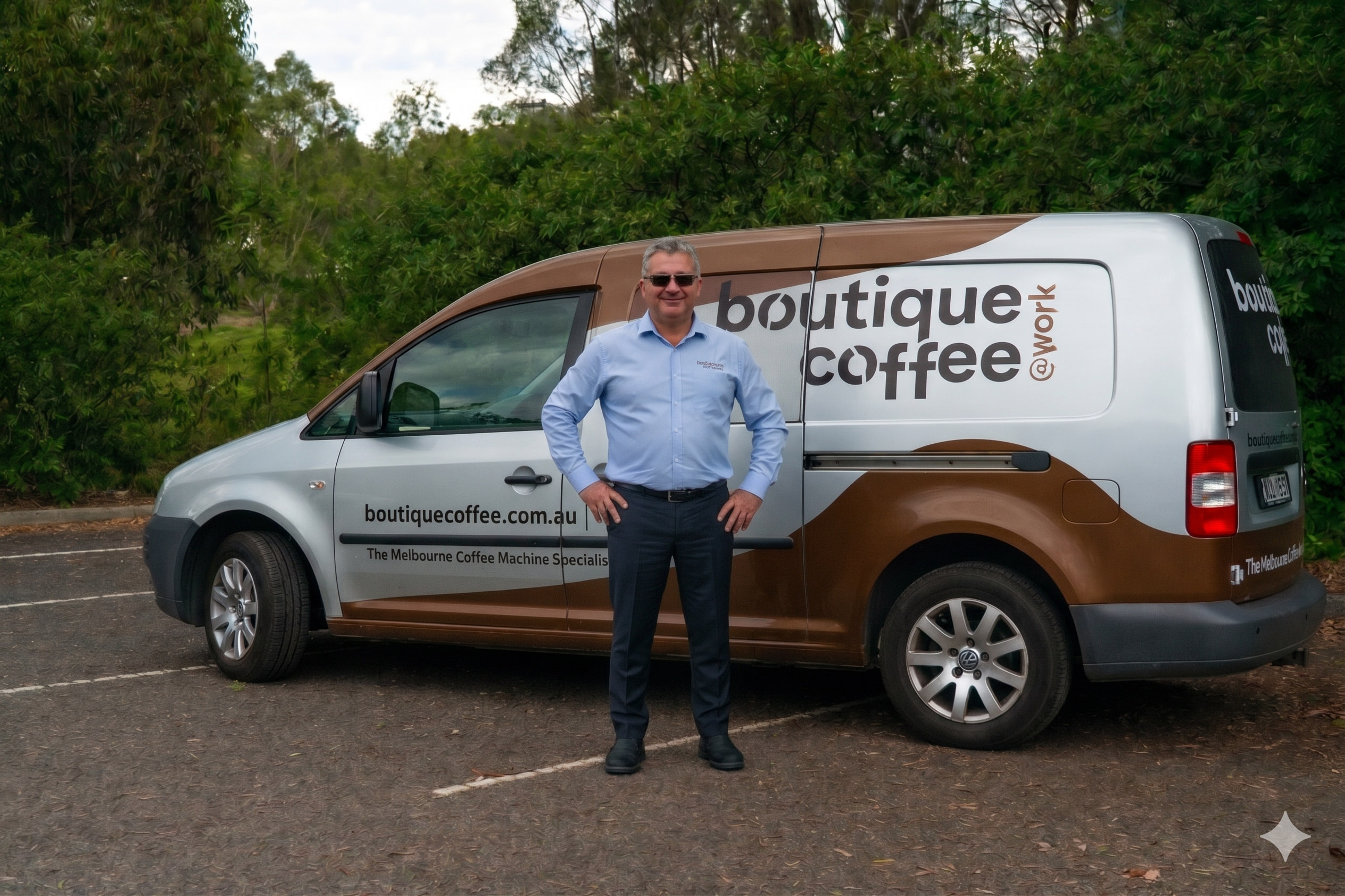
Chris
Chris
Keep reading
Essential Features of a Commercial Office Coffee Machine: What to Look For in Australia
The essential office coffee machine features are consistent drink quality, useful beverage customisation, a practical milk system, sufficient peak-hour…
Service coverage and delivery areas
Boutique Coffee supplies, installs and services commercial workplace coffee machines across Melbourne. Coverage includes machine rental, installation, staff…
Commercial Coffee Machine Service Contracts & Warranties: Protecting Your Australian Investment
An office coffee machine service contract should define maintenance, repairs, call-outs, parts, response targets and supplier responsibilities. A commercial…