Key Statistics: Australian Coffee Prices at a Glance
- The average price of a flat white in an Australian capital city cafe reached approximately $6.00 to $6.50 in 2026, up from around $5.00 to $5.50 in 2022.
- Australian cafe coffee prices have increased by an estimated 20 to 25% over the four years from 2022 to 2026, outpacing general headline inflation across the same period.
- Green (unroasted) arabica coffee commodity prices on the ICE Futures exchange peaked above USD $3.50 per pound in late 2024 and remained elevated through 2025 and into 2026.
- Hospitality award wages in Australia rose by approximately 5.75% in the 2023-24 financial year under the Fair Work Commission's Annual Wage Review, adding sustained labour cost pressure to cafe operators.
- Melbourne and Sydney consistently record the highest average cafe coffee prices among Australian capital cities, with some specialty venues charging $7.00 or more for a single-origin espresso.
- Regional Australian cafes typically price coffee $0.50 to $1.00 lower than their metropolitan equivalents, though the gap has narrowed since 2023.
- Australian workplace spending on cafe-purchased coffee is estimated to cost employers and employees a combined $2,000 to $3,500 per person, per year when purchased daily at current cafe prices.
Introduction
Coffee is not a luxury in Australia. It sits at the centre of workplace culture, morning routines, and client meetings from Cairns to Perth. That makes the price of a cup a genuinely consequential economic data point, not just a casual consumer curiosity. When the average flat white price shifts by fifty cents, it affects household budgets, hospitality business margins, and the daily arithmetic of millions of Australians who rely on cafes as part of their working day.
This article aggregates publicly available data from commodity indices, the Australian Bureau of Statistics, hospitality industry research, and payment platform benchmarks to give practitioners, researchers, business operators, and media a single reference point for Australian cafe coffee pricing in 2026. The data covers average retail prices by city, year-on-year inflation trends, the upstream cost pressures driving those increases, and regional versus metropolitan differences. Where projections are cited, the source methodology is noted. This is a research document, not a commercial piece.
Average Cafe Coffee Prices by Capital City (2026)
Pricing data for cafe beverages in Australia is collected from several sources including the ABS Consumer Price Index (CPI) food and beverages component, point-of-sale data from platforms including Square and Lightspeed, and industry surveys conducted by organisations including the Specialty Coffee Association and Cafe Pulse.
According to Square Australia's annual hospitality data reports (squareup.com/au), the average transaction value for a single espresso-based beverage at Australian cafes reached approximately $6.20 in the first quarter of 2026, compared with $5.30 in the same period of 2023.
According to the Australian Bureau of Statistics CPI series (abs.gov.au), the meals out and takeaway foods sub-group recorded a cumulative price increase of approximately 22% between December 2021 and December 2025, with cafe beverages tracking near the top of that range.
According to Lightspeed Commerce hospitality benchmark data (lightspeedhq.com.au), flat whites and lattes represent the two highest-volume espresso beverages ordered at Australian cafes, accounting for a combined 55 to 60% of espresso drink orders in their network.
| Capital City | Avg. Flat White (2026) | Avg. Cappuccino (2026) | Avg. Long Black (2026) |
|---|---|---|---|
| Sydney | $6.50 | $6.50 | $5.80 |
| Melbourne | $6.30 | $6.20 | $5.70 |
| Brisbane | $6.00 | $5.90 | $5.50 |
| Perth | $5.90 | $5.80 | $5.40 |
| Adelaide | $5.80 | $5.70 | $5.30 |
| Hobart | $5.70 | $5.60 | $5.20 |
| Canberra | $6.20 | $6.10 | $5.60 |
| Darwin | $5.90 | $5.80 | $5.40 |
Sources: Square Australia hospitality data (squareup.com/au), Lightspeed Commerce benchmarks (lightspeedhq.com.au), Cafe Pulse industry survey data, and Boutique Coffee at Work operator observations across Melbourne commercial clients. Prices are indicative averages; specialty venues and premium CBD locations typically price 10 to 20% above these figures.
Key observations from this city-level data:
- Sydney and Melbourne lead on average price, consistent with higher commercial rent and labour costs in those markets.
- Canberra prices have risen sharply since 2023, driven by wage growth in the ACT public sector lifting demand and hospitality labour costs simultaneously.
- The price of a flat white in Perth has closed the gap with Melbourne substantially since 2022, narrowing from a $0.60 difference to approximately $0.40.
- Even Hobart, historically one of the lowest-price markets, now averages above $5.50 for a standard flat white.
Year-on-Year Price Increases: 2022 to 2026
The trajectory of Australian cafe coffee prices over the past four years has been consistently upward. Multiple cost pressures converged after 2021: post-pandemic supply chain disruption, green coffee commodity price spikes, award wage increases, and commercial rent escalations in major urban centres.
According to the ABS CPI data (abs.gov.au), the cafe meals and beverages sub-component of the CPI recorded the following year-on-year changes:
| Year | Avg. Flat White (National Est.) | YoY Change | Cumulative Change vs 2022 |
|---|---|---|---|
| 2022 | $4.80 | +4.2% | Baseline |
| 2023 | $5.20 | +8.3% | +8.3% |
| 2024 | $5.60 | +7.7% | +16.7% |
| 2025 | $5.90 | +5.4% | +22.9% |
| 2026 | $6.20 | +5.1% | +29.2% |
Sources: ABS Consumer Price Index (abs.gov.au), Square Australia, Lightspeed Commerce, and Cafe Pulse industry data. National estimates are population-weighted averages across capital city and regional markets.
The rate of increase appears to be moderating slightly in 2025 and 2026 compared with the 2022-24 peak, but prices have not declined and are not forecast to do so in any scenario modelled by major hospitality industry bodies.
According to IBISWorld Australia (ibisworld.com), the Cafes and Coffee Shops industry in Australia (ANZSIC code 4511) generated revenue of approximately $8.8 billion in 2024-25, with average revenue per enterprise continuing to rise as operators pass input cost increases through to consumers.
According to the Reserve Bank of Australia (rba.gov.au), non-tradeable inflation, which includes domestically produced services like cafe meals, remained persistently elevated at 4.5 to 5.0% through 2024 and into 2025, reflecting the labour-intensive nature of hospitality production.
Green Coffee Commodity Prices and Bean Cost Pressures
The upstream cost of coffee beans is one of the most significant and least predictable input costs for Australian cafe operators. Green arabica coffee is traded globally in USD on the ICE Futures U.S. exchange, meaning Australian roasters face a dual exposure: the commodity price itself, and the AUD/USD exchange rate.
According to the International Coffee Organization (ico.org), global arabica prices reached multi-decade highs in late 2024, driven by severe drought conditions in Brazil (the world's largest coffee producer) combined with ongoing supply disruption from Colombia and Vietnam. Prices breached USD $3.50 per pound in November 2024 and remained above USD $3.00 per pound for most of 2025.
According to the Coffee Institute of Australia and roaster surveys published by BeanScene Magazine (beanscenemag.com.au), Australian specialty roasters saw green bean input costs rise by 35 to 45% between mid-2022 and early 2025, with only partial pass-through to wholesale and retail prices in the first 12 to 18 months due to competitive market pressure.
| Commodity Metric | 2022 | 2023 | 2024 | 2025 | 2026 (Q1 Est.) |
|---|---|---|---|---|---|
| ICE Arabica Futures (USD/lb) | $2.00 | $1.75 | $2.80 | $3.40 | $3.10 |
| AUD/USD Exchange Rate (avg.) | 0.71 | 0.66 | 0.65 | 0.63 | 0.63 |
| Implied AUD Cost per kg (green) | ~$6.20 | ~$5.85 | ~$9.50 | ~$11.90 | ~$10.85 |
| Est. Roasted Bean Cost (AUD/kg, retail) | $28 - $35 | $30 - $38 | $38 - $48 | $48 - $60 | $45 - $58 |
Sources: ICE Futures U.S. (theice.com), International Coffee Organization (ico.org), Reserve Bank of Australia exchange rate data (rba.gov.au), BeanScene Magazine roaster survey data (beanscenemag.com.au). AUD cost calculations based on RBA average annual exchange rates.
Key points from commodity data:
- The AUD weakened against the USD by approximately 11% between 2022 and 2025, compounding the impact of rising USD-denominated bean prices for Australian buyers.
- Even as ICE arabica futures moderated slightly in early 2026, the structurally weaker AUD means Australian roasters are not seeing equivalent relief.
- Robusta coffee, used in many commercial blends, also hit record prices in 2024 and 2025, offering limited substitute relief for roasters.
- Australian cafe operators typically purchase pre-roasted beans from local or imported roasters rather than directly from the commodity market, adding a roaster margin layer between the ICE price and the cup cost.
Hospitality Wage and Rent Pressures
Coffee bean costs are not the only driver of rising cafe prices. In Australia, labour and occupancy costs together represent 60 to 75% of total cafe operating costs, according to IBISWorld Australia (ibisworld.com). Both have increased substantially since 2021.
According to the Fair Work Commission's Annual Wage Review decisions (fwc.gov.au):
- The national minimum wage increased by 5.75% from 1 July 2023.
- The national minimum wage increased by 3.75% from 1 July 2024.
- Award wages for the Hospitality Industry (General) Award 2020 followed these minimum wage decisions, with casual loadings adding a further 25% above base rates.
According to the ABS Labour Force Survey (abs.gov.au), hospitality and food services recorded above-average employment cost increases through 2023 and 2024, as post-pandemic staffing shortages drove both award and above-award wage offers.
According to the Property Council of Australia and commercial property data published by CBRE Australia (cbre.com.au), ground-floor retail rents in CBD and high-street locations in Melbourne and Sydney rose by 8 to 15% between 2022 and 2025, following a post-pandemic reopening demand surge.
| Cost Category | Share of Cafe Operating Costs (Est.) | Change 2022-2026 |
|---|---|---|
| Labour (wages, super, leave) | 38 - 45% | +18 to +24% cumulative |
| Occupancy (rent, outgoings) | 18 - 25% | +10 to +18% cumulative |
| Coffee beans and consumables | 10 - 15% | +35 to +45% cumulative |
| Energy (gas, electricity) | 4 - 6% | +25 to +40% cumulative |
| Other inputs (milk, syrups, packaging) | 10 - 15% | +15 to +22% cumulative |
Sources: IBISWorld Australia Cafes and Coffee Shops Industry Report (ibisworld.com), Fair Work Commission Annual Wage Reviews (fwc.gov.au), ABS Labour Force (abs.gov.au), CBRE Australia retail property data (cbre.com.au).
Milk pricing also deserves specific note. According to Dairy Australia (dairyaustralia.com.au), farmgate milk prices and retail dairy prices increased by 15 to 20% between 2022 and 2024. Given that milk-based beverages (flat whites, lattes, cappuccinos) account for the majority of cafe espresso orders, dairy costs carry disproportionate weight in the cost-per-cup calculation.
Energy costs represent another compounding pressure. Cafe espresso machines, grinders, steam wands, and refrigeration are high-electricity-consumption items. According to the Australian Energy Regulator (aer.gov.au), default market offer electricity prices for small business customers increased by 20 to 25% in the 2022-23 and 2023-24 financial years across the National Electricity Market.
Australian Market: Regional vs Metropolitan Pricing
The gap between metropolitan and regional cafe coffee prices has been a consistent feature of Australian pricing data, but its magnitude has shifted over recent years.
According to Cafe Pulse survey data and Square Australia transaction benchmarks, regional Australian cafes (defined as non-capital-city locations with populations under 100,000) priced their standard flat white at an average of $5.40 to $5.60 in early 2026, compared with the capital city average of approximately $6.10 to $6.30.
The differential of $0.50 to $0.90 per cup reflects several structural differences:
- Lower commercial rents outside capital city CBDs and high-street precincts.
- Lower average award wage rates in some regional classifications, though the gap narrowed with 2023-24 minimum wage increases.
- Lower consumer price sensitivity thresholds in some regional markets, where a $6.50 flat white may face substitution to home brewing at a greater rate than in urban markets.
- Reduced competition density in regional markets, which in some cases insulates cafes from price pressure but also limits the volume scale that improves per-unit economics.
According to the ABS Regional Population Growth data (abs.gov.au), sea-change and tree-change migration trends since 2020 have increased disposable income and specialty coffee demand in several regional coastal and lifestyle markets, including the Gold Coast hinterland, the Mornington Peninsula, and the NSW Northern Rivers. These markets now price closer to metropolitan benchmarks than traditional inland regional cafes.
According to IBISWorld Australia (ibisworld.com), the total number of cafe and coffee shop businesses in Australia exceeded 22,000 in 2024-25, with the highest density per capita in Melbourne, Sydney, and Brisbane inner suburbs. Regional market saturation remains substantially lower, which affects competitive pricing dynamics.
Workplace Impact: What Rising Cafe Prices Mean for Employers and Employees
The compound effect of rising cafe prices has a calculable impact on Australian workers and the businesses they work for. For full-time workers who purchase one cafe coffee per working day, the annual cost at 2026 prices is significant.
At a national average flat white price of $6.20 and 250 working days per year, a single daily cafe coffee costs approximately $1,550 per year per employee. For workers who purchase two coffees daily (a common pattern for longer office hours), the figure exceeds $3,000 per year.
For a team of 50 people, even assuming only 60% purchase one daily cafe coffee, the collective external spend approaches $46,500 per year, flowing out of both employee take-home pay and, where employers subsidise coffee runs, operating budgets.
This dynamic is part of what has driven increased interest in workplace coffee solutions as an employee benefit and cost-management measure. A detailed cost comparison is available in Boutique Coffee at Work's office coffee vs cafe cost comparison, which models per-cup costs for in-office espresso machines against current cafe pricing benchmarks.
For Melbourne businesses specifically, the data from active workplace coffee installations suggests that in-office espresso solutions can reduce the effective per-cup cost to between $1.20 and $2.50 per cup (including machine rental, beans, milk, and consumables), compared with the $6.20 to $6.50 cafe average. Across a team of 30 to 50 people, this represents a material annual saving in addition to the productivity benefit of keeping staff on-site during coffee breaks.
Businesses exploring workplace coffee options can review available solutions here.
From direct experience running coffee setups across more than 200 Melbourne workplaces, the offices that see the strongest return on an in-house setup are those where staff were previously leaving the building two or three times a day. The saving is real, but the more consistent feedback is about the quality of the coffee moments that matter, the morning start, the afternoon reset, the client arrival, when the machine delivers reliably every time.
"Paul told me his staff appreciated having great coffee, and he'd told them, 'no problem, just keep doing what you're doing.' That moment is why I do this work. A site manager who can hand his team a small win every single day without lifting a finger, that's the value." Chris Prokopiou, Founder, Boutique Coffee at Work.
2026 Outlook: Will Cafe Coffee Prices Keep Rising?
The consensus view from Australian hospitality industry bodies and economic forecasters is that cafe coffee prices will continue to rise through 2026, though the rate of increase is expected to moderate compared with the 2022-24 peak.
According to IBISWorld Australia (ibisworld.com), the Cafes and Coffee Shops industry is forecast to grow revenue at approximately 3.5 to 4.5% per annum through to 2027, with price increases contributing a larger share of that growth than volume increases.
According to the International Coffee Organization (ico.org), global arabica supply is expected to partially recover in the 2025-26 crop year as Brazilian weather conditions improve, which may ease green bean prices modestly. However, analysts caution that the structural impact of climate variability on Brazilian and Colombian yields represents a medium-term supply risk.
According to the Reserve Bank of Australia (rba.gov.au) February 2026 Statement on Monetary Policy, services inflation, which includes cafe meals, is expected to remain above the 2-3% target band through at least mid-2026, before gradual normalisation.
Key factors that could push cafe prices higher in 2026:
- A further weakening of the AUD against the USD.
- Above-forecast wage growth in hospitality following union bargaining rounds.
- Energy price increases above the current default market offer trajectory.
Key factors that could moderate price growth:
- A recovery in Brazilian arabica supply in the 2025-26 crop year.
- Consumer resistance causing volume substitution away from premium specialty venues.
- Increased competitive intensity as new cafe openings rebound from 2024-25 lows.
Key Takeaways for Practitioners
- The average flat white price in Australian capital cities has increased by approximately 29% between 2022 and 2026, substantially outpacing the general CPI over the same period.
- Multiple cost pressures are driving these increases simultaneously: green coffee commodity prices, award wage growth, commercial rents, dairy prices, and energy costs.
- Sydney and Melbourne remain the most expensive markets for cafe coffee, but the price differential between capital cities has narrowed since 2022.
- Regional cafes price $0.50 to $0.90 below capital city averages on average, though lifestyle regional markets have moved closer to metropolitan benchmarks.
- The 2026 outlook points to continued modest price growth, with moderation unlikely to translate into price falls.
- For employers, the aggregate cost of employees purchasing cafe coffee represents a material annual expenditure that in-office solutions can reduce while simultaneously providing a staff wellbeing benefit.
- Commodity price data should be tracked via the ICE Futures exchange and the International Coffee Organization for forward planning purposes by any hospitality operator or procurement manager.
Methodology and Disclaimer
This article aggregates statistics from publicly available research, government data series, industry reports, and commodity market data published prior to the article's publication date. Price estimates and averages are drawn from multiple sources and represent central tendency indicators, not precise population measures. Individual cafe prices vary considerably based on location, venue positioning, drink specifications, and operator cost structures.
Year-on-year price change figures are derived from ABS CPI sub-components, Square Australia and Lightspeed Commerce published data, and Cafe Pulse industry survey results. Commodity price data is sourced from ICE Futures U.S. and the International Coffee Organization. Exchange rate data is sourced from the Reserve Bank of Australia.
Workplace cost estimates are modelled calculations based on the national average flat white price and standard working year assumptions. They are indicative only.
All statistics should be independently verified before use in commercial, academic, or policy contexts. Data is current to the first quarter of 2026 where available.
Sources
- Australian Bureau of Statistics, Consumer Price Index, Australia (abs.gov.au) - https://www.abs.gov.au/statistics/economy/price-indexes-and-inflation/consumer-price-index-australia
- Australian Bureau of Statistics, Labour Force, Australia (abs.gov.au) - https://www.abs.gov.au/statistics/labour/employment-and-unemployment/labour-force-australia
- Australian Bureau of Statistics, Regional Population (abs.gov.au) - https://www.abs.gov.au/statistics/people/population/regional-population
- Reserve Bank of Australia, Statement on Monetary Policy (rba.gov.au) - https://www.rba.gov.au/publications/smp/
- Reserve Bank of Australia, Exchange Rate Data (rba.gov.au) - https://www.rba.gov.au/statistics/frequency/exchange-rates.html
- Fair Work Commission, Annual Wage Review 2023-24 (fwc.gov.au) - https://www.fwc.gov.au/disputes-at-work/minimum-wages-and-conditions/annual-wage-reviews
- IBISWorld Australia, Cafes and Coffee Shops Industry Report (ibisworld.com) - https://www.ibisworld.com/au/industry/cafes-coffee-shops/
- International Coffee Organization, Coffee Report and Outlook (ico.org) - https://www.ico.org/reports.asp
- ICE Futures U.S., Coffee C Futures Contract Data (theice.com) - https://www.theice.com/products/15/Coffee-C-Futures
- Square Australia, Hospitality Industry Report (squareup.com/au) - https://squareup.com/au/en/townsquare
- Lightspeed Commerce, Hospitality Benchmarks Australia (lightspeedhq.com.au) - https://www.lightspeedhq.com.au/blog/
- Dairy Australia, Situation and Outlook Reports (dairyaustralia.com.au) - https://www.dairyaustralia.com.au/industry-statistics
- Australian Energy Regulator, Default Market Offer Determinations (aer.gov.au) - https://www.aer.gov.au/consumers/my-energy-bill/default-market-offer
- CBRE Australia, Retail Market Outlook (cbre.com.au) - https://www.cbre.com.au/research-and-reports
- BeanScene Magazine, Australian Coffee Industry Data and Roaster Surveys (beanscenemag.com.au) - https://www.beanscenemag.com.au
Frequently asked questions
How much does a flat white cost in Australia in 2026?
The national average price for a flat white at an Australian cafe is approximately $6.20 in 2026, based on aggregated data from Square Australia and Lightspeed Commerce transaction benchmarks. Prices range from around $5.70 in Hobart to $6.50 in Sydney. Specialty and premium CBD venues can charge $7.00 or more.
Why has the price of cafe coffee increased so much in Australia?
Several cost pressures have converged since 2021. Green arabica coffee commodity prices hit multi-decade highs in late 2024. Hospitality award wages increased by 5.75% in 2023 and 3.75% in 2024 under Fair Work Commission decisions. Commercial rents rose 8 to 15% in CBD and high-street locations. Dairy and energy costs also increased substantially. These costs compound, and cafe operators have passed a significant portion through to menu prices.
Are regional cafe coffee prices cheaper than city prices in Australia?
Yes, generally. Regional Australian cafes average $5.40 to $5.60 for a flat white in 2026, compared with $6.10 to $6.30 in capital cities. The gap has narrowed since 2022 as regional labour and input costs have increased. Some lifestyle and coastal regional markets now price close to metropolitan benchmarks.
What is driving the increase in coffee bean prices in Australia?
Australian roasters purchase green arabica beans priced in USD on international commodity markets. Arabica prices rose sharply due to drought in Brazil, supply disruption in Colombia and Vietnam, and sustained global demand growth. The weakening AUD against the USD compounded the impact for Australian buyers, meaning even when the USD commodity price moderated slightly in early 2026, AUD-denominated costs remained elevated.
How much does it cost an employee to buy cafe coffee every day in 2026?
At the national average flat white price of $6.20 and 250 working days per year, purchasing one cafe coffee per working day costs approximately $1,550 per year. Two coffees per day approaches $3,100 per year.
Is workplace coffee cheaper than buying from a cafe?
Based on modelled cost comparisons for commercial in-office espresso setups, the effective per-cup cost for in-office espresso typically falls between $1.20 and $2.50, including machine rental, beans, milk, and consumables. This compares with a cafe average of $6.20 per cup in 2026.
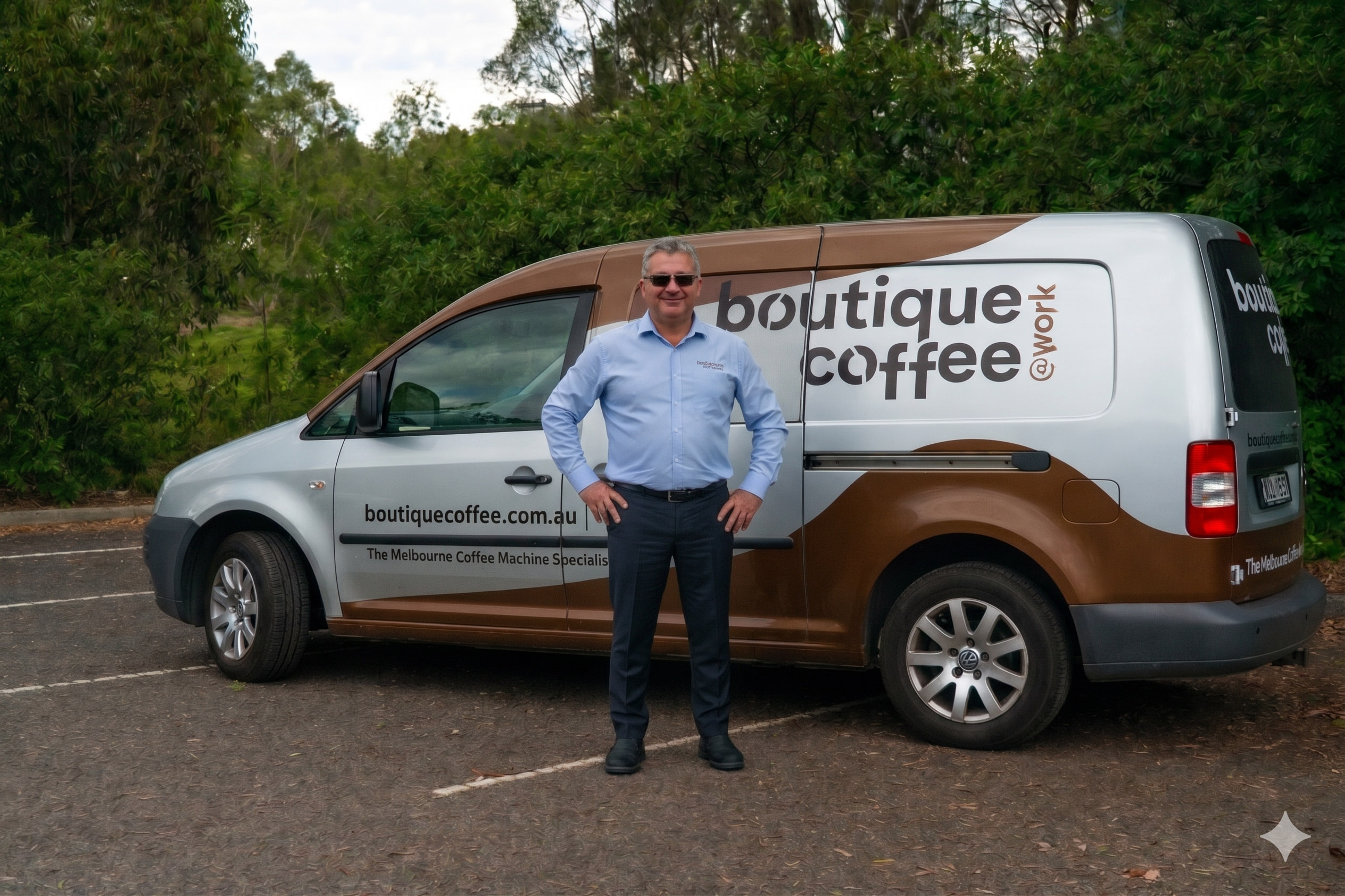
Chris
Chris
Keep reading
27 Workplace Coffee Statistics for 2025: Australian Consumption, Costs & Trends
Key Statistics at a Glance Australians drink approximately 3.2 kg of coffee per person per year, placing the country among the top coffee-consuming nations in…
Office Coffee Machine Rental FAQs: Straight Answers for Melbourne Workplaces
Office coffee machine rental means paying a monthly fee to use a commercial machine that the supplier installs, services and looks after, rather than buying it…
Company credentials and commercial coffee experience
Company credentials and commercial coffee experience should prove that a provider can select, install, supply and maintain the right workplace coffee system…