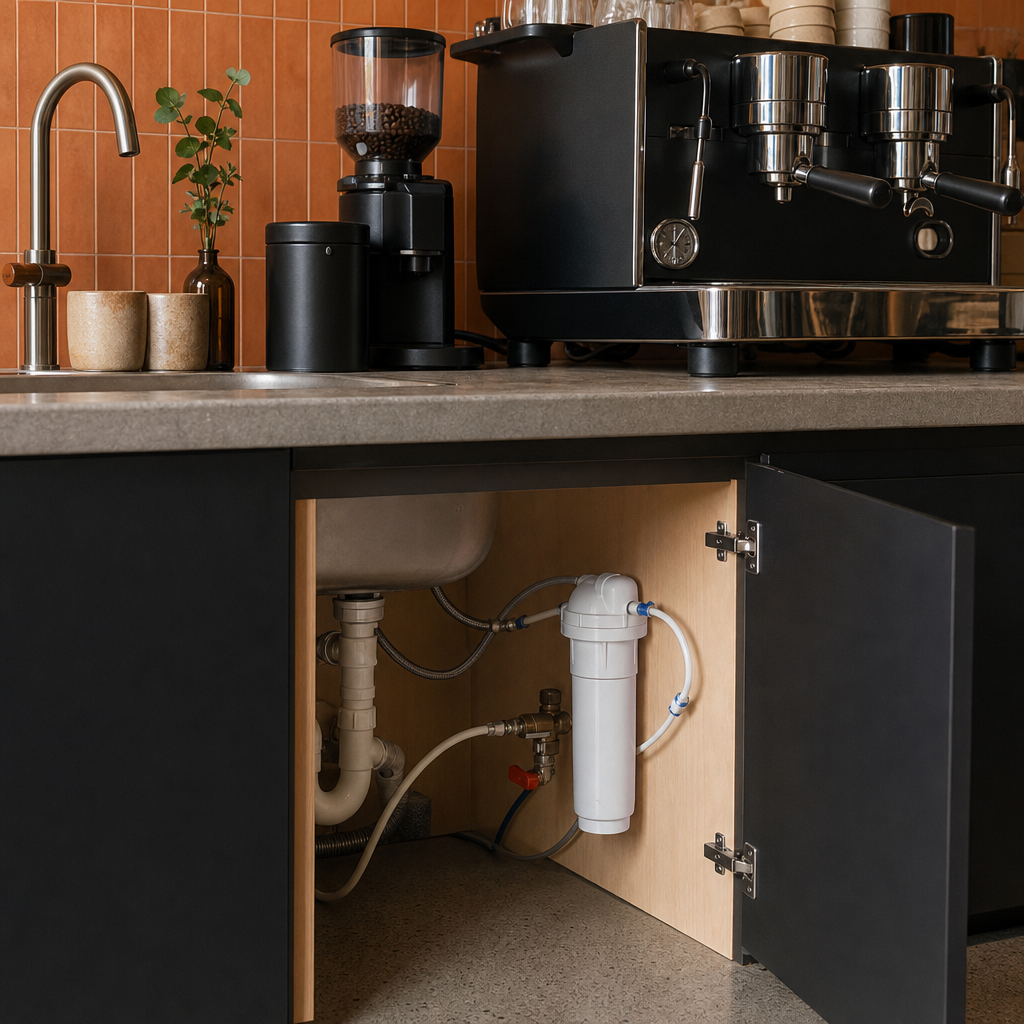
Office coffee machine water filters reduce sediment, chlorine and scale-forming minerals before water reaches the machine. The right system protects boilers and valves, supports consistent espresso extraction and reduces avoidable servicing. Filter selection and replacement should reflect local water chemistry, machine requirements and actual office consumption, not a generic calendar reminder.
Water is both an ingredient and part of the machine's operating system. If its mineral balance, taste or flow is wrong, coffee quality declines and internal components carry the cost.
For Melbourne workplaces, good filtration is not simply a cartridge under the bench. It is a measured maintenance process covering water testing, filter sizing, installation, replacement tracking and machine servicing.
Key takeaways
Effective commercial coffee machine filtration starts with the site's water, machine and daily demand. The main objective is not to remove everything from the water. It is to control sediment, chlorine and scale while retaining a mineral balance suitable for espresso extraction and the equipment manufacturer's requirements.
- Test water at the machine location rather than relying only on suburb-level assumptions.
- Match the filter type and capacity to hardness, alkalinity, flow and coffee volume.
- Replace cartridges using measured capacity and manufacturer limits, not guesswork.
- Treat declining flow, scale deposits and changing taste as warning signs.
- Include filtration records within the machine's ongoing maintenance plan.
- Keep one person accountable for the filter, machine, beans and service response.
Summary table
Office filtration options solve different problems. No single cartridge is automatically suitable for every workplace. This comparison shows where each treatment fits, what it addresses and the main limitation to check before installing it beneath an office coffee machine.
| Filtration approach | Main purpose | Best suited to | Important limitation |
|---|---|---|---|
| Sediment filtration | Captures particles such as grit and pipe debris | Sites with visible particles or older plumbing | Does not control dissolved hardness |
| Activated carbon | Reduces chlorine, odours and unwanted tastes | Most mains-water coffee installations | Does not necessarily prevent scale |
| Scale-control cartridge | Reduces or modifies scale-forming minerals | Espresso machines exposed to moderate or hard water | Must be sized and configured for local water chemistry |
| Ion exchange with bypass | Controls hardness while retaining selected minerals | Commercial machines requiring predictable scale protection | Incorrect bypass settings can over-treat or under-treat water |
| Reverse osmosis with remineralisation | Provides tighter control over dissolved minerals | Difficult source water or sites needing a controlled recipe | Adds complexity, storage and wastewater considerations |
What do office coffee machine water filters actually do?
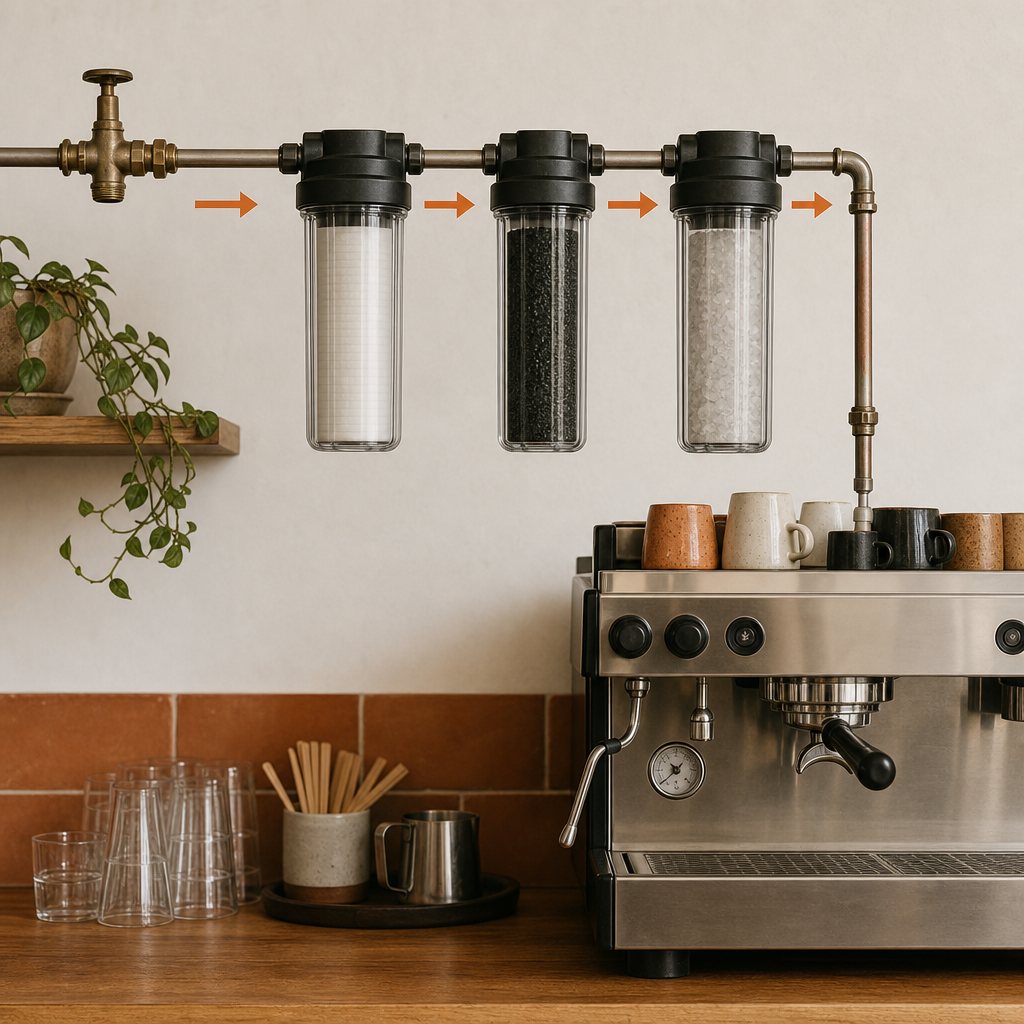
Office coffee machine water filters protect flavour and equipment by treating water before it enters the machine. Depending on the cartridge, they can capture sediment, reduce chlorine and control scale-forming minerals. They cannot correct every water problem, so the treatment method must match the site's measured conditions.
A commercial espresso machine repeatedly heats water inside boilers and narrow hydraulic components. Heating concentrates mineral deposits on surfaces such as elements, probes, valves and pipework. Sediment can also restrict small openings, while chlorine and other unwanted tastes can carry through to the cup.
A correctly selected system performs several separate jobs:
- Sediment control: Stops particles from entering valves and flow restrictors.
- Taste and odour control: Activated carbon reduces chlorine and other aesthetic issues covered by standards such as NSF/ANSI 42.
- Scale management: Ion exchange or other scale-control media reduces the minerals likely to deposit during heating.
- Flow protection: A properly sized cartridge supplies enough water during busy periods without starving the machine.
- Consistency: Stable water helps dialled-in beans produce more repeatable espresso.
Filtration does not remove scale already inside a machine. If a boiler or valve is already restricted, installing a fresh cartridge will prevent further exposure but may not correct the existing fault. Inspection, descaling or component replacement may still be required.
Water treatment should also avoid stripping out minerals without a reason. Espresso extraction depends partly on dissolved minerals. Extremely low-mineral water can taste flat and may conflict with machine requirements. This is why reverse osmosis should normally include controlled remineralisation rather than feeding untreated permeate directly into a commercial machine.
How does hard water cause coffee machine scale?
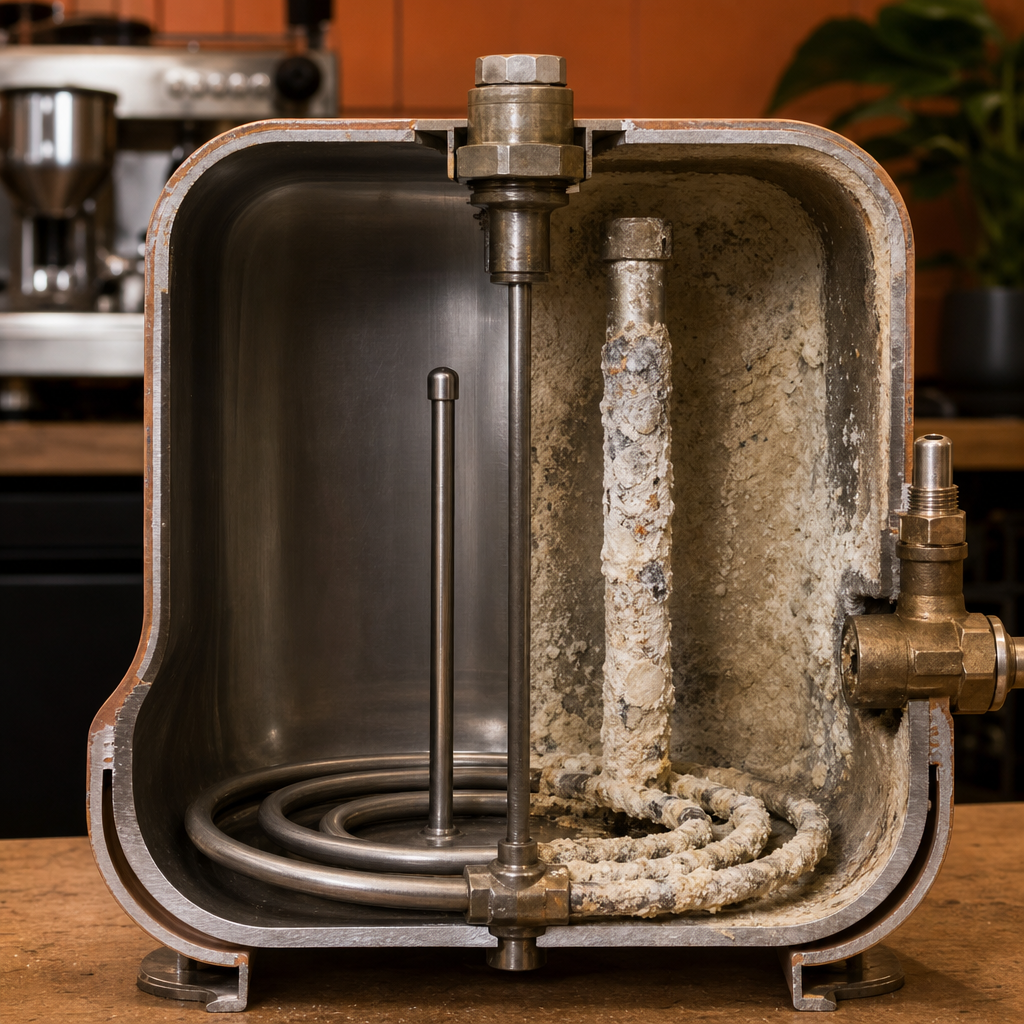
Hard water contains dissolved calcium and magnesium compounds. When a coffee machine heats that water, some compounds form solid deposits on hot internal surfaces. The resulting scale insulates heating elements, restricts waterways, interferes with sensors and creates conditions that make breakdowns more likely.
The Australian Drinking Water Guidelines express hardness as calcium carbonate. They describe water below 60 mg/L as soft, 60-200 mg/L as generally good quality, 200-500 mg/L as increasingly scale-forming and above 500 mg/L as severely scale-forming.
Those ranges help interpret a test, but they do not replace site assessment. Australian water hardness varies between regions, sources and supply zones. Conditions can also change inside a building due to storage tanks, ageing pipes or an existing treatment system.
Melbourne is often described broadly as having soft water. That does not mean every Melbourne office can skip filtration. A machine still needs protection from sediment, chlorine, local plumbing conditions and the cumulative effect of heating large volumes of water. A relatively modest mineral concentration can still create deposits when enough water passes through the boiler.
Hardness is also not the only measurement that matters. Alkalinity affects buffering and scale behaviour. Chlorine affects taste. Total dissolved solids provide context but do not identify which minerals are present. A single inexpensive meter reading should not be treated as a complete water analysis.
Common signs of hard water coffee machine scale include:
- Chalky deposits around hot-water outlets or fittings.
- Slower heating or unstable boiler performance.
- Reduced water flow from the group head.
- Valves that drip, stick or fail to seal.
- Changing shot temperature or inconsistent extraction.
- More frequent service faults involving probes, elements or hydraulic components.
These symptoms can have other causes. A slow group head may result from coffee residue, a blocked jet or pump trouble. The correct response is diagnosis, not automatically adding a stronger filter.
How do you choose the best water filter for an espresso machine?
The best water filter for an espresso machine is the system that meets the machine manufacturer's water specifications at the site's expected consumption. Selection should consider hardness, alkalinity, chlorine, sediment, available pressure, peak flow and cartridge capacity. Brand recognition alone does not establish suitability.
Start by testing water from the actual connection point. Do not test a kitchen tap on another floor and assume the result applies. Record hardness and alkalinity, then note taste, odour, sediment and any existing treatment equipment.
Next, confirm the machine's requirements. Commercial machines differ in boiler design, flow demand and acceptable water chemistry. A filter suitable for a small automatic machine may be restrictive or undersized for a high-volume espresso setup.
The cartridge must then be sized against consumption. Office demand includes espresso, long blacks, milk-drink rinsing, cleaning cycles and hot-water use. Team size helps estimate demand, but observed consumption is more useful once the machine is operating.
I look for five practical characteristics:
Appropriate scale control
The media must address the tested hardness without removing more mineral content than necessary. Adjustable bypass systems can help achieve this, provided the bypass is set from test results rather than left at a factory default.
Adequate flow rate
A filter that protects water chemistry but restricts flow during the morning rush is the wrong filter. Check pressure and peak demand, not just average daily volume.
Verifiable capacity
Capacity should be stated for relevant water conditions. Harder water generally reduces the useful capacity of scale-control media. The cartridge label alone may not tell the whole story, so consult the manufacturer's capacity table.
Accessible installation
Technicians need enough space to isolate the water, remove the cartridge and inspect the head. Hiding the assembly behind fixed cabinetry makes routine replacement slower and increases the chance of it being ignored.
Safe failure management
A sound installation includes suitable isolation, secure fittings and leak management appropriate to the site. Filters should not hang from flexible tubing or sit where a minor leak can damage electrical equipment and cabinetry.
If you are planning a complete workplace setup, Boutique Coffee's office coffee solutions combine machine selection, installation, consumables and ongoing servicing rather than treating filtration as an isolated accessory.
When should a commercial coffee machine filter be replaced?

Replace a commercial coffee machine filter at the earliest of its rated treated-water capacity, the manufacturer's maximum in-service interval or evidence that performance has declined. High-volume offices may exhaust cartridges early, while low-volume sites must still follow hygiene and service-life limits stated by the manufacturer.
A generic calendar schedule is easy to administer but often inaccurate. The better method connects replacement timing to site data.
At installation, record:
- Cartridge manufacturer and exact model.
- Installation date.
- Water hardness and alkalinity readings.
- Bypass or blending setting, where applicable.
- Stated capacity under the tested conditions.
- Meter reading or estimated machine throughput.
- Manufacturer's maximum in-service interval.
At each service visit, check the record against consumption and inspect for declining pressure, leakage, visible deposits and changes in water taste. Replace the cartridge before capacity is exceeded. Flush and commission the new cartridge according to its instructions, then update the record.
This creates a usage-based replacement schedule. It also gives the service technician evidence when conditions change. If a cartridge repeatedly exhausts earlier than expected, the answer may be a larger filter, a different treatment method or revised bypass settings.
Do not reset the date and walk away without checking the machine. A spent filter may have allowed scale into the system. Conversely, a blocked machine can produce poor flow even after the filter has been replaced.
A cartridge should also be reviewed after prolonged shutdowns, plumbing work, contamination concerns or unexplained changes in taste and pressure. The manufacturer's sanitation and recommissioning instructions should guide the response.
How should filtration fit into coffee machine maintenance?
Filtration should be managed as part of the coffee machine's service history, not as a separate consumable nobody owns. The maintenance plan should track water tests, cartridge changes, bypass settings, faults and machine condition. This connects the cause of water-related problems with the work required to prevent them.
For a new installation, filtration begins before the machine reaches the bench. In Boutique Coffee's Six-Step Process, the on-site visit checks plumbing, power and bench space before installation. That is when the filter position, isolation access, drainage and available pressure should be assessed.
On install day, the technician should connect the filter, flush it correctly, check for leaks and test machine flow. Espresso can then be dialled in using the treated water the machine will receive every day.
Ongoing maintenance should cover three layers:
Daily operator care
Staff should complete the machine's required cleaning process, empty waste systems and report unusual flow, taste, noise or leakage. A filter does not replace cleaning.
Scheduled site checks
The service provider should inspect the filter assembly, compare usage with capacity, test water where appropriate and examine the machine for early scale indicators. Beans and consumables can be checked during the same visit.
Technical servicing
A technician should assess components affected by water, including valves, probes, flow paths and heating systems. The scope depends on machine design and observed condition.
At a busy Melbourne workplace I supported, machine downtime during peak hours created what the site contact described as havoc. Regular scheduled servicing and direct personal contact gave the team reliable access to coffee when they needed it. Filtration is one part of that reliability, but accountability is what keeps the full system working.
This is why our model remains one number, one person. No call centres, no corporate runaround. Boutique Coffee's own active-client data shows a typical service-call response time of 24 hours as of 2026. That response is possible because the person taking responsibility understands the installed machine and its service history.
You can review how the workplace coffee service works before deciding whether a managed plan suits your office.
A filter cartridge is not a maintenance strategy
My view is direct: selling an office a filter without assigning responsibility for testing, capacity tracking and replacement is incomplete work. The cartridge matters, but the process around it matters more. Unrecorded filters are routinely forgotten until flow declines, scale appears or the machine stops during a busy period.
According to Boutique Coffee's anonymised internal case-study data supplied for this article, maintenance calls fell by 35% after proper filtration and a tracked replacement routine were introduced. This is an internal operational result, not a controlled study, so it should not be treated as a universal forecast.
The useful lesson is the mechanism behind the result. Correct filtration reduced avoidable water exposure, while tracking prevented cartridges from remaining in service beyond their effective life. The maintenance team also had a clearer record for diagnosis.
This is the gap many filter product pages miss. They focus on cartridge specifications but do not explain who checks the water, calculates capacity, changes the cartridge or responds when the machine behaves differently.
A workplace does not need another supplier dropping boxes at reception. It needs a coffee partner, not a supplier, who remains responsible for the whole setup. That includes the machine, filter, beans, training and service response.
I am not trying to be the biggest. Boutique Coffee has focused exclusively on Melbourne workplaces for 17 years, according to our own 2026 business records. Across more than 200 active rental clients, the average relationship exceeds five years. Those relationships are retained month-to-month, not through lock-in contracts.
The same principle applies to filtration advice. I will recommend the system that fits the actual machine and water conditions, even when the cheaper option is sufficient. Oversized equipment does not correct poor testing, just as an expensive cartridge does not correct neglected maintenance.
If you want filtration, servicing and supplies managed under one accountable plan, contact Boutique Coffee to arrange a site assessment and maintenance plan.
References
These sources provide the technical and Australian water-quality foundations used in this guide. Filter capacity and replacement limits remain product-specific, so the selected cartridge's current technical documentation and the coffee machine manufacturer's water specifications should always take precedence at installation.
- National Health and Medical Research Council, Australian Drinking Water Guidelines
- Melbourne Water, Water quality
- NSF, NSF/ANSI 42: Drinking Water Treatment Units, Aesthetic Effects
- Specialty Coffee Association, Coffee Standards
FAQ_SCHEMA_JSON
Frequently asked questions
Does every office coffee machine need a water filter?
Most plumbed commercial coffee machines benefit from appropriate filtration, but the treatment type depends on site water and manufacturer requirements. Even relatively soft water may require sediment and chlorine reduction. A water test and installation assessment should determine whether scale control is also needed.
Can I use a domestic water filter on a commercial coffee machine?
Only if its capacity, flow, pressure rating, fittings and treatment performance meet the commercial machine's requirements. Many domestic filters are not designed for office peak demand or predictable scale control. Using an undersized cartridge can restrict flow and exhaust the media earlier than expected.
Will a new filter remove existing scale from the machine?
No. A new filter treats incoming water but does not reliably remove deposits already attached to boilers, elements, valves or pipework. Existing scale requires technical inspection. Depending on the machine and deposit severity, servicing may involve controlled descaling or replacement of affected parts.
What is the difference between water hardness and total dissolved solids?
Hardness mainly describes dissolved calcium and magnesium compounds associated with scale. Total dissolved solids is a broader measure of dissolved material and does not identify individual minerals. A total dissolved solids reading alone cannot confirm the correct scale-control cartridge or bypass setting.
Why does filtered coffee machine water sometimes taste flat?
The system may be removing too much mineral content, or the issue may relate to stale beans, grinder settings, temperature or cleaning. Water should support extraction without creating damaging scale. Test the treated water and compare it with the machine manufacturer's specifications before changing the filter.
Who should replace an office coffee machine filter?
A trained service provider should manage replacement where the cartridge is connected to a commercial machine and fixed plumbing. The provider should isolate the supply, install and flush the correct cartridge, check for leaks, confirm flow and update the maintenance record.

Chris
Chris
Keep reading
Office Coffee Machine ROI Calculator: Justifying Your Investment in Workplace Coffee in Australia
An office coffee machine ROI calculator compares the total cost of renting or purchasing with measurable benefits such as reduced café trips, lower downtime…
The Real Cost of Commercial Coffee Machine Cleaning & Maintenance in Australia
Coffee machine cleaning cost depends on the machine, usage, water quality, labour, replacement parts and service arrangement. Owners pay these expenses…
Commercial Coffee Machine Service Contracts & Warranties: Protecting Your Australian Investment
An office coffee machine service contract should define maintenance, repairs, call-outs, parts, response targets and supplier responsibilities. A commercial…