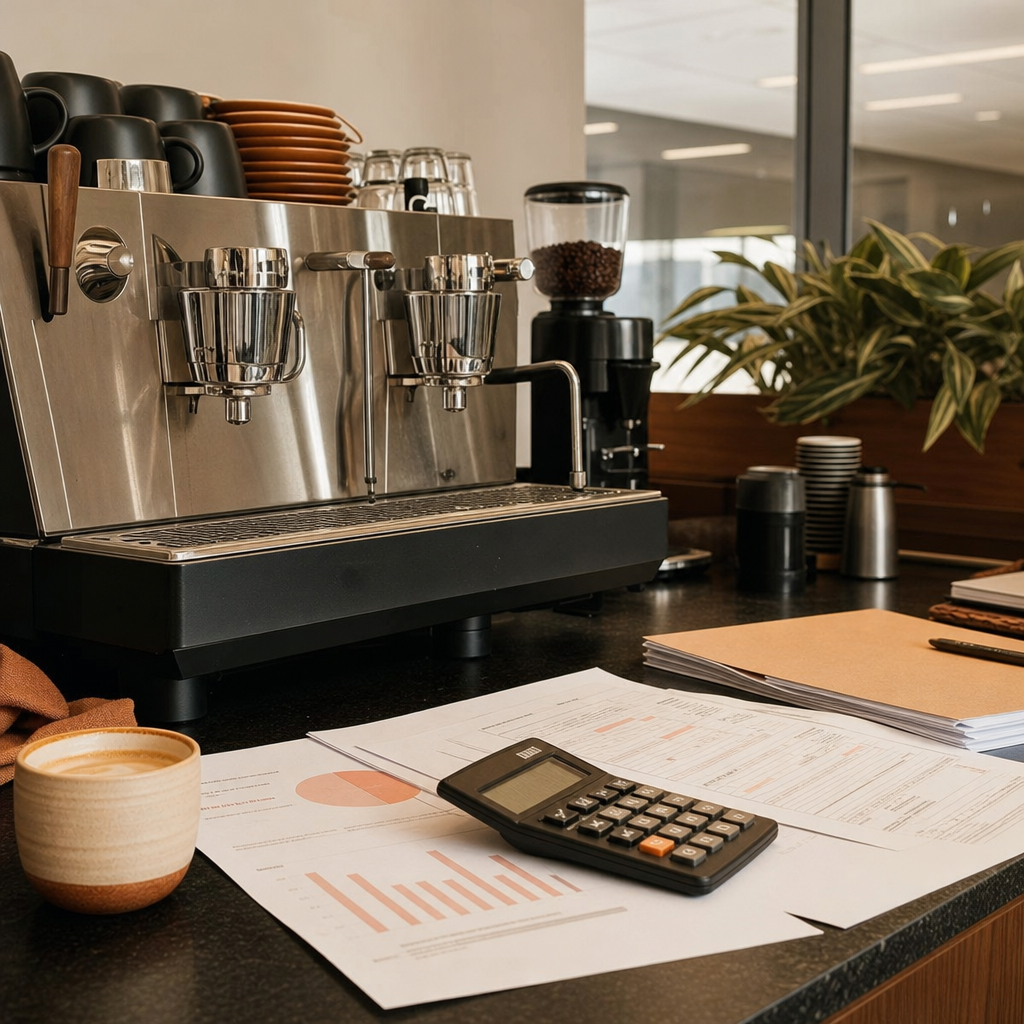
An office coffee machine ROI calculator compares the total cost of renting or purchasing with measurable benefits such as reduced café trips, lower downtime and better staff amenity. The right calculation includes equipment, consumables, servicing, staff time, reliability and residual value, using conservative assumptions based on your workplace's actual behaviour.
Workplace coffee is often treated as a minor perk. That makes it vulnerable when budgets tighten, even when the machine is used throughout the working day. A proper workplace coffee cost-benefit analysis replaces vague claims about morale with costs, observed behaviour and accountable assumptions.
This guide provides a practical calculator framework for Australian workplaces. It also explains where rental and purchase comparisons commonly go wrong, how to value time without overstating productivity, and how service reliability changes the result.
Key takeaways
A defensible coffee machine business case starts with total cost, not the advertised machine price. It then values only those benefits the workplace can observe and reasonably attribute to the coffee setup. Rental often improves predictability and service accountability, while purchase can suit organisations willing to carry maintenance, downtime and asset risk.
- Compare rental and purchase over the same assessment period, with consistent GST treatment.
- Include installation, consumables, cleaning, maintenance, administration, downtime and disposal costs.
- Measure café-trip time before assigning any productivity value to time saved.
- Treat morale and retention as supported benefits unless internal evidence justifies a dollar value.
- Model machine reliability separately because an unavailable machine cannot produce a benefit.
- Test conservative, expected and high-use scenarios before approving the investment.
Summary table
The choice between renting and purchasing depends on cash flow, internal maintenance capacity, usage certainty and the consequences of downtime. Purchase price alone is a poor decision measure. The better comparison is the expected cost of delivering reliable coffee over the period your organisation actually plans to use the machine.
| Decision factor | Rental | Purchase | What to enter in the calculator |
|---|---|---|---|
| Initial cash requirement | Usually spread through recurring fees | Equipment and setup commonly paid upfront or financed | All establishment payments |
| Servicing | May be included, subject to the agreement | Usually arranged and paid by the owner | Planned and reactive maintenance |
| Downtime risk | Supplier may carry more responsibility | Workplace manages repair and replacement decisions | Lost availability and staff disruption |
| Flexibility | Easier to change equipment if terms allow | Change requires resale, storage or replacement | Exit and upgrade costs |
| Asset value | No owned residual asset | Possible resale or trade-in value | Conservative residual value |
| Consumables | May be bundled or supplied separately | Purchased separately | Beans, milk, chocolate, filters and cleaning products |
| Accounting treatment | Depends on agreement and accounting policy | May involve depreciation and capital allowances | Confirmed finance or accounting treatment |
| Best fit | Teams wanting predictable support and lower operational burden | Teams comfortable managing an equipment asset | Usage, cash flow and service capability |
Boutique Coffee at Work snapshot
Boutique Coffee at Work's internal client records, current in 2026, show the scale and service context behind this framework. These figures are operating data, not general industry benchmarks, so they should not be copied into your ROI model as assumptions about another supplier or workplace.
200+ active Melbourne workplace rentals | Average active-client relationship of 5+ years | Typical service-call response within 24 hours | Largest installed workplace of 400+ people
Source: Boutique Coffee at Work internal client and service records, current in 2026.
Defining ROI for workplace coffee
Workplace coffee ROI is the net value created by the coffee programme divided by its total cost. Net value can include avoided employer-funded café purchases, conservatively valued staff time, reduced disruption and hospitality benefits. The calculation should separate financial savings from cultural benefits rather than forcing every positive outcome into dollars.
The basic framework is:
ROI = (measured benefits minus total costs) divided by total costs
That formula is simple. Defining the inputs is where most business cases become unreliable.
Start by identifying the decision being made. Common questions include:
- Should the organisation continue with instant coffee or introduce a commercial machine?
- Should it rent or purchase the selected machine?
- Should it replace an unreliable existing setup?
- Should coffee remain employee-funded, become employer-funded or use a mixed model?
Each question needs a different baseline. If the current machine is unreliable, the relevant comparison is not machine versus no machine. It is the current setup's full operating cost versus a more reliable alternative.
Financial return and operational return are different
Financial return appears in accounts or budgets. Examples include reduced repair invoices, avoided employer-funded café orders and lower equipment administration costs.
Operational return covers outcomes such as machine availability, shorter coffee trips and less disruption when faults occur. These outcomes can support a financial case, but only when the conversion into dollars is explicit and conservative.
Morale deserves similar care. Good coffee can improve the daily workplace experience, but it would be misleading to claim that a machine directly causes staff retention. A better business case records coffee as part of the employee experience and uses internal survey or exit data before assigning retention value.
Define success before collecting numbers
Choose measures that can be observed before and after implementation. Useful measures include café trips during paid time, employer coffee spending, machine fault records, service response, consumable wastage and employee feedback.
Do not begin with a desired ROI and work backwards. Begin with a baseline, document assumptions and let the result guide the decision.
Quantifying costs: direct and indirect

The complete cost of an office coffee machine includes equipment, installation, finance, consumables, maintenance, cleaning, administration, downtime and exit costs. Rental and purchase must be compared using the same boundaries. Excluding internal labour or repair risk makes the cheaper-looking option appear better without showing its true cost of operation.
Direct rental costs
For rental, capture:
- Recurring equipment rental
- Installation or establishment charges
- Beans and other contracted consumables
- Delivery fees
- Scheduled servicing
- Repairs or parts excluded from the agreement
- Equipment upgrade charges
- Exit, collection or make-good costs
Read the agreement rather than assuming servicing means everything is covered. Ask who pays for parts, what happens when misuse causes a fault, whether a temporary replacement is available, and how quickly the supplier responds.
Boutique Coffee at Work uses month-to-month rentals with one month's notice and free machine pickup, according to its current rental policy. That changes the risk profile compared with a long fixed agreement because the customer is not relying on distant usage forecasts to justify the commitment.
Direct purchase costs
For purchase, include:
- Machine and grinder purchase price
- Finance charges where applicable
- Freight and installation
- Plumbing, filtration and electrical work
- Staff training
- Preventive servicing
- Repairs, labour and replacement parts
- Temporary equipment during major repairs
- Eventual removal or disposal
- Residual or trade-in value
Residual value should reduce purchase cost only when there is a realistic market and the equipment is likely to remain saleable. An optimistic resale estimate can make ownership look artificially attractive.
The Australian Taxation Office explains that depreciating assets and capital expenses can receive different tax treatment from ordinary operating expenses. GST-registered businesses may also be entitled to credits for GST included in eligible business purchases. Confirm the treatment with your accountant and compare alternatives consistently, either before or after recoverable GST.
Consumables and use-dependent costs
Beans are only part of the running cost. Include milk, alternatives to dairy milk, hot chocolate, sugar, cups where reusable cups are not used, cleaning tablets, filters and water treatment.
Use purchasing records where possible. If no machine exists yet, run a short trial and record actual consumption. Boutique Coffee at Work offers a workplace coffee machine free trial, which can provide more useful consumption evidence than a generic cups-per-person assumption.
The bean selection also affects waste and adoption. Boutique's Curated Coffee Plan starts with the team's espresso and milk-based drink preferences, selects a suitable blend, then adjusts it from feedback. The purpose is practical: coffee that people do not enjoy produces weak adoption regardless of the machine specification.
Hidden labour and downtime costs
Someone in the office will order stock, clean the machine, report faults and coordinate technicians. Record that time. A machine that needs frequent attention may have a low invoice cost but a high internal burden.
Downtime should also be modelled. Relevant costs can include staff leaving the premises for coffee, meetings disrupted by an unavailable hospitality facility, and administrative time spent chasing support.
This is where supplier accountability has financial value. One number, one person reduces the internal runaround. Boutique's internal service records show a typical response within 24 hours across its active client base in 2026. Your calculator should use the response commitment and historical performance of the supplier being assessed, not this figure by default.
Valuing the benefits: productivity and morale
The most defensible benefits are avoided costs and measured time changes. Productivity should be valued only after observing whether staff make fewer or shorter off-site coffee trips. Morale, collaboration and retention belong in the case, but should remain non-financial benefits unless your organisation has credible internal evidence connecting them to a measurable cost.
Measure time saved rather than assuming it
Run a simple baseline observation before installing or changing the machine. Record how often employees leave for coffee during paid time and the approximate elapsed time. Repeat the observation after implementation.
Then apply an attribution factor. Not every minute spent away from a desk would otherwise become productive work. Employees are entitled to breaks under applicable workplace laws, awards and agreements. Fair Work Ombudsman guidance confirms that break entitlements depend on the relevant award, enterprise agreement or employment arrangement.
A conservative calculation is:
Attributed time benefit = observed reduction in paid-time café travel multiplied by loaded labour cost multiplied by a conservative attribution factor
The attribution factor is a management judgement. Document it. If decision-makers disagree, show the result under several assumptions rather than presenting one precise answer as fact.
Distinguish employee savings from employer savings
If employees buy their own café coffee, bringing coffee into the office may save them money. That is a staff benefit, not a direct saving to the employer.
It becomes an employer benefit only through another mechanism, such as an existing coffee allowance being reduced, less paid travel time, improved recruitment feedback or a measurable change in retention. Keeping that distinction clear makes the financial justification more credible.
Value reliability through avoided disruption
Reliability is often more important than drink variety. A sophisticated machine that regularly stops working has poor realised value because its theoretical benefits disappear during outages.
Track:
- Fault occurrence and cause
- Time from report to response
- Time from report to restored service
- Whether temporary equipment was supplied
- Staff time spent reporting and following up
- Consumables wasted during faults or recalibration
For a busy workplace, availability should be a required service outcome. It should not be treated as an optional extra after the equipment decision.
Keep morale visible without inventing a dollar value
Staff feedback can still form part of the approval case. Ask focused questions about coffee quality, convenience, machine reliability and whether the amenity affects the workplace experience.
Avoid broad questions that invite positive but unusable answers. A short recurring pulse question can show whether satisfaction holds after the novelty wears off.
Coffee can also create informal contact between teams. That may support workplace culture, but it is rarely possible to isolate its financial effect. Report it honestly as an observed cultural benefit rather than manufacturing a productivity percentage.
The office coffee machine ROI calculation framework

A useful coffee machine rental versus purchase calculator has four stages: establish the current baseline, calculate each option's total cost, estimate attributable benefits, then test the result under different usage and reliability assumptions. Use actual supplier quotes and workplace observations wherever possible. Generic online estimates are not a substitute for site-specific inputs.
Step A: set the comparison boundary
Define:
- The assessment period
- Expected team size and attendance pattern
- Current coffee arrangement
- Drinks funded by the organisation
- Required machine availability
- Accounting and GST treatment
- Expected ownership or rental exit point
Hybrid work matters because headcount and daily attendance are different. Machine capacity should match peak on-site demand rather than total payroll headcount or a quiet-day average.
Boutique's position is direct: choose the machine that fits the actual team. Based on the founder's operating experience, a 12-person team does not need a $15,000 Eversys, while an 80-person team can exhaust home-grade equipment within a month. Those examples are Boutique Coffee at Work's practical observations, not universal product-life benchmarks.
Step B: calculate total cost
Use these variables:
| Variable | Rental calculation | Purchase calculation |
|---|---|---|
| Equipment | Rental payments | Purchase price and finance cost |
| Establishment | Installation and site preparation | Installation and site preparation |
| Operations | Consumables and excluded service | Consumables, maintenance and repairs |
| Internal burden | Administration and fault-management time | Administration, maintenance and fault-management time |
| Downtime | Attributed outage cost | Attributed outage cost |
| Exit | Notice, collection and make-good costs | Disposal cost less conservative residual value |
Total rental cost = rental payments + establishment + consumables + exclusions + internal labour + downtime + exit costs
Total purchase cost = purchase and finance + establishment + consumables + maintenance + repairs + internal labour + downtime + disposal minus residual value
Step C: calculate attributable benefits
Create separate lines for:
- Avoided employer-funded café spending
- Attributed value of reduced café travel
- Avoided repair and downtime costs from the existing setup
- Reduced ordering or supplier-management labour
- Customer hospitality savings
- Other benefits supported by internal records
Then list non-financial benefits separately. These may include staff satisfaction, perceived coffee quality, convenience and confidence that the machine will be working when needed.
Step D: calculate ROI and payback
Use:
Net benefit = total attributable benefits minus total cost
ROI = net benefit divided by total cost, expressed as a percentage
Payback period = initial cash requirement divided by recurring net benefit for the same time unit
Payback is particularly useful when comparing a large purchase with rental. ROI can favour ownership over a long assessment period while rental still preserves more cash and transfers more service responsibility.
Step E: stress-test the result
Run at least these scenarios:
- Conservative adoption with limited time savings
- Expected adoption based on observed trial usage
- Higher use with increased consumable and maintenance requirements
- Reliable operation under the quoted service arrangement
- Service delays or recurring faults
- Team growth or reduced office attendance
A decision that only works under the most optimistic scenario is not financially robust.
Use the trial as a data collection period
A trial should do more than ask whether people like the coffee. Record drink volumes, peak queues, cleaning needs, consumable use, preferred drinks and support questions.
Boutique's Six-Step Process generally takes Melbourne clients from enquiry to installation in 5-7 business days, according to its internal operating process. It includes a site visit to assess power, plumbing and bench space, followed by installation, dialled-in beans, staff training and ongoing service visits.
That site assessment prevents a common calculator error: approving equipment before identifying installation constraints and their costs.
Real-world ROI examples from Melbourne workplaces
Real workplace examples show that operational return often appears first through reliability, adoption and reduced disruption, not a neatly recorded dollar figure. The examples below are genuine Boutique Coffee at Work engagements. No formal financial ROI percentage was captured, so none has been invented. Their value lies in the specific operational outcomes reported by each workplace.
Melbourne office: replacing an underperforming setup
A mid-size Melbourne office had an existing coffee arrangement that was not meeting staff expectations. Boutique Coffee at Work installed a WMF commercial machine, trained staff and included ongoing service within the rental arrangement.
The site manager reported that the machine was easy to use each day, the coffee and hot chocolate were well received, and service remained consistent over years. The operational ROI measures were adoption, daily usability, drink quality and continuity of service.
The manager's response to appreciative staff was: "No problem, just keep doing what you're doing."
That testimonial does not establish a financial return by itself. It does show that the amenity was visible and valued by staff after implementation, rather than being an unused equipment purchase.
For a retrospective financial analysis, this workplace could compare its previous and current repair records, staff café-trip observations, consumable waste and administration time. Those records would allow management to calculate the dollar value without relying on a generic productivity claim.
Busy workplace: reducing disruption from breakdowns
Another busy Melbourne workplace experienced significant disruption whenever its coffee machine failed during peak office hours. Boutique supplied a maintained machine, scheduled regular servicing and gave the workplace direct personal contact for issues.
The workplace contact reported that dependable service meant the team had coffee when it was needed most, removing the havoc created by breakdowns. The relevant ROI measures were machine availability, peak-time continuity and reduced fault-management burden.
Again, no dollar result was recorded. The correct approach is to state that limitation. A future calculation could value employee time spent reporting faults, support delays, café travel during outages and any emergency repair costs.
These cases also reveal why rental terms alone do not determine value. A low rental price attached to slow support can cost more operationally than a better-supported machine.
Why accountability belongs inside the calculator
Most coffee machine comparisons treat service as a contract inclusion rather than an economic variable. I think that is a mistake. The person responsible for installation should remain accountable for ongoing performance. Direct knowledge of the site shortens diagnosis, reduces internal follow-up and makes it more likely that the promised benefit will actually be delivered.
Corporate suppliers often route faults through call centres, ticket systems and account teams. That structure can look efficient from the supplier's side while creating extra work for the customer.
My model is founder-led, always: one number, one person, with no call centres and no corporate runaround. Many minor issues can be discussed quickly when the person answering already knows the machine, installation and team.
This accountability should appear in the calculator through expected downtime, internal coordination time and replacement-machine arrangements. If two quotes use the same equipment but offer different service structures, they are not financially equivalent.
The same principle applies to contract flexibility. Boutique's internal records show an average active-client relationship exceeding five years in 2026, despite rentals being month-to-month. Long relationships retained by service are more useful than clients retained by difficult exit terms.
I am not trying to be the biggest. The aim is to be a coffee partner, not a supplier, and recommend equipment designed around the workplace's culture and budget. If the cheaper machine is the correct fit, that is the recommendation.
Building the final financial justification
A strong coffee machine financial justification gives decision-makers a transparent comparison, not a sales pitch. Present the baseline, assumptions, cost boundaries, attributable benefits, risks and sensitivity scenarios on one page. Keep staff-experience evidence beside the calculation, while clearly separating it from benefits already converted into dollars.
Your approval document should contain:
- The workplace problem being addressed
- Current coffee and downtime costs
- Rental and purchase options using the same assessment boundary
- Supplier inclusions and exclusions
- Site preparation requirements
- Expected usage based on observation or trial data
- Benefit assumptions and attribution method
- Conservative and expected scenarios
- Operational risks and responsible owners
- A review date and measures to track after installation
Do not bury assumptions in a spreadsheet. State them beside the result. If the case depends heavily on time savings, explain how café travel was observed and what portion was treated as productive time.
Also record what happens if the workplace changes. Team growth, a relocation or lower office attendance can alter the appropriate machine. Flexible rental can reduce that risk, but only if upgrade and exit terms are clear.
Boutique Coffee at Work provides commercial workplace coffee solutions for Melbourne teams, including installation, training, coffee supply and ongoing maintenance. To test the costs against your actual site and usage, contact Boutique Coffee at Work for a practical recommendation rather than an oversized machine.
References
- Australian Taxation Office, "Depreciation and capital expenses and allowances": https://www.ato.gov.au/businesses-and-organisations/income-deductions-and-concessions/depreciation-and-capital-expenses-and-allowances
- Australian Taxation Office, "Claiming GST credits": https://www.ato.gov.au/businesses-and-organisations/gst-excise-and-indirect-taxes/gst/claiming-gst-credits
- Fair Work Ombudsman, "Breaks": https://www.fairwork.gov.au/employment-conditions/hours-of-work-breaks-and-rosters/breaks
- Boutique Coffee at Work internal client, service and operating records, current in 2026.
FAQ_SCHEMA_JSON
Frequently asked questions
Is it better to rent or buy an office coffee machine?
Rental is often better when predictable costs, servicing, flexibility and reduced internal administration matter. Purchase may be better when the organisation has available capital, stable long-term demand and the capability to manage repairs and downtime. Compare total cost and risk over the same assessment period.
What should a coffee machine rental versus purchase calculator include?
Include equipment, finance, installation, plumbing, filtration, consumables, maintenance, repairs, administration, downtime, exit costs and residual value. Add attributable benefits such as avoided employer-funded coffee spending and measured reductions in paid-time café travel.
How do I calculate the return on investment of an office coffee machine?
Subtract total costs from attributable benefits to find net benefit. Divide net benefit by total cost and express the result as a percentage. Document every assumption and test lower usage and machine availability scenarios.
Can improved staff morale be included in coffee machine ROI?
Yes, but it should usually be reported as a non-financial benefit. Use staff surveys, adoption and workplace feedback as evidence. Assign a dollar value only when internal data supports a measurable connection.
Are office coffee machine costs tax deductible in Australia?
Tax treatment depends on the purchase, rental agreement, business use and accounting circumstances. Equipment purchases may involve depreciation or capital allowance rules, while eligible expenses and GST credits may receive different treatment. Obtain advice from an accountant.
How can we estimate usage before choosing a machine?
Use office attendance data, observe current café trips and run a workplace trial. Record drinks made, peak demand, drink preferences, cleaning requirements and consumable use. Size the machine for realistic peak attendance rather than total headcount alone.

Chris
Chris
Keep reading
Office Coffee Machine Water Filters: Scaling, Maintenance & Water Quality
Office coffee machine water filters reduce sediment, chlorine and scale-forming minerals before water reaches the machine. The right system protects boilers…
Essential Features of a Commercial Office Coffee Machine: What to Look For in Australia
The essential office coffee machine features are consistent drink quality, useful beverage customisation, a practical milk system, sufficient peak-hour…
The Real Cost of Commercial Coffee Machine Cleaning & Maintenance in Australia
Coffee machine cleaning cost depends on the machine, usage, water quality, labour, replacement parts and service arrangement. Owners pay these expenses…