Australian businesses are spending thousands of dollars on retention strategies right now. Sign-on bonuses, flexible work policies, learning and development budgets, team-building days. And then every single morning, the same team walks past three exceptional Melbourne cafés to sit down at a desk and drink instant coffee from a tin.
I've been supplying commercial coffee machines to Melbourne workplaces since 2008. In that time, I've spoken with hundreds of HR managers, office managers, and founders who genuinely care about their culture and their people. Almost none of them had consciously connected the quality of their office coffee to the daily experience of every employee who walks through the door. It's the most frequent touchpoint in any office. More frequent than a performance review, a team lunch, or a town hall. It happens two, three, four times a day for most people. And in the majority of Australian offices, it's still an afterthought.
This post is a practical guide for HR professionals and office managers who want to build the internal business case for a quality coffee program. I'll walk through the retention data, the productivity research, what it actually costs, how to pitch it to leadership, and how to handle the objections you'll face. If you've ever suspected that coffee is more than a beverage in your workplace, you're right. Here's the evidence.
Key Takeaways
- Workplace amenities including coffee are a measurable factor in employee retention decisions, with Australian salary surveys consistently ranking perks among the top reasons employees stay or leave
- Caffeine has well-documented short-term cognitive benefits, but the social ritual of a coffee break produces compounding benefits that no supplement can replicate
- A quality office coffee program costs as little as $1.50 to $3.00 per employee per day, making it one of the lowest-cost, highest-visibility perks available to any office
- Instant coffee is not a neutral option. It sends a signal to your team about how much the organisation values their daily experience
- The business case is straightforward: one retained employee covers the cost of a coffee program for years
- A properly set up office coffee program requires almost no management overhead when the supplier actually shows up and does their job
Summary Table: Office Coffee vs Other Common Workplace Perks
| Perk | Estimated Cost Per Employee Per Day | Daily Usage Rate | Perceived Value by Staff | Visibility |
|---|---|---|---|---|
| Bean-to-cup coffee program | $1.50 - $3.00 | High (2-4x per person) | High | Constant, daily |
| Fruit box delivery | $0.80 - $1.50 | Low-medium (once, if noticed) | Medium | Low |
| Gym membership subsidy | $3.00 - $6.00 | Low (15-30% uptake typical) | Medium | Low |
| Team lunch (monthly) | $1.50 - $3.00 (averaged daily) | Medium (once monthly) | Medium-High | Monthly only |
| Paid streaming or app subscriptions | $0.50 - $1.50 | Low-medium | Low-Medium | Invisible |
| End-of-year bonus | Variable | Once annually | High | Once annually |
The coffee program wins on one dimension no other perk can match: it shows up every single day, multiple times, without anyone having to remember to activate it.
The Retention Data: What Australian Surveys Actually Show
Let's start with the numbers, because this conversation needs to be grounded in evidence if you're going to take it into a leadership meeting.
The ELMO Employee Sentiment Index, which surveys thousands of Australian workers each year, has consistently identified workplace culture and daily experience as primary drivers of both satisfaction and retention intent. In the most recent data available, over 40 percent of Australian employees reported that non-salary benefits influenced their decision to stay with or leave an employer. That figure has been climbing year on year as the post-pandemic workforce has become more deliberate about where they spend their time.
SEEK's annual candidate survey data paints a similar picture. Workplace culture and environment rank among the top five factors Australian job seekers evaluate when assessing an employer, often ahead of career progression opportunities. The Hays Salary Guide for Australia, which canvasses employers and candidates across most major sectors, has reported for several consecutive years that employees place meaningful weight on the quality of their physical workspace and the benefits embedded in daily office life.
None of these surveys single out coffee specifically. They don't need to. What they reveal is that the accumulation of daily experience, the small signals an organisation sends about how much it values its people, matters far more to retention than leaders typically acknowledge. Coffee is one of those signals. It happens before the first meeting of the day. It happens when a team member is stressed and needs a moment. It happens when two colleagues from different departments end up at the machine at the same time and have a conversation that wouldn't otherwise occur. These are the coffee moments that matter.
To put it in cost terms: the average cost of replacing a single employee in Australia, when you account for recruitment advertising, agency fees, onboarding time, and productivity loss during the ramp-up period, is generally estimated at between 50 and 200 percent of that employee's annual salary. For a mid-level professional on $90,000 AUD, that's $45,000 to $180,000 per departure. A coffee program serving a 30-person team at $3 per head per day costs roughly $22,000 per year including GST. If it contributes meaningfully to retaining even one person who would otherwise have left, the ROI pays out in the first month.
I want to be direct here: coffee alone doesn't retain people. Toxic management, stagnant pay, and unclear career paths will chase people out regardless of what's in the kitchen. But in a competitive market where your offer and a competitor's offer are broadly similar, the daily experience of coming into your office matters. And the daily experience starts with coffee.
The Return-to-Office Factor
This is worth its own paragraph in 2026. Australian employers across Melbourne, Sydney, and Brisbane are navigating return-to-office policies with varying levels of success. The friction point, almost universally, is the question of why someone should commute when their home setup is comfortable and their home coffee is good.
I've had conversations with office managers who are struggling to get people back in three days a week. In almost every case, the office experience they're asking people to commute for is objectively worse than the home experience on the basics: desk setup, noise levels, and yes, coffee. If you're asking someone to leave their home espresso machine and sit in traffic to drink Nescafé at a shared desk, you have already lost the argument.
A quality coffee program doesn't solve return-to-office on its own. But it removes one very visible, very daily source of resentment. And it signals that you've thought about what makes the office worth coming to.
Productivity and the Coffee Break Effect
The research on caffeine and cognitive performance is extensive and, within reasonable bounds, fairly settled. Caffeine improves alertness, working memory, and reaction time. It reduces the perception of effort during mentally demanding tasks. The effect is most pronounced in the first two to three hours after consumption, which maps neatly onto the morning period when most knowledge workers do their highest-value work.
A 2023 study published in Nutrients, an open-access peer-reviewed journal, found that moderate caffeine consumption (200-400mg per day, equivalent to two to four espresso-based coffees) was associated with statistically significant improvements in sustained attention and processing speed compared to placebo. This isn't new information, but it's worth having on hand when you're building a business case.
What's less often cited, but arguably more important for workplace culture, is what happens around the coffee machine rather than in the cup. Research from MIT's Human Dynamics Laboratory, led by Alex Pentland, found that the timing and structure of informal social interactions within teams was one of the strongest predictors of team productivity. Planned meetings are not sufficient. The unstructured moments, where people cross paths without an agenda, are where information spreads, problems get solved informally, and team cohesion develops.
The office coffee machine is the primary infrastructure for those moments in most workplaces. It's the place where a developer overhears a client concern the sales team is wrestling with. Where a new employee gets a five-minute orientation from a senior colleague that no induction programme ever provides. Where a team catches up briefly after a difficult client call and recalibrates before the afternoon. These micro-breaks serve a function that no calendar invite can replicate.
When the coffee is bad, or unavailable, those moments either don't happen or happen less often. People make coffee at their desk, or they leave the building entirely to find a decent flat white. Both outcomes fragment the informal social fabric of the office.
The Instant Coffee Problem
I need to address this directly, because I speak to office managers who genuinely believe instant coffee is a reasonable baseline. It isn't. Not in Melbourne in 2026. Not when every team member walks past a specialty café to get to your office.
Instant coffee doesn't just produce an inferior beverage. It sends a message. The message is that the person responsible for the office didn't think coffee was worth spending money on properly. For some employees, particularly younger ones who have grown up with café culture as a daily norm, that signal lands as indifference. Not cruelty, not malice, just indifference. And indifference is one of the most corrosive things an organisation can communicate to its people.
I've had someone approach me at a client's office who used to work for one of my clients. He'd moved to a new employer and the coffee had gone backwards. He wasn't upset about salary or management. He was frustrated enough about the coffee to track me down and ask for my card so he could recommend me to their senior team. That's not an unusual reaction. Coffee quality registers.
A bean-to-cup commercial machine, paired with fresh roasted beans matched to your team's preferences, produces a result that is genuinely comparable to a café. It doesn't require a barista. It doesn't require skill. It requires the right machine, properly maintained, with good coffee in it. That's the whole model.
What a Quality Coffee Program Actually Costs Per Head
Let me break down what a realistic office coffee program costs in a Melbourne workplace, because vague pricing is one of the reasons this conversation stalls in leadership meetings.
For a team of 10 to 20 people, a commercial bean-to-cup machine rental typically runs in the range of $150 to $250 per month, depending on the machine specification and what's included in the service arrangement. Beans and consumables for a team that size generally add $100 to $200 per month, depending on consumption patterns. Total monthly cost: $250 to $450, or roughly $13 to $22 per working day for the whole team.
For a team of 30 to 50 people, the economics shift slightly. A higher-capacity machine may be warranted, and bean volume increases, but the cost per head actually improves because of the fixed nature of the machine rental. You're typically looking at $400 to $700 per month all in, or $1.50 to $3.00 per person per day.
For a team above 80 people, you're moving into multi-machine territory or high-throughput commercial equipment. I've installed setups for teams of 400-plus, and the economics at scale are still favourable against almost every other retention spend.
These numbers exclude GST. On that point: office coffee provided to employees is generally deductible as a staff amenity under Australian tax law. You should confirm the specifics with your accountant, but the ATO's general position on staff amenities in an office context is well-established. The net cost after tax is lower than the headline number.
For a fuller breakdown of how pricing works across different team sizes, the Boutique Coffee cost guide for workplace coffee suppliers in Melbourne is worth reviewing before you go into a budget conversation.
What You're Not Paying For
One thing I want to be clear about: when a coffee program is set up properly, you're not paying in management time. I drive throughout Melbourne attending to my clients' machines. Checking they're operating smoothly, topping up beans and consumables, catching any maintenance issues before they become problems. That's the service. The office manager doesn't manage the coffee. The coffee manages itself.
I had a client, Paul, a site manager at a mid-size Melbourne office, who had been running a machine setup that wasn't working well for the team. After upgrading to a WMF commercial machine with proper installation, training, and a regular service rhythm, his whole approach changed. He told me his staff came to him to say how much they appreciated the change, and his response was simple: "No problem, just keep doing what you're doing." That's the outcome. The office manager stops thinking about coffee entirely because it just works.
How to Pitch a Coffee Program to Leadership
This is where a lot of good ideas die. The coffee program idea comes up in an office manager meeting, people nod, someone says "great idea," and then nothing happens because no one frames it as a business decision with a return.
Here is a framing that works in most Australian leadership contexts.
The one-pager pitch structure:
Start with the cost of turnover. Use a specific example from your own organisation or the benchmark of 50 to 150 percent of annual salary. Frame the question: what is one employee departure costing us in real dollars?
Then introduce the programme cost. "We can provide a café-quality coffee experience for every person in this office, every day, for $X per month. That's $Y per head per day. For context, that's less than we spend on the monthly fruit box that half the team doesn't touch."
Then make the connection explicit. "This is not a luxury. This is daily infrastructure for our office culture. It signals to every person here that we've thought about their daily experience. It gives people a reason to come in, a reason to interact informally, and a daily reminder that this is a workplace that's worth being in."
Finally, de-risk the decision. "There's no lock-in contract. We can trial it for one month and assess the response. The machine is installed in under an hour. If we decide it's not working, we give one month's notice and the machine is collected. There's no capital outlay."
That last point matters more than people realise. The no-lock-in structure removes the psychological barrier of a long-term commitment. Month-to-month rental with one month's notice is the model I've operated on since day one, because I'd rather keep clients by choice than by contract. In 17 years, it's never been a problem worth worrying about.
If you want to see exactly how the setup process works before you take it to a leadership meeting, the how it works page walks through the Six-Step Process from first enquiry to ongoing service rhythm. Most Melbourne clients go from first phone call to installed machine in five to seven business days.
ROI Framing for CFO-Level Conversations
If your leadership team is financially oriented, here's the framing that tends to land well at CFO level.
Assume a 30-person team. Average salary: $85,000 AUD. Estimated replacement cost per departure: 75 percent of salary, or $63,750. Coffee programme cost: $550 per month, or $6,600 per year.
If the programme contributes to retaining one person who would have otherwise left, the payback period is approximately 37 days of avoided recruitment cost. The programme pays for itself for the entire year in the first five weeks.
You don't need to claim that coffee is the sole retention factor. You only need to claim that it is a visible, daily, low-cost signal that improves the overall employment experience. In a market where people have choices, those signals accumulate.
Common Objections and How to Address Them
I've heard every objection. Here are the ones that come up most often and how to respond.
"We already have instant coffee. People seem fine with it."
People rarely complain about the coffee to management. They complain about it to each other. The absence of complaint is not the same as satisfaction. Ask a few team members directly and you'll get a more honest picture. Beyond the quality issue, the question is what signal instant coffee sends, not whether people are openly unhappy about it.
"It's a luxury, not a necessity."
Compare the daily cost to other line items you don't question. Most offices spend more than $3 per head per day on paper, printer maintenance, or software subscriptions that half the team never opens. Coffee is infrastructure for the social and productive functioning of the office. Frame it accordingly.
"People can just go to the café downstairs."
At $5 to $7 per cup, two coffees a day is a $50 to $70 per week discretionary expense for an employee. That's a cost the employee bears, often resentfully, while also taking 10 to 15 minutes out of their workday per trip. An in-office machine eliminates both the cost and the lost time. You could model the productivity return on reduced café trips alone and the numbers would be favourable.
"What if people abuse it and drink too much?"
This objection almost never survives scrutiny. In over 17 years of servicing Melbourne offices, I have never had a client report that their team over-consumed coffee to a problematic degree. People self-regulate caffeine intake. The concern is theoretical; the daily cost overrun from heavy consumption at a commercial machine is marginal.
"We can't justify it when we're managing costs."
This is the most understandable objection and deserves a direct response. If you're in a cost-reduction phase, you need to be choosing what to cut carefully. A programme that costs $300 to $600 per month and affects the daily experience of every person in the office is a high-visibility item to cut. The signal it sends when you remove a quality coffee programme is as loud as the signal it sends when you introduce one. Cutting the visible, daily, low-cost benefit is one of the fastest ways to communicate to your team that people are not the priority right now.
"What about the machine breaking down?"
This one I take seriously, because a broken machine at peak office hours is genuinely disruptive. I heard this directly from Chrissie Straw, the manager at one of my Melbourne clients, AJM-JV, who described the havoc a machine outage caused before they moved to a properly maintained setup. The answer is not to avoid the programme. The answer is to choose a supplier who actually responds when something goes wrong. One phone number, one person who knows your machine and your setup, same-day or next-day response. That's not a feature exclusive to large suppliers. It's what working with a founder-led operation actually gets you.
Choosing the Right Setup for Your Office
Not every office needs the same machine. This sounds obvious but it's where a lot of suppliers get it wrong, either because they're upselling on specification or because they're defaulting to a one-size-fits-all solution.
A 12-person team has different throughput requirements than an 80-person team. A home-grade superautomatic will break under office load within weeks. A high-throughput commercial machine built for 200 drinks per day is oversized and over-specced for a small team. Getting this right requires an honest conversation about how many people are in the office each day, how many drinks per person per day they're likely to make, and what drink styles matter to the team (espresso-based drinks versus filter, dairy versus plant milk, and so on).
The process I use with every new client is what I call the Curated Coffee Plan. Before anything is installed, I ask about the team's preferences: do they mostly drink flat whites and lattes, or is there a contingent of espresso drinkers? Any strong preferences about strength or roast profile? Any dislikes? From that conversation, I match both the machine specification and the opening bean selection to the actual team rather than to a catalogue default. Within the first month, I adjust based on feedback. The goal is that the coffee in your office reflects your team's actual preferences, not what the supplier had in stock.
For anyone starting to think through what setup might suit their office, the free trial option is genuinely the lowest-risk way to test this. Your team experiences the product in your actual environment before any ongoing commitment is made.
The Supplier Relationship Matters More Than Most Offices Realise
I want to close the body of this post with something that doesn't get discussed enough in the category: the difference between a coffee supplier and a coffee partner.
Most commercial coffee suppliers route client contact through call centres, ticketing systems, and account managers who rotate. The person who answers your call has never seen your office, doesn't know whether your machine takes 15-amp or 20-amp power, and has no authority to dispatch a technician without opening a ticket that takes 48 to 72 hours to resolve. Meanwhile, your office is without coffee during the peak of the working day.
I'm not trying to be the biggest supplier in Melbourne. I work with 200-plus active workplace clients, all in Melbourne, all renting month-to-month, and I answer the phone when they call. There's one number. That number reaches me. I know every client's machine, their setup, their team size, and their preferences. Most service calls can be resolved in a two-minute conversation. When something needs an on-site visit, the typical response time is 24 hours.
That model only works when the business is founder-led and deliberately kept within a scope that makes it possible. It's a choice, not a limitation. And for the clients who've been with me for five-plus years, it's the reason they stay.
If you're ready to have a conversation about what the right setup looks like for your office, contact us here. No pitch deck, no sales team. A straightforward conversation about your team size, your space, and what would actually work.
References
-
ELMO Employee Sentiment Index (Annual, Australia), An annual survey of Australian employees measuring satisfaction, engagement, and retention intent across industries. Consistently identifies workplace culture and non-salary benefits as significant factors in retention decisions. Published by ELMO Software, an Australian HR platform.
-
Hays Salary Guide (Australia, Annual), A comprehensive annual survey of salaries, hiring trends, and candidate priorities across Australian industries. Includes data on the weight employees place on workplace perks and physical work environment in employment decisions. Published by Hays Recruitment Australia.
-
Nutrients Journal, Caffeine and Cognitive Performance Research (2023), A peer-reviewed open-access journal publishing research on nutrition and health. Studies on caffeine's effects on sustained attention, processing speed, and working memory provide the scientific basis for claims about coffee and workplace productivity. Published under MDPI.
-
MIT Human Dynamics Laboratory, Social Physics Research (Alex Pentland), Research from MIT's Media Lab examining how patterns of informal social interaction within teams predict team productivity and performance. Foundational for understanding the role of unstructured social moments, including coffee breaks, in workplace effectiveness.
-
Australian Taxation Office (ATO), Fringe Benefits Tax and Staff Amenities Guidance, The ATO's published guidance on FBT treatment of employee benefits, including food and drink provided on business premises. Relevant to the tax deductibility of office coffee programmes for Australian businesses.
-
SEEK Annual Candidate Survey (Australia), An annual survey of Australian job seekers examining the factors that influence employer selection and retention decisions. Workplace culture and environment consistently rank among the top considerations alongside salary and career development.
Frequently asked questions
Is office coffee tax deductible in Australia?
Generally, yes. Coffee and other food and drink provided to employees on business premises as a staff amenity is typically deductible under Australian tax law. The fringe benefits tax (FBT) treatment depends on the circumstances: coffee consumed at the office is usually classified as a minor benefit or an exempt employee benefit, meaning FBT does not apply in most standard office situations. Confirm the specifics with your accountant or tax adviser, and refer to ATO guidance on entertainment and staff amenities.
How much does an office coffee program cost per employee per day in Australia?
For most Melbourne workplaces, a bean-to-cup coffee program including machine rental, beans, and consumables costs between $1.50 and $3.00 per employee per day, depending on team size and consumption. Smaller teams (under 20 people) are at the higher end of that range. Larger teams benefit from better per-head economics as the fixed cost of the machine rental is spread across more users.
Does the quality of office coffee actually affect employee satisfaction?
Yes. Directly, coffee quality affects the daily experience of every employee who uses it multiple times per day. Indirectly, the quality of the coffee signals how much thought and investment the organisation has put into the daily work environment. Australian salary surveys including the Hays Salary Guide and the ELMO Employee Sentiment Index consistently show that workplace perks and culture influence retention decisions.
What is the difference between instant coffee and a bean-to-cup machine for office use?
A commercial bean-to-cup machine grinds fresh coffee for each drink, producing espresso-based beverages including flat whites, lattes, cappuccinos, and long blacks that are genuinely comparable to café quality. Instant coffee produces a hot drink but lacks the flavour complexity, crema, and sensory experience of fresh espresso. For most Melbourne workplaces surrounded by specialty coffee culture, the gap between what is available outside the office and what is available inside is meaningful.
How quickly can a coffee machine be installed in a Melbourne office?
For most Melbourne offices, the process from first enquiry to installed machine takes five to seven business days. The installation itself takes approximately 45 minutes, covering machine connection, grinder calibration, and test shots. At least two staff members are trained during the install, and a reference guide is left at the machine. Ongoing service visits, typically weekly or fortnightly, keep everything running without requiring management overhead.
Do I need to sign a long-term contract for an office coffee machine rental?
Not with Boutique Coffee. All machine rentals operate on a month-to-month basis with one month's notice to exit, and free machine collection is included. There is no lock-in period, no minimum term, and no penalty for leaving. Long-term relationships built on performance are worth more than clients retained by contract.
What happens if the coffee machine breaks down during office hours?
With Boutique Coffee, there is one phone number that reaches one person who knows your office, your machine, and your setup. Most issues can be diagnosed and resolved in a two-minute phone call. When an on-site visit is required, the typical response time is 24 hours. Compare that to corporate supplier models with call centres and 48 to 72 hour ticket resolution times.
How do I know which coffee machine is right for my team size?
The right machine depends primarily on how many people are in your office each day and how many drinks per person the team is likely to make. A 10 to 20 person team has very different throughput requirements than a 60-person team. A home-grade machine cannot handle sustained commercial use. An oversized commercial machine for a small team adds unnecessary cost and complexity. The starting point is an honest conversation about team size, office layout, and drink preferences.
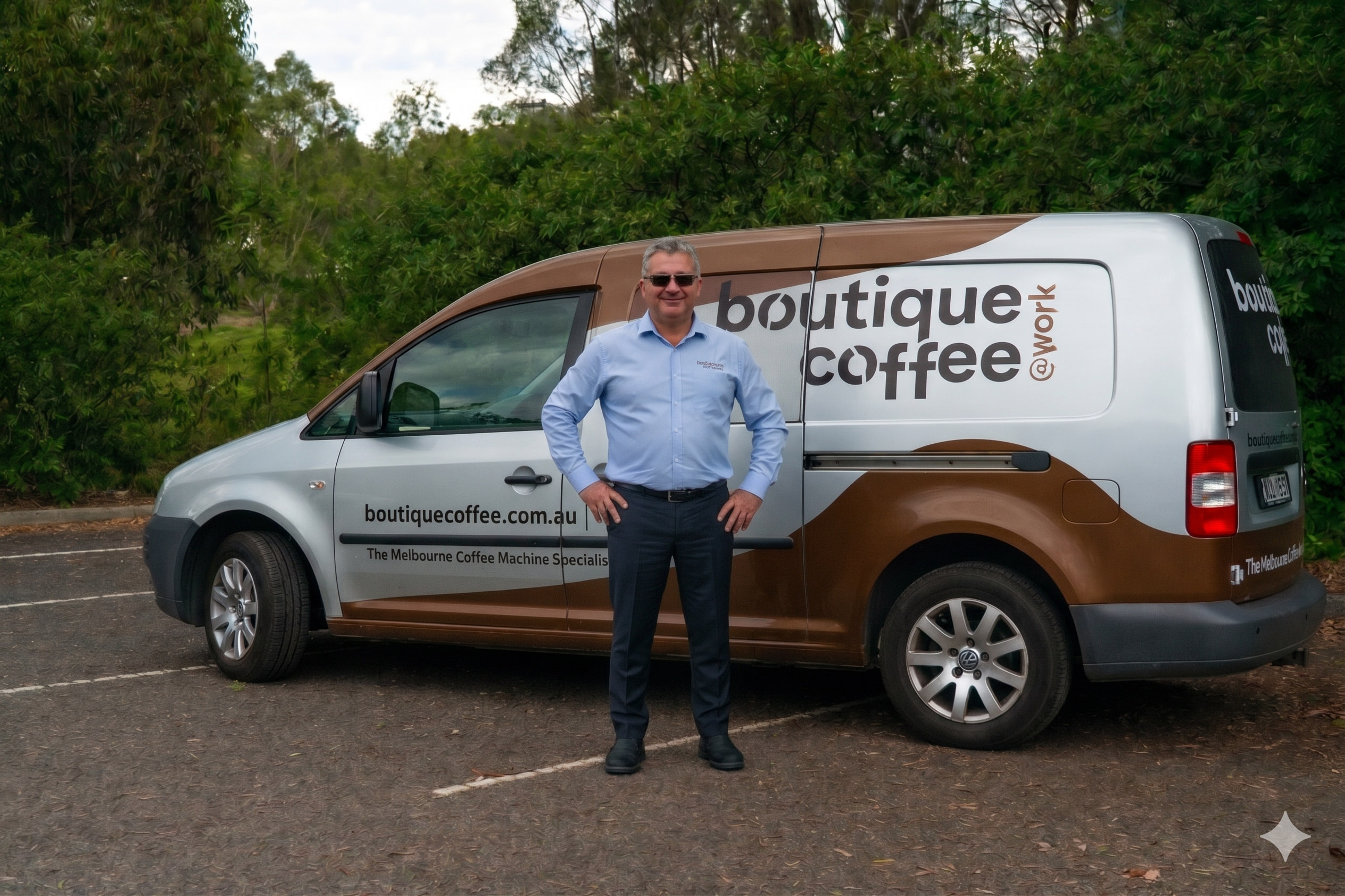
Boutique Coffee
The Boutique Coffee team
Melbourne workplace coffee, done properly.
Keep reading
Australian Workplace Perks and Amenities Statistics 2026
Key Statistics Summary According to the Australian Bureau of Statistics (ABS), 36% of employed Australians usually worked from home in August 2024. According…
Plumbed vs Water Tank Office Coffee Machines: Installation, Costs & Which Suits Your Workplace
Introduction If you are deciding between a plumbed office coffee machine and a water tank model, you are really choosing between consistency at scale and…
Office Coffee Machine Hygiene: Cleaning Standards & Food Safety for Australian Workplaces
If your office coffee machine has never been professionally cleaned, you are not alone. Across Melbourne workplaces, I see the same pattern repeatedly: a…