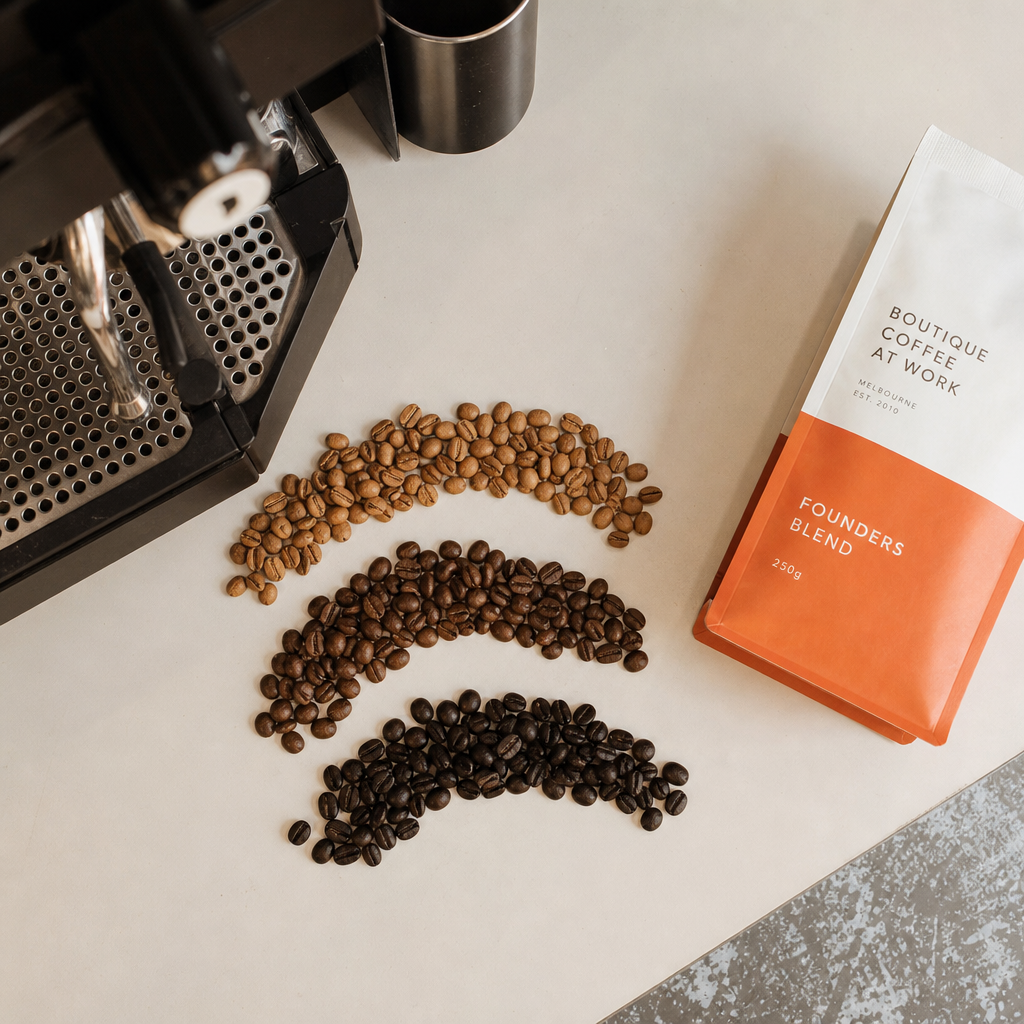
If your office coffee tastes flat, bitter, or just a step above instant, the machine probably isn't the problem. In most cases, it's the beans. The right coffee bean, matched to your machine type and your team's actual preferences, is the difference between a coffee station people walk past and one they genuinely look forward to using.
This guide covers everything you need to make a confident decision: Arabica versus Robusta, roast levels and which suit milk-based or black coffee drinkers, the case for blends over single origin in an office setting, how freshness affects extraction, and how to match your bean choice to your specific workplace culture. Whether you're running a bean-to-cup machine for 15 people or managing coffee supply for a 200-person Melbourne office, the principles here apply directly.
At Boutique Coffee at Work, we've been matching beans to workplace machines since 2008, across more than 200 active Melbourne clients. What follows isn't generic advice. It's what actually works in real offices, with real teams, every day.
Key Takeaways
- Arabica and Robusta each have a role. Blends combining both typically outperform single-variety beans in an office espresso context.
- Roast level has a larger impact on daily satisfaction than most buyers realise. Medium roast suits the widest range of office drink preferences.
- Freshness has a defined window. Beans used beyond 4-6 weeks post-roast produce noticeably poorer results, especially in automatic machines.
- Office machines, particularly bean-to-cup models, perform best with consistent, purpose-selected beans rather than whatever is cheapest per kilogram.
- Matching beans to your team's drink profile (milk-based vs black, strong vs smooth) produces measurably higher satisfaction than a one-size-fits-all supply.
- Australian-roasted, ethically sourced options are more accessible and more cost-competitive than most offices assume.
At a Glance: Office Coffee Preferences and Bean Freshness
| Factor | Detail | Practical Implication |
|---|---|---|
| Most popular workplace drink | Flat white or latte (milk-based) | Medium-dark roast blends perform best |
| Black coffee drinkers | Approximately 20-25% of typical office teams | Medium or light-medium roast suits this group |
| Optimal freshness window | 2-6 weeks post-roast | Order in quantities consumed within 3-4 weeks |
| Arabica content in quality office blends | Typically 60-100% | Higher Arabica = smoother, more complex flavour |
| Robusta contribution | Adds crema, body, caffeine | Useful in office blends at 10-30% blend ratio |
| Roast recommendation for bean-to-cup | Medium to medium-dark | Light roasts often under-extract in auto grinders |
| Decaf demand in typical office | 5-15% of team | Worth supplying separately once team size exceeds 20 |
| Average consumption per person per day | 2-3 cups | Key metric for calculating weekly bean order volume |
Why the Bean Decision Matters More Than the Machine
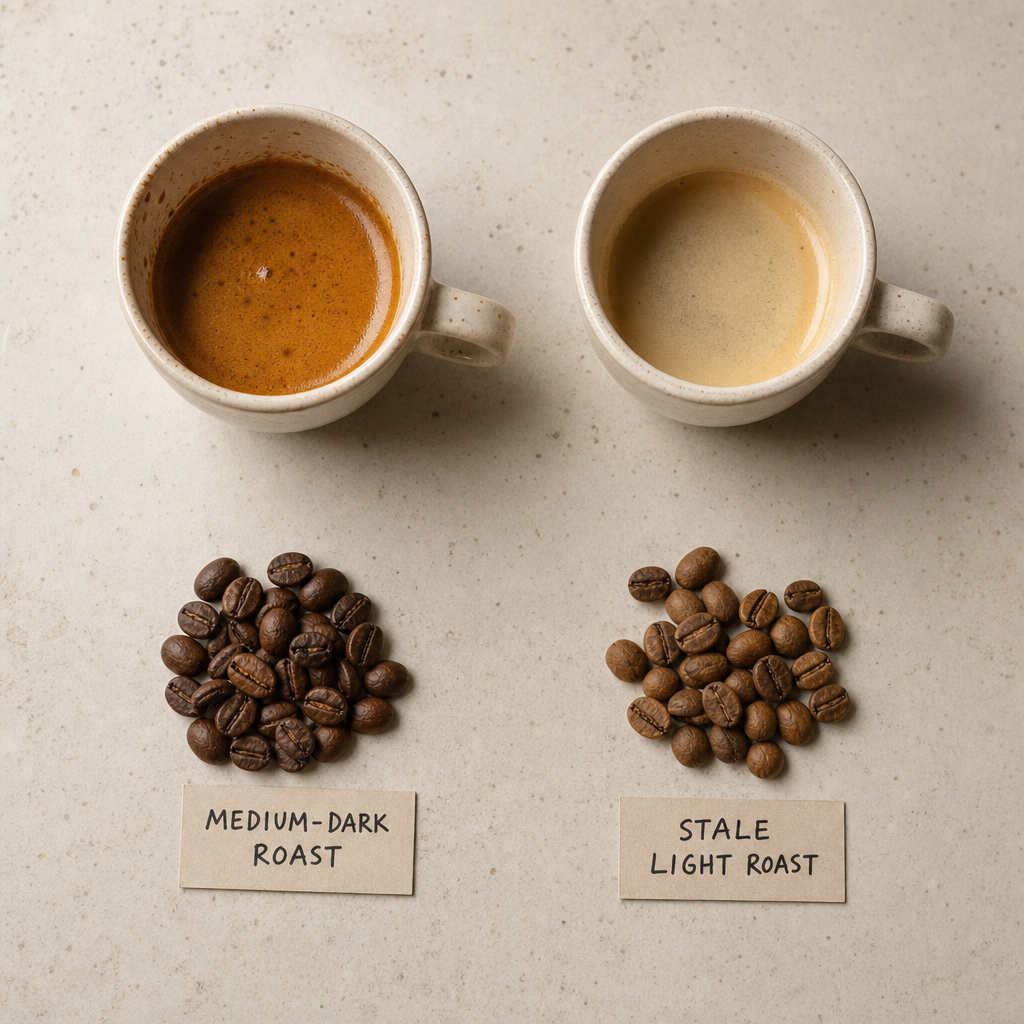
Most businesses investing in a quality office coffee machine spend significant time selecting the hardware and almost no time selecting the beans. That's the wrong order of priority.
A $12,000 commercial espresso machine fed mediocre, stale beans will produce mediocre, stale coffee. A properly maintained mid-tier bean-to-cup machine running fresh, well-matched beans will produce something your team actually wants to drink. The machine creates the conditions. The bean determines the outcome.
I've visited enough Melbourne offices over the past 17 years to see this pattern repeat constantly. The machine gets upgraded, the beans stay the same, and the team satisfaction barely shifts. Then we change the beans, and within a week there's a noticeable difference in how the station gets used.
The other reason bean choice matters at the office level specifically is volume. A home machine pulling two or three shots a day is forgiving. An office machine running 40, 60, or 150 cups a day will expose every weakness in your bean selection. Inconsistent roasting, poor storage, wrong grind profile for your machine type, these problems compound at scale.
The volume reality for Melbourne offices
Based on typical consumption across our active client base, a 30-person office will go through roughly 1-1.5 kilograms of whole beans per week. A 100-person office sits closer to 4-5 kilograms per week. At that volume, bean quality, freshness logistics, and machine compatibility all become genuinely operational concerns, not just preference calls.
Getting the bean selection right from the start, and reviewing it when the team grows or tastes shift, is how you protect both the coffee experience and the machine's long-term performance.
Arabica vs Robusta: What the Difference Actually Means in an Office
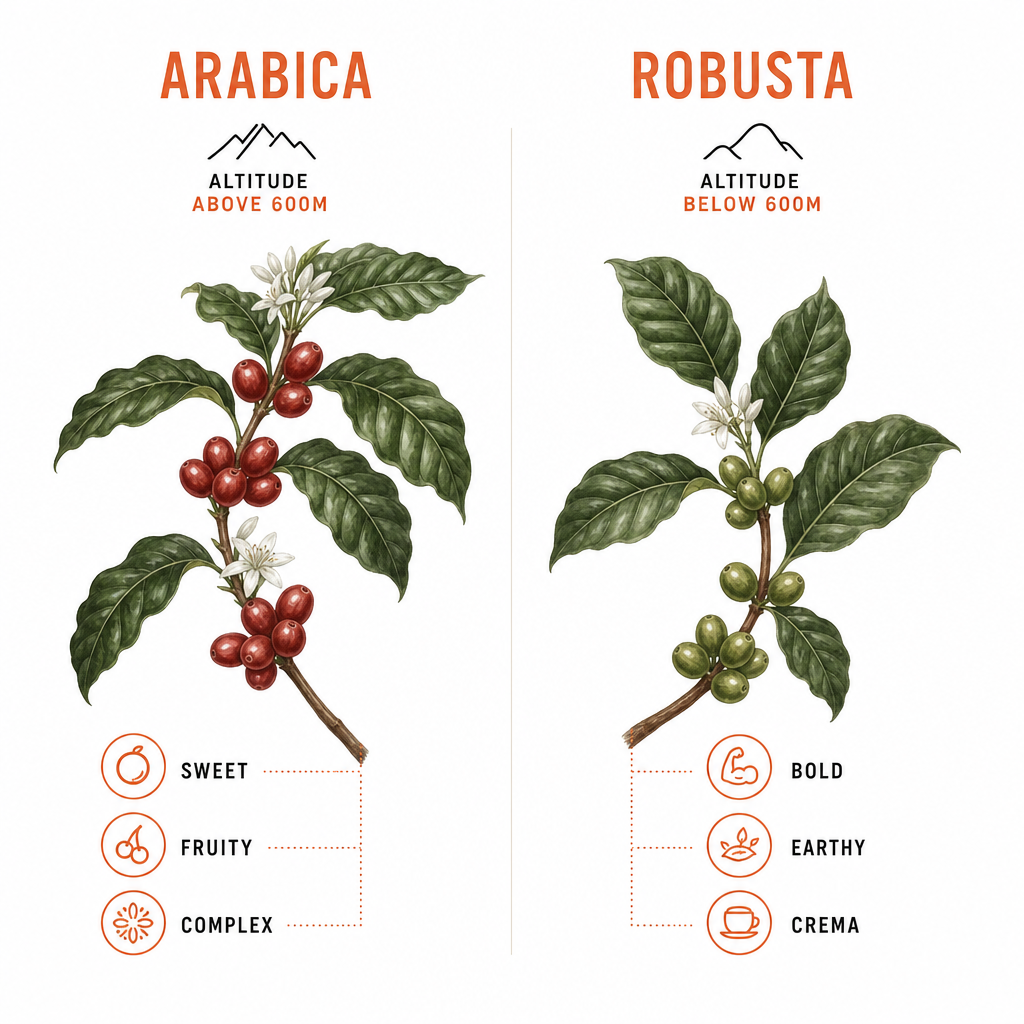
The Arabica versus Robusta distinction comes up in almost every supplier conversation, and it's often presented as a simple quality hierarchy: Arabica is premium, Robusta is inferior. That framing is too simple, and it leads offices to make suboptimal choices.
Arabica
Arabica beans (Coffea arabica) grow at higher altitudes, typically above 600 metres, in regions across Central and South America, East Africa, and parts of Asia. They contain less caffeine than Robusta (approximately 1.2-1.5% by weight), produce a more complex, nuanced flavour profile with notes that can range from fruity to nutty to chocolatey, and tend toward a naturally sweeter, softer body.
For black coffee drinkers in particular, a high-Arabica bean drunk as an espresso or long black rewards attention. The complexity is genuinely there.
The practical downside: Arabica produces less crema under espresso conditions, which is why a 100% Arabica shot can look thin in a commercial machine compared to what your team might expect.
Robusta
Robusta (Coffea canephora) grows at lower altitudes across parts of Africa, Vietnam, and Indonesia. It contains roughly twice the caffeine of Arabica (2-2.7% by weight), produces a thicker, more persistent crema, and contributes a stronger, earthier, sometimes more bitter flavour. At lower quality, it can taste harsh or rubbery. At higher quality, it adds depth and body that Arabica alone doesn't deliver.
For an office context, Robusta's main contribution is structural. It supports the base of a blend, lifts the caffeine content for people who need coffee to actually do something, and gives milk-based drinks the backbone to hold up against 150ml-200ml of steamed milk.
The blend argument for office machines
For most Australian workplaces, a well-constructed blend is the right answer. A blend at roughly 70-80% Arabica and 20-30% Robusta gives you complexity and sweetness from the Arabica, crema and body from the Robusta, and enough caffeine punch to satisfy the team's stronger-coffee contingent.
Single-origin Arabica beans, while genuinely excellent for filter or pour-over brewing, often underperform in a commercial espresso context. The delicate flavour notes that make them interesting to a specialty coffee enthusiast get muted under espresso pressure, and the light-roasted profile many single origins favour can cause under-extraction in the automatic grinders built into most office bean-to-cup machines.
This is the core of what I'd call a Curated Coffee Plan for any new workplace: we start by understanding how the team drinks their coffee, and we match the blend ratio and roast to that reality. A team of 40 where 80% drink flat whites needs a different bean than a 15-person tech office where half the team drinks espresso straight.
Roast Levels Explained: Light, Medium and Dark
Roast level is probably the most misunderstood variable in the office coffee conversation. People often equate darker roast with stronger coffee, and that's not accurate. Roast level determines flavour character, body, and acidity. Actual strength is primarily a function of dose and grind.
Light roast
Light roast beans are roasted to an internal temperature of approximately 180-205°C. They retain more of the bean's original character, which can mean higher acidity, more fruity or floral notes, and less of the caramelised, roasted flavours associated with espresso.
Light roasts are popular in specialty coffee circles and work well in filter brewing methods. In an office espresso machine, they present a challenge: most commercial grinders, particularly those built into bean-to-cup machines, are calibrated around medium-to-dark roasts. Light roast beans are denser and require a finer grind and longer extraction to develop properly. If the grinder isn't adjusted for a light roast, the result is sour, underdeveloped coffee that frustrates the team.
Light roast is a valid choice for an office with a knowledgeable barista-trained staff member managing the grinder, or for a high-end machine with a sophisticated grind profile. For most workplaces, it's a risk that isn't worth taking.
Medium roast
Medium roast, typically 210-220°C internal roasting temperature, is the sweet spot for the widest range of office coffee preferences. It retains enough of the bean's original character to be interesting, while developing the caramelised sweetness and reduced acidity that make espresso approachable for the majority of drinkers.
Medium roast suits milk-based drinks well. The flavour is present enough to come through the milk without needing to be intensely dark. It also works for black coffee drinkers who prefer a balanced cup without sharp bitterness. For a mixed-preference office team, medium roast is reliably the right starting point.
Dark roast
Dark roast (above 225°C) pushes the bean's original character aside in favour of roast-derived flavours. The result is a bold, full-bodied shot with low acidity, some bitterness, and the deep, smoky notes many people associate with traditional Italian-style espresso.
Dark roast performs consistently in milk-based drinks. A strong, assertive shot cuts through milk beautifully, which is why the traditional espresso blends used across Melbourne's café culture tend toward medium-dark or dark profiles. For an office where most people want a proper flat white or cappuccino, a medium-dark or dark roast is a reliable choice.
The trade-off is that dark roast narrows the flavour experience for black coffee drinkers and can mask quality differences between beans. If your office has a contingent of serious coffee drinkers, a split supply approach, medium roast for the bean-to-cup machine and a darker blend for the espresso setup, can work well.
Matching roast to your machine type
| Machine Type | Recommended Roast | Reason |
|---|---|---|
| Automatic bean-to-cup | Medium to medium-dark | Consistent grind calibration; light roasts under-extract |
| Traditional espresso + grinder | Medium-dark to dark | High extraction pressure rewards bolder profiles |
| Filter/batch brew machine | Light to medium | Lower extraction temperature suits lighter roasts |
| Pod/capsule machine | Capsule-specific, not applicable | Bean choice not relevant; capsule format controls extraction |
Whole Bean Freshness: The Variable Most Offices Get Wrong
Freshness is the most consistently neglected variable in office coffee supply. Beans begin degassing CO2 immediately after roasting, and this degassing process is fundamental to extraction quality. Within the first 2-4 days post-roast, beans are often too gassy to extract evenly. From approximately day 5 to day 42 post-roast, most espresso blends are in their optimal window. Beyond 6 weeks, even well-stored beans begin to produce noticeably flatter, less vibrant coffee.
The implication for offices is straightforward: order quantities that your team will consume within 3-4 weeks. Buying in bulk to save on per-kilogram cost only makes sense if the consumption rate keeps the beans within their freshness window.
Storage fundamentals
Whole beans should be stored in an airtight container, away from direct sunlight, heat sources, and moisture. An office kitchen bench near the kettle or coffee machine is often the worst possible location for long-term bean storage. A cool, dark cupboard is far better.
Refrigerating whole beans is a contested practice. The concern is that beans in an open or loosely sealed container will absorb odours and moisture from the fridge environment. If you're refrigerating, use a genuinely airtight container with a one-way CO2 valve.
Freezing is an option for longer-term storage of sealed bags, but it's rarely necessary in an office context where weekly or fortnightly deliveries keep supply fresh. The logistics of correctly defrosting and using frozen beans introduce more variables than they solve for most workplace setups.
The grind freshness consideration
For offices using whole bean machines with integrated grinders, the grind should happen immediately before brewing. Pre-ground coffee loses its volatile aromatic compounds within minutes of grinding. The surface area created by grinding dramatically accelerates oxidation.
If your office is using a separate grinder, grind what you need for the session and store the rest as whole beans. Grinding a week's worth of coffee on Monday morning and storing it in the hopper is one of the most common causes of flat-tasting office coffee I encounter on site visits.
Bean Compatibility with Bean-to-Cup Machines
Bean-to-cup machines, which integrate the grinder, tamper, and brewing unit into a single automated system, are the most common commercial machine type in Australian offices above 15 people. They're the right choice for most workplaces: consistent output, minimal staff training required, and scalable to team size.
They're also the machine type most affected by the wrong bean selection.
Why bean-to-cup machines are sensitive to roast
The integrated grinders in commercial bean-to-cup machines like the WMF range we supply are calibrated for a specific density range. That range corresponds roughly to medium and medium-dark roasts. Light roast beans, being denser, require a finer grind setting. If the grinder isn't manually adjusted, the extraction will be too short, resulting in sour, thin coffee.
Oily, very dark roast beans present a different problem. Excess surface oil from an extremely dark roast can build up on the grinder burrs and in the brew unit over time, causing blockages, inconsistent extraction, and accelerated wear. Most quality medium-dark roasts don't have this issue. The problem is more pronounced with very oily Italian-style roasts or specialty dark roasts.
Grind size and machine calibration
When we install a new machine through our Six-Step Process, one of the most important steps on install day is dialling in the grinder to the specific bean we're supplying. This takes 15-20 minutes and involves pulling test shots, assessing extraction time and yield, and adjusting the grind size until the shot parameters are consistent. We leave a cheat sheet with the settings so that if the grinder drifts over time, staff know what to check.
What this means in practice: if you change your bean supply, particularly if you change roast level, the grinder needs to be recalibrated. This is not a minor point. A grinder set for a medium-dark roast and then loaded with a light roast will produce poor coffee until someone adjusts it. This is one reason we review bean selection whenever a client wants to change their supply, it's not just a flavour question, it's an operational one.
Explore our full range of coffee bean options to see what's available for your workplace machine.
Blends vs Single Origin for Office Machines
The specialty coffee movement has done a lot for the quality of Australian coffee culture. It has also created some confusion in the office context, where single-origin beans are sometimes assumed to be the premium choice.
Single-origin beans, sourced from one farm, cooperative, or region, offer traceability, distinctive flavour character, and a story worth telling. In a café environment with a skilled barista dialling in a specific extraction for that bean's profile, they shine. In an office bean-to-cup machine running 80 cups a day across a team with varied preferences, they're often a poor fit.
The reasons:
First, single-origin beans tend to be lighter roasted, which, as covered above, creates extraction challenges in automatic grinders. Second, their distinctive flavour profiles, high acidity, unusual fruit notes, or unexpected bitterness, can alienate the majority of office drinkers who just want a reliable, approachable flat white. Third, single-origin supply is seasonally variable. When the harvest changes, the flavour changes, sometimes significantly. For a consistent office experience, that variability is a problem.
Blends, by contrast, are designed for consistency. A good roaster will adjust the blend components season to season to maintain the target flavour profile as individual components vary. For an office, that consistency is a genuine asset.
That said, there is a middle ground: a high-quality, well-constructed Arabica-dominant blend that showcases a particular regional character without the extraction challenges of a specialty light roast. This is often the best of both worlds for an office that wants quality and approachability at the same time.
Sustainable and Australian-Roasted Options
For many Melbourne workplaces, the sustainability credentials of their coffee supply are increasingly relevant. Whether that's driven by company values, staff expectations, or formal ESG commitments, the good news is that quality and ethical sourcing are no longer in tension.
Australian-roasted beans, sourced from Rainforest Alliance, Fairtrade, or direct-trade relationships with farming cooperatives, are readily available at price points that work for commercial supply. The roasters serving the workplace market have, over the past decade, significantly improved both their sourcing transparency and their roasting consistency.
When evaluating a coffee bean supplier, the questions worth asking are:
- Can they tell you the origin of the beans by country and region, not just "blend"?
- Are the beans roasted in Australia, and how recently?
- What is their minimum order frequency to ensure freshness?
- Do they hold any formal certification (Fairtrade, Rainforest Alliance, Organic)?
- Can they provide a Rainforest Alliance or Fairtrade certificate on request?
At Boutique Coffee at Work, we supply Australian-roasted beans as standard. Every client gets beans that are roasted locally and delivered on a schedule matched to their consumption rate. That's not just better for flavour. It's better for the environment and the farming communities at the start of the supply chain.
If your business has a sustainability policy that includes procurement commitments, we can discuss specific certification options when we talk through your coffee supply solutions.
Matching Beans to Your Team's Taste Profile
This is the practical step most suppliers skip. They send you a bag of their house blend and leave you to figure out whether your team likes it. That approach is fine for a café, where the customer can order elsewhere if they don't. In an office, there's no alternative down the hall. The bean that goes in the machine is the only option available.
The approach that consistently produces better outcomes is what I call the Curated Coffee Plan: before we settle on a bean, we take 10 minutes to understand how the team actually drinks their coffee.
The questions that matter:
- What percentage of the team drink milk-based coffees (flat white, latte, cappuccino) versus black (espresso, long black, filter)?
- Is there a preference for strong, full-bodied coffee versus smooth and approachable?
- Are there any strong dislikes (e.g., very bitter, very acidic)?
- Is there significant demand for decaf?
- Are there any dietary considerations (some flavoured or processed beans contain additives)?
A team of 50 where 85% drink flat whites and want something strong and reliable is perfectly served by a medium-dark Arabica-Robusta blend. A 20-person creative agency where half the team drink long blacks and have strong opinions about acidity is a different conversation, and probably wants a higher-Arabica medium roast.
Starting on the right bean from day one means fewer complaints, higher consumption, and a coffee station that actually earns its space in the kitchen.
Client Case Study 1: Pepperl+Fuchs Australia, Melbourne
One of the clearest examples of how much the bean decision matters came from a Melbourne manufacturing office I've been working with for several years. The team had a coffee setup in place when I first visited, but the feedback was consistent: the coffee was average, usage was low, and staff were either bringing coffee from outside or not bothering.
After going through the Curated Coffee Plan process, it was clear the existing beans were the wrong roast profile for the machine and, frankly, the wrong quality tier for what the team actually wanted. We moved them onto a medium-dark Arabica-dominant blend, installed a WMF commercial machine properly matched to the team size, and dialled in the grinder on install day.
The change was immediate and measurable. Paul Bruno, the site manager, told me the team responded almost immediately. He put it simply: the staff told him how much they appreciated having great coffee, and his response was straightforward. "No problem, just keep doing what you're doing." That kind of feedback, unprompted and direct from the team, is exactly what good bean matching produces. The setup has been running consistently ever since.
Client Case Study 2: AJM-JV, Melbourne
A different issue, but the same root principle: the bean supply needs to be managed as carefully as the machine. This Melbourne workplace was experiencing real disruption whenever their coffee machine went down. In a busy team, losing the coffee station for even half a day has a knock-on effect on mood and productivity that people underestimate until it happens.
The solution wasn't just about the machine. It was about creating a reliable, consistent supply rhythm so the team always had what they needed. Chrissie Straw, who manages the site, noted that having regular, scheduled service and a direct line to someone who actually knows the setup meant the team always had coffee when they needed it most. "Reliable, regular service" was how she described it. No tickets, no call centres, no waiting on hold. One number, one person.
When your bean supply is managed the same way, with a consistent delivery schedule and someone paying attention to consumption rates, you eliminate the other common disruption: running out.
Decaf, Alternatives and Specific Dietary Needs
Decaf is underused in Australian workplaces. The standard assumption is that it's a niche request, but in practice, across a team of 30 or more, there are almost always team members who want good coffee later in the day without the caffeine hit. Pregnant staff, those with caffeine sensitivities, and afternoon meetings all create genuine decaf demand.
Modern Swiss Water Process decaf beans, which use water extraction rather than chemical solvents to remove caffeine, produce a significantly better result than the decaf of a decade ago. In a properly maintained machine with a well-matched decaf bean, most people can't reliably distinguish it from regular coffee in a milk-based drink.
The practical approach for offices: once your team size exceeds 20, it's worth stocking a small quantity of decaf whole beans, separately stored and clearly labelled, for use in an alternate hopper or a smaller dedicated machine. The demand is there even if people haven't explicitly asked for it.
For offices with staff who have specific dietary requirements, such as those avoiding gluten-containing additives or artificial flavours, the safest approach is a plain, unflavoured espresso blend. Flavoured coffee beans introduce variables that aren't always clearly labelled, and in a workplace setting, simplicity is a practical advantage.
How to Switch Coffee Bean Suppliers Without Disrupting Your Office
Switching bean suppliers is straightforward if managed properly. The main risks are a grinder calibration mismatch (covered above), a gap in supply during the transition, and the team adjusting to a different flavour profile if the change is significant.
The practical steps:
- Overlap your supply for at least one delivery cycle. Don't run out of the existing beans before the new ones arrive.
- Inform whoever manages the machine that a grinder recalibration may be needed. If your supplier handles machine servicing, arrange a visit around the bean change.
- Communicate the change to the team. People notice, and a brief note explaining that the coffee is changing, and why, avoids unnecessary complaints about "something tasting different."
- Allow a 2-4 week period for genuine feedback before making a second adjustment. Initial reactions to a flavour change aren't always representative of settled preference.
At Boutique Coffee at Work, every bean change is treated as a mini-onboarding. We revisit the Curated Coffee Plan process, recalibrate the grinder if needed, and check in after the first delivery to see how the team is responding. That's what being a coffee partner rather than just a supplier actually looks like in practice.
If you're ready to try a better bean matched to your machine and your team, you can start a free trial or get in touch directly to talk through your setup.
Testimonial
"Chris's attention to detail is the reason we can serve great coffee every day without interruption. He manages the supply and the machine, and nothing falls through the cracks."
, Michael May, Melbourne business client, Boutique Coffee at Work
References
-
Specialty Coffee Association (SCA), "Water Activity and Coffee Storage Research," SCA Technical Standards Series. Covers optimal storage conditions, freshness windows post-roast, and the impact of humidity and temperature on bean degradation. Used to inform freshness window guidance in this article.
-
Australian Bureau of Statistics (ABS), "Household Expenditure Survey: Food and Beverages," ABS.gov.au. Provides data on Australian coffee consumption habits by drink type, informing workplace preference splits cited in the summary table.
-
Food Standards Australia New Zealand (FSANZ), "Standard 4.5.1 Coffee and Coffee Products," FSANZ Food Standards Code. Defines regulatory standards for coffee labelling, composition, and decaffeination processes relevant to Australian suppliers.
-
Fairtrade Australia and New Zealand, "Fairtrade Certified Coffee: Standards and Certification," Fairtrade ANZCO. Describes Fairtrade certification criteria for coffee sourcing, relevant to ethically sourced supply options for Australian workplaces.
-
World Coffee Research, "Arabica Coffee Varieties and Sensory Profiles," World Coffee Research Variety Catalogue. Peer-reviewed reference covering Arabica variety characteristics, sensory attributes, and growing altitude data used in the Arabica vs Robusta section.
-
Boutique Coffee at Work internal client data, 2026. Consumption rate benchmarks, client relationship tenure, and response time metrics cited in this article are drawn from active client records across 200+ Melbourne workplace accounts.
Frequently asked questions
How many kilograms of coffee beans does my office need per week?
The standard calculation is approximately 2-3 cups per person per day, with each kilogram of whole beans producing roughly 55-65 espresso-based drinks. A 20-person office will typically use around 500-700 grams per week. A 50-person team will use 1.5-2 kilograms. A 100-person office sits at 4-5 kilograms per week. These figures vary based on your machine type, shot size, and the proportion of the team who actually use the coffee station.
What is the best roast level for an office espresso machine?
For most Australian offices, medium to medium-dark roast is the most reliable choice. It suits the widest range of drink preferences, from flat whites to long blacks, and is compatible with the grinder profiles built into the commercial bean-to-cup machines most commonly used in workplaces. Light roasts often under-extract in automated grinders unless the machine is specifically calibrated for them.
How should we store coffee beans in the office?
Store whole beans in an airtight container with a one-way CO2 valve, away from direct sunlight, heat, and moisture. A cool, dark cupboard is ideal. Avoid storing beans near the coffee machine itself if it generates significant heat. Do not store beans in an open container in the fridge. For most offices, weekly or fortnightly deliveries matched to consumption rate are a better freshness strategy than bulk buying and long-term storage.
Can we offer decaf through our office machine?
Yes, and it is worth doing once your team exceeds around 20 people. Swiss Water Process decaf, which uses no chemical solvents, produces excellent results in commercial espresso machines. The practical options are a dual-hopper machine that can hold both regular and decaf beans simultaneously, a separate small machine dedicated to decaf, or a manual switch between beans with a grinder clean-out in between.
Is Arabica always better than Robusta for office coffee?
Not in isolation. 100% Arabica beans produce less crema and may lack the body needed to hold up in milk-based drinks. A well-constructed blend with 70-80% Arabica and 20-30% quality Robusta typically outperforms either variety alone in an office espresso context. The Robusta component contributes crema, caffeine, and body. The Arabica contributes flavour complexity and sweetness.
How do I know when it is time to change our coffee bean supplier?
The clearest signals are: the coffee quality has declined without any machine changes; your supplier is slow to respond to service or delivery issues; the bean supply does not align with your consumption rate; or the team is consistently unhappy with the flavour. A good bean supplier reviews your setup proactively, not reactively. If you are chasing your supplier rather than the other way around, that is a sign the relationship is not working.
How quickly can Boutique Coffee at Work set up a new office coffee supply?
For Melbourne clients, most engagements go from first enquiry to an installed machine and first delivery within 5-7 business days. The process starts with a short phone call, followed by an on-site visit to assess power, plumbing, and bench space. Install day is typically 45 minutes, and we train at least two staff members on the same visit. Bean deliveries are then scheduled to match your consumption rate. There is no lock-in contract and no minimum term.
Can we source Australian-roasted and ethically certified beans through Boutique Coffee?
Yes. All beans supplied through Boutique Coffee at Work are roasted in Australia and delivered fresh. We can discuss specific origin stories, Fairtrade or Rainforest Alliance certification, and organic options depending on your workplace requirements. If your business has a sustainability procurement policy, we can work within those parameters when selecting your bean supply.
Chris
Chris
Keep reading
Office Coffee vs Daily Cafe Runs: The True Cost Comparison for Australian Workplaces
If your team of 30 is walking to the cafe twice a day, you are not just spending money on coffee. You are spending money on time, on attention gaps, on the…
27 Workplace Coffee Statistics for 2025: Australian Consumption, Costs & Trends
Key Statistics at a Glance Australians drink approximately 3.2 kg of coffee per person per year, placing the country among the top coffee-consuming nations in…
Office Coffee in Melbourne: The Complete Workplace Guide to Machines, Costs, Beans and Service
The best office coffee in Melbourne comes from a commercial bean-to-cup or espresso machine sized to your headcount, rented month-to-month with installation,…