
Fresh milk is the better office coffee option when taste, texture and employee experience matter. Powdered milk suits workplaces prioritising simple storage and lower refrigeration demands. The right choice still depends on usage, cleaning capacity and service support. For most Melbourne offices seeking café-quality coffee, I recommend a properly maintained fresh milk system.
Introduction
The gap between Melbourne's café coffee and the drink inside many offices usually becomes obvious at the milk stage. Good beans cannot compensate for thin texture, stale powder or an incorrectly cleaned milk system. Your milk choice affects every cup, along with hygiene, staff effort, machine reliability and perceived workplace value.
I have focused exclusively on workplace coffee since 2008. This guide explains where each system works, where it fails and how to choose without being upsold into unnecessary equipment.
Key takeaways
Fresh milk normally produces the better flat white, latte and cappuccino, but only when refrigeration, cleaning and servicing are handled correctly. Powdered milk is convenient and shelf-stable before preparation, yet it does not remove maintenance or hygiene responsibilities. The strongest office setup is the one your team can operate consistently.
- Fresh milk offers the closest result to a Melbourne café, particularly for texture and mouthfeel.
- Powdered milk reduces cold-storage dependence but can introduce a cooked flavour or thinner finish.
- Fresh milk systems require temperature control and thorough cleaning of every milk-contact component.
- Powder dispensers still need dry, clean hoppers and regular attention to mixing chambers and outlets.
- Perceived value depends on the complete cup, not merely the machine specification.
- Machine fit and accountable servicing matter more than a long list of automated features.
Fresh milk and powdered milk summary
The practical difference is not simply fresh versus dry. It is a choice between distinct storage, preparation and maintenance workflows. Fresh milk generally leads on cup quality and staff perception. Powder leads on ambient storage before use. Neither option is maintenance-free, and poor management can undermine the supposed advantage of either system.
| Factor | Fresh milk system | Powdered milk system | Practical verdict |
|---|---|---|---|
| Taste | Familiar dairy flavour with better integration into espresso | Product-dependent, sometimes sweeter or more cooked in character | Fresh milk usually wins |
| Texture | Can produce smooth microfoam when calibrated correctly | Often produces a lighter, more uniform foam | Fresh milk better matches café expectations |
| Storage | Requires reliable refrigeration and stock rotation | Unopened powder can be stored dry according to its label | Powder is simpler before preparation |
| Hygiene | Requires temperature control and cleaning of milk lines | Requires moisture control and cleaning of hoppers and mixers | Both require a defined routine |
| Staff effort | Milk containers must be checked, replaced and refrigerated | Hopper levels and powder condition must be checked | Depends on machine design and service |
| Waste | Open milk can spoil if demand is misjudged | Powder can clump or deteriorate if exposed to moisture | Usage patterns determine the result |
| Perceived value | Closely aligned with café-style workplace coffee | Commonly associated with convenience-led vending | Fresh milk usually feels more premium |
| Best fit | Offices where milk-based drinks and experience matter | Sites prioritising simple storage and rapid automated dispensing | Choose around culture and operating conditions |
What is the difference between fresh milk and powdered milk office coffee?
Fresh milk machines draw chilled liquid milk into a frothing or heating system. Powdered dispensers combine stored milk powder with water inside the machine. That mechanical difference changes flavour, texture, storage, cleaning and failure points. It also changes what staff must check before the first coffee and throughout a busy workday.
Codex Alimentarius defines milk powders as milk products obtained through the partial removal of water from milk (Codex Alimentarius). Powder is not automatically fake milk. However, removing water and later reconstituting the product creates a different sensory and operational result from heating refrigerated liquid milk.
A fresh milk coffee machine may use an integrated refrigerator, an adjacent milk fridge or another manufacturer-approved chilled container. The machine draws milk through tubing before heating and aerating it. Automatic cleaning programmes can support the process, but they do not remove the need to follow the manufacturer's instructions.
A powdered milk coffee dispenser normally holds powder in a hopper. A measured portion enters a mixing chamber, where the machine adds hot water and dispenses the reconstituted milk product. This works well for speed and repeatability, particularly where convenience matters more than café-style texture.
The labels can also hide important differences. Some vending products are dairy-based whiteners rather than straightforward milk powder. Ingredients may include sweeteners, vegetable fats, anti-caking agents or flavour components. Read the ingredient list and allergen declaration rather than assuming every powder is equivalent.
Which option makes better-tasting office coffee?

Fresh milk normally makes the better-tasting flat white, latte and cappuccino because its flavour, body and foam behave more like the milk used in Australian cafés. Powder can produce an acceptable drink, but it rarely delivers the same natural mouthfeel. Bean quality, water, temperature and calibration still influence the final cup.
Taste is not one isolated property. Staff experience the balance between espresso, sweetness, temperature, body and aroma. Fresh milk generally integrates more naturally with espresso. When it is textured correctly, it softens acidity without burying the coffee under a separate powder flavour.
Powdered products can taste sweeter, thinner or slightly cooked. The result depends on the formulation, dose, water temperature and cleanliness of the mixing system. A good powder in a clean, calibrated dispenser can outperform neglected fresh milk. That does not make powder the stronger format. It shows that execution matters.
Texture matters as much as flavour
Melbourne workers generally know what a flat white should feel like. Smooth microfoam carries the espresso across the palate. Large bubbles, watery foam or a rigid cap make the drink feel closer to vending coffee.
Fresh milk gives a capable machine more control over aeration and texture. Powder systems tend to optimise for consistent output rather than true microfoam. That distinction is easy to dismiss in a specification sheet and obvious in the cup.
The beans must be selected for milk drinks
Milk can flatten a light or delicate espresso. A workplace where most people order milk-based drinks needs beans with enough structure to remain clear through the milk. That is why our Curated Coffee Plan starts with the team's actual preferences, including drink style, strength and dislikes.
We then choose an appropriate blend and adjust it after the team has used it. The beans are chosen on purpose rather than supplied as a generic add-on. You can review Boutique Coffee's workplace coffee options when comparing complete systems.
Temperature can ruin either format
Very hot milk is not evidence of a better machine. Excessive heat can make a drink taste flat and unpleasant. Powder also depends on correct water temperature and dosage. If the machine is miscalibrated, staff may receive a weak drink, undissolved powder or an overpowering milk component.
A proper installation includes tasting and adjustment. Reading the factory defaults is not enough. Espresso extraction, milk delivery and cup size must work together.
Is fresh milk hygienic in an office coffee machine?
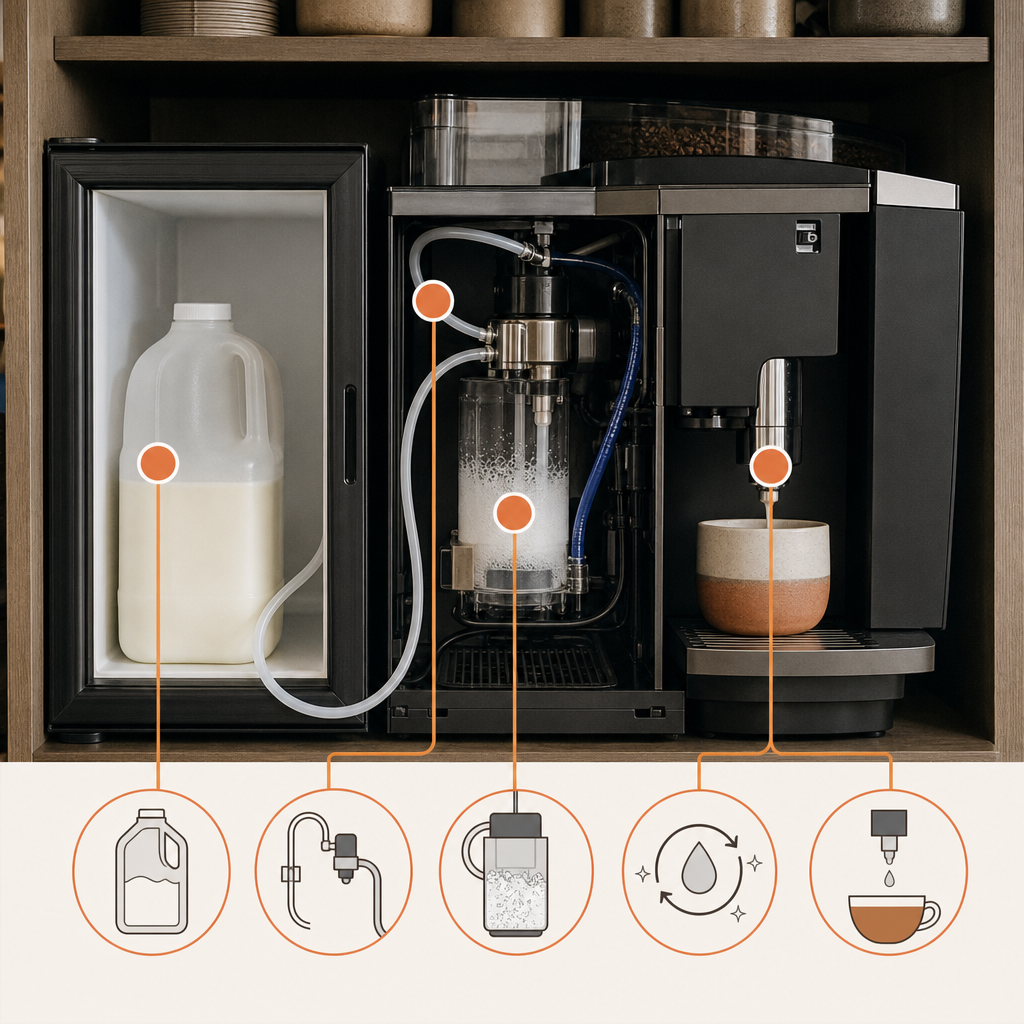
Fresh milk is hygienic when it remains under effective temperature control and every milk-contact surface is cleaned as directed. It becomes risky when milk warms, residue remains in tubing or staff improvise the cleaning routine. Powder avoids liquid refrigeration before mixing, but moisture and residue can still create hygiene and product-quality problems.
Food Standards Australia New Zealand states that potentially hazardous food generally needs to be kept at or below 5°C, or at or above 60°C, unless another safe control is used (FSANZ). Offices using fresh milk should treat refrigeration as an operating requirement, not an optional accessory.
That means checking that the milk fridge is working, keeping the container closed, rotating stock and returning milk to refrigeration promptly. The coffee machine's milk hose, frothing unit and outlet also need the cleaning process specified by the manufacturer.
Automatic cleaning is helpful, not magical
Many commercial machines run automatic rinsing or milk-cleaning programmes. These reduce staff effort and improve consistency. They still require the correct cleaning product, correct frequency and human follow-through.
A screen saying "cleaning complete" does not confirm that somebody inspected a removable nozzle or replaced a deteriorated hose. The practical routine should identify who performs each task and what to do when the nominated person is absent.
Powder systems have different hygiene risks
Powdered milk is easier to store before preparation because it does not require refrigeration while sealed and kept according to its label. Once loaded into a machine, it needs protection from moisture, contamination and careless topping up.
A hopper should not become a permanent container where new powder is repeatedly poured over old residue. Mixing chambers and dispensing outlets can retain damp product. Clumping is also an operational warning because it can affect dosing and indicate moisture exposure.
Dairy powder still presents a milk allergen. FSANZ requires prescribed allergen information to be declared clearly on packaged food labels (FSANZ). In a shared workplace, staff should be able to identify what the machine contains.
Plant-based milk needs its own controls
A fresh milk setup may support oat, soy, almond or other alternatives, depending on the machine and workplace process. Do not run different products through shared components without considering cross-contact, cleaning and manufacturer guidance.
An open carton of plant-based milk also needs storage according to its label. It should not be left beside the machine merely because it is not dairy milk. If allergies are a material workplace concern, separate equipment or a controlled manual process may be more appropriate.
Which milk system needs more maintenance?
Fresh milk systems generally demand a stricter cleaning and refrigeration routine. Powder systems simplify cold storage but require hopper, mixer and outlet maintenance. The real maintenance burden depends on machine design, usage and service quality. A neglected powder machine can be less reliable and less hygienic than a properly supported fresh milk machine.
Fresh milk components carry a perishable product through narrow pathways. Residue can affect flavour, flow and frothing performance. The team needs a simple close-down routine, while the service provider must inspect components that ordinary users should not dismantle.
Powder creates another set of issues. It can bridge inside a hopper, clump when exposed to humidity, coat internal surfaces and obstruct the mixing system. A dispenser that appears convenient may still require frequent intervention if the product and machine are poorly matched.
Separate user tasks from technician tasks
A strong workplace setup distinguishes between routine operator care and technical servicing.
Staff tasks may include:
- checking milk or powder levels
- running the prompted cleaning cycle
- wiping the steam or dispensing area
- emptying waste containers
- reporting unusual noises, leaks or changes in cup quality
Technical service may include:
- inspecting internal milk or powder pathways
- replacing worn seals, tubes and other service parts
- checking refrigeration performance
- calibrating coffee, water and milk delivery
- investigating recurring errors rather than repeatedly resetting them
The machine supplier should explain these responsibilities during installation. A laminated instruction beside the machine is more useful than a manual hidden in a cupboard.
Service response is part of the system
An office machine is most valuable when it works during the coffee moments that matter. At a busy Melbourne workplace we support, machine downtime had previously caused serious disruption during peak office hours. We introduced scheduled servicing and direct personal contact for faults. The team then had reliable coffee when demand was highest.
That outcome was not created by milk format alone. It came from maintenance ownership. Our model is one number, one person, with no call centres and no corporate runaround.
Across Boutique Coffee's active client base, our own 2026 records show a typical service-call response time of 24 hours. That does not mean every fault can be repaired remotely. It means an accountable person familiar with the site can diagnose the issue and organise the next step without an internal escalation path.
How do fresh milk and powder compare on cost and perceived value?
Powder can reduce refrigeration, spoilage exposure and some handling, but the lowest operating cost does not automatically produce the best workplace value. Fresh milk often creates stronger perceived value because employees recognise it as closer to café coffee. Compare the complete service, labour, waste, reliability and employee experience, not only ingredient price.
A purchasing team can easily compare invoices and miss the hidden costs. Staff time spent cleaning, refilling or troubleshooting matters. So does waste from over-ordering fresh milk or mishandling powder. Machine downtime has a cost when employees leave the office to buy coffee or gather around a failed dispenser.
There is also a difference between price and perceived value. A technically expensive machine may deliver little value if the milk tastes poor. A correctly sized commercial machine with fresh milk and dialled-in beans can feel more considered, even without every available feature.
Fresh milk signals care more clearly
Employees rarely inspect pump specifications. They notice whether the coffee tastes good, whether their preferred drink is available and whether the machine works. Fresh milk supports the familiar ritual of a café-style coffee without requiring employees to leave the workplace.
This does not mean every site should install the most expensive fresh milk machine. I recommend equipment based on actual team size and demand. Upselling creates the wrong machine, the wrong cleaning burden and the wrong relationship.
Powder may be the rational commercial choice
Powder deserves consideration where refrigerated storage is impractical, demand is irregular or unattended dispensing is the main requirement. It can also suit sites where speed and simple drink consistency outrank milk texture.
The mistake is presenting powder as identical to fresh milk. It is a different product with different strengths. A clear decision beats a sales pitch that hides the trade-off.
Ask suppliers to expose the whole cost model
Before choosing, confirm what the quoted arrangement includes:
- machine rental or purchase
- refrigeration equipment
- installation and plumbing
- cleaning products
- scheduled servicing
- call-out arrangements
- beans, milk powder and other consumables
- training for staff
- collection or exit terms
Our rentals are month-to-month, with one month's notice and free machine pickup under our stated terms. No lock-in, ever. The point is accountability. Long relationships should continue because the service works, not because the exit clause is painful.
Which office coffee milk option suits your workplace?
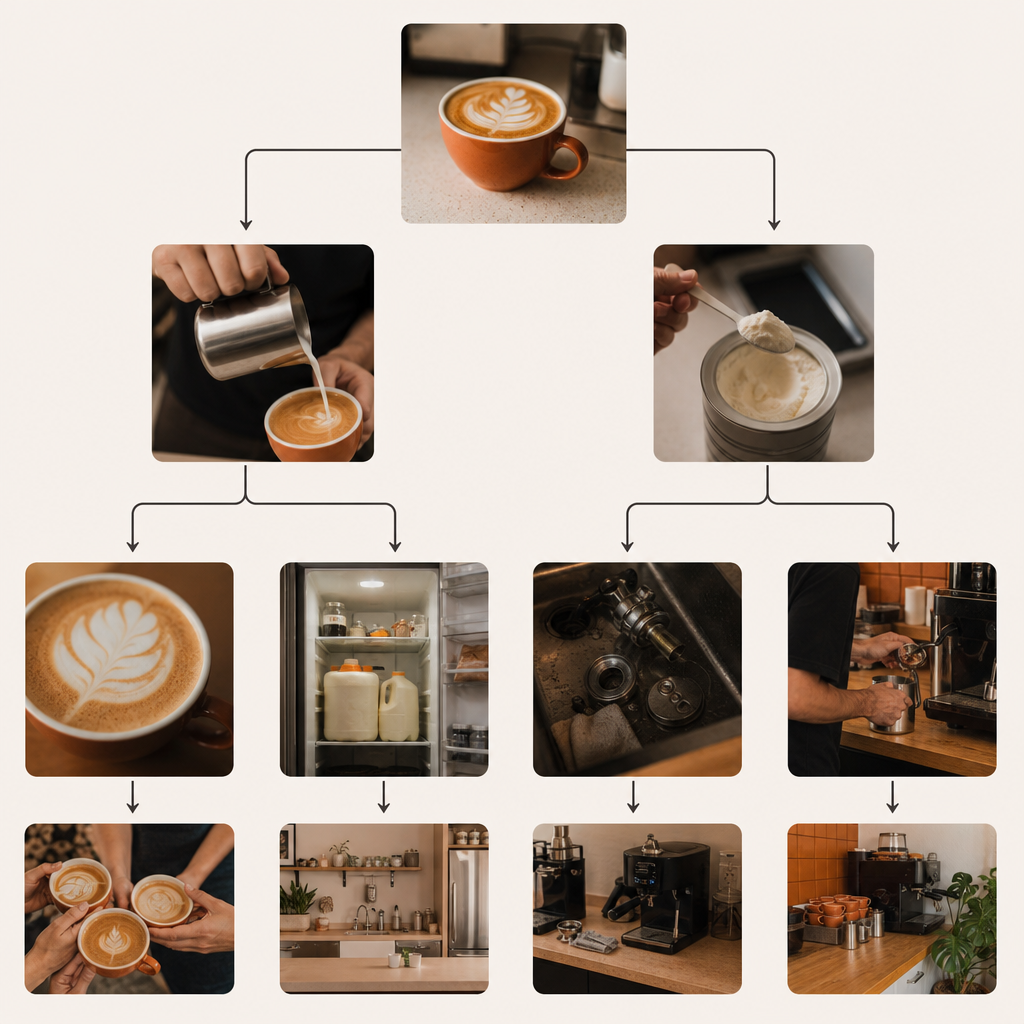
Choose fresh milk when employees expect café-style milk drinks and the workplace can support refrigeration, cleaning and regular service. Choose powder when ambient storage and automated convenience outweigh texture. For mixed or uncertain demand, assess actual drink preferences, peak usage, bench space, plumbing and who will own routine machine care.
Choose fresh milk when
Fresh milk is normally the stronger option if:
- flat whites, lattes and cappuccinos dominate orders
- employee experience is a stated workplace priority
- the office has reliable power, suitable bench space and refrigeration
- somebody can complete simple prompted cleaning tasks
- the supplier provides installation, training and ongoing service
- management wants a result closer to the cafés outside the office
A fresh milk system is particularly suitable for professional offices hosting candidates, customers or partners. Coffee becomes part of the workplace impression. A weak powdered drink can undermine an otherwise thoughtful environment.
Choose powder when
A powdered system may be more practical if:
- milk-based drink quality is secondary to speed
- the machine operates with limited supervision
- fresh milk deliveries and stock rotation would be unreliable
- refrigeration cannot be accommodated safely
- demand varies enough to create frequent fresh milk waste
- users already accept vending-style drinks
Powder is not automatically a poor decision. It is poor when selected to save effort without understanding the remaining cleaning work, or when staff clearly expect café-style coffee.
Consider a hybrid arrangement carefully
Some workplaces use fresh milk for the main office and simpler dispensing elsewhere. Others retain plant-based cartons for manual use beside a fresh dairy system. A hybrid can address varied needs, but every extra pathway increases stocking, labelling and cleaning complexity.
Start with employee drink behaviour rather than a feature catalogue. Ask what people order outside the office, when demand peaks and which compromises they would actually notice.
How should a fresh milk coffee machine be installed?
A fresh milk machine should be selected only after checking team demand, plumbing, power, refrigeration, bench space and cleaning ownership. Installation must include espresso calibration, milk testing and staff training. Dropping a machine at reception without commissioning it properly creates predictable flavour, hygiene and reliability problems from the first week.
Our Six-Step Process is designed to take most Melbourne clients from enquiry to an installed machine in 5-7 business days, based on Boutique Coffee's own operating process. It covers:
- Enquiry, where the client provides basic team information.
- A direct phone call with me to shortlist suitable machines and discuss rough pricing.
- An on-site visit to assess power, plumbing, access and bench space.
- Installation, including connection, grinder adjustment and espresso testing.
- The first brew and practical training, with instructions left on site.
- An ongoing service rhythm covering consumables, machine condition and support.
The timings used within this process vary by site and equipment availability. The important point is sequencing. Machine choice should follow the site assessment, not precede it.
Size the machine for real demand
Team headcount is only the starting point. A workplace with concentrated morning demand needs different capacity from a site where drinks are spread across operating hours. Visitors, meetings, shift changes and hot chocolate use also affect output.
As of 2026, Boutique Coffee's own client records cover more than 200 active Melbourne workplace rentals, including a single workplace serving more than 400 people. That range reinforces a simple lesson: one machine cannot sensibly suit every office.
Train more than one person
A system becomes fragile when only one employee understands the cleaning cycle or milk changeover. Training should cover normal use, cleaning prompts, refilling and basic fault reporting. It should also explain what staff must not dismantle.
The supplier must remain available after installation. Most simple questions are resolved quickly when the person answering knows the exact machine, site and setup.
What does real workplace experience show?
Real workplace evidence shows that reliability, drink quality and service are noticed across the office, even when satisfaction is not measured through a formal survey. In the supplied Melbourne case evidence, fresh milk machine upgrades produced positive staff feedback and sustained use. I will not attach an unsupported percentage to those outcomes.
At one mid-sized Melbourne office, the existing coffee arrangement was not meeting the team's needs. I upgraded the site to a WMF commercial machine with full installation, training and ongoing service included in the rental.
The site manager reported that the machine was easy to use, the coffee and hot chocolate were well received, and service remained consistent over the following years. He also told me how much his staff appreciated having good coffee. His response to them was simple: keep doing what you are doing.
That feedback matters because it shows how workplace coffee is judged. Employees did not praise the machine's internal specification. They valued easy use, drink quality and reliable availability.
At another site, I met an employee who had previously worked at a workplace I supported. He had sought me out to ask for my card because the supplier at his new workplace was producing poor coffee. He wanted senior management to consider a different arrangement.
This is anecdotal evidence, not a controlled satisfaction study. It still reveals a useful behaviour: employees remember the contrast between a dependable café-quality setup and a poor one. Coffee quality can travel with them as an expectation when they change employers.
The content brief for this article referenced a 40% employee satisfaction increase. No formal survey data or verifiable study supporting that figure was supplied, so I have not presented it as fact. The honest case evidence is strong enough without adding a percentage that cannot be substantiated.
Milk choice is really a service model decision
My view is that fresh milk versus powder is not primarily an ingredient debate. It is a test of whether the supplier will remain accountable for the whole system. Fresh milk exposes weak service quickly, while powder can hide it temporarily. Either system fails when installation, cleaning, calibration and support are fragmented.
Top-level comparisons often treat fresh milk as premium and powder as convenient. That is directionally useful but incomplete. The decisive question is who takes responsibility when the milk will not froth, the powder clumps or the machine stops during the morning rush.
A helpdesk can log a fault without understanding it. An account manager can apologise without fixing it. I prefer founder-led, always: one person stays responsible from the site visit through ongoing service.
This approach also changes the sales recommendation. I am not trying to be the biggest. I would rather specify the cheaper suitable machine than place oversized equipment into a small office. The reverse also applies. Underpowered equipment placed into a high-demand workplace will become a service problem regardless of its milk format.
Our active-client data in 2026 shows an average relationship length exceeding 5 years. That is Boutique Coffee's own business measure, not an industry benchmark. It suggests that long-term retention comes from fit and accountability rather than restrictive contracts.
The practical verdict is therefore conditional but clear:
- Choose fresh milk for the strongest employee experience.
- Choose powder where storage and unattended convenience genuinely take priority.
- Reject any proposal that does not explain cleaning, service and failure response.
- Select the supplier before becoming distracted by the machine brochure.
A good arrangement should be designed around your culture and budget. It should also ensure your team never goes without coffee because responsibility disappeared into a ticket queue.
References
These sources support the food-safety, allergen and product-definition guidance used in this comparison. Machine-specific cleaning, storage and maintenance instructions should always take priority for the installed equipment. Workplace managers should also check product labels and seek qualified food-safety advice where their operating environment creates additional risks.
- Food Standards Australia New Zealand, Temperature control
- Food Standards Australia New Zealand, Allergen labelling
- Food Standards Australia New Zealand, Food safety information for businesses
- Codex Alimentarius, International food standards catalogue
- Australian Government, Australian Dietary Guidelines
FAQ_SCHEMA_JSON
Frequently asked questions
Is powdered milk safe in an office coffee machine?
Yes, when it is stored, loaded and dispensed according to the product label and machine instructions. Keep the hopper dry and clean, avoid topping new powder over old residue, and clean mixing components as specified. Powdered dairy products still contain milk allergen unless the label clearly states otherwise.
Does a fresh milk coffee machine require cleaning every day?
Follow the machine manufacturer's required cleaning frequency. Milk-contact components require frequent attention because residue affects hygiene, flavour and frothing. Automatic cleaning programmes help, but staff must still use the correct process and inspect removable parts.
Is powdered milk cheaper than fresh milk for office coffee?
It can be cheaper or easier to manage in some workplaces, especially where fresh milk waste or refrigeration would be significant. Compare product, cleaning, servicing, staff handling and downtime rather than ingredient price alone.
Can office coffee machines provide oat or soy milk?
Yes, but the method depends on the machine. Consider refrigeration, cross-contact, cleaning and product labelling. Confirm compatibility with the machine supplier before putting an alternative milk through an automated dairy pathway.
Which milk option is best for a small office?
Team size alone does not decide the answer. Assess drink preferences, peak demand, cleaning ownership, plumbing, bench space and supplier support. Fresh milk suits teams prioritising café-style drinks, while powder may suit lightly used or unattended sites.
Can we trial a fresh milk coffee machine first?
A trial can help staff compare cup quality, usability and cleaning requirements under real workplace conditions. Boutique Coffee offers workplace coffee trials subject to suitability and availability.

Chris
Chris
Keep reading
Office Coffee Machine Installation Guide: What Australian Businesses Need to Know
Installing an office coffee machine starts with matching the equipment to your team, then confirming power, potable water, drainage, bench space, ventilation…
Understanding the Daily Cost of a Commercial Coffee Machine in an Australian Office
The cost of a commercial coffee machine per day equals daily beans, milk, electricity, water filtration, cleaning, rental or equipment ownership, and…
Comprehensive Corporate Coffee Solutions: Elevating Australian Workplace Experiences
Corporate coffee machine solutions combine commercial equipment, installation, fresh beans, staff training, maintenance and responsive support in one workplace…