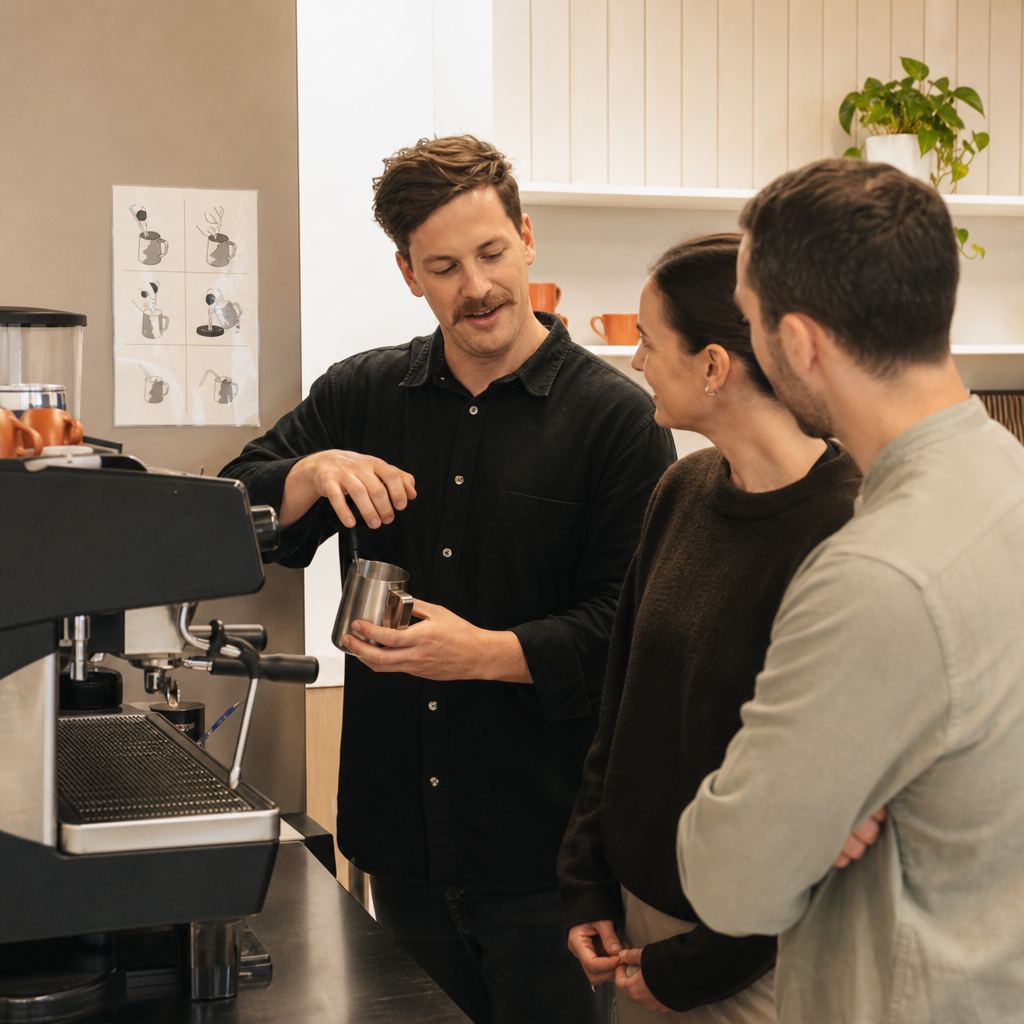
Good coffee machine installation and staff training means the machine is connected correctly, at least two staff learn basic operation, cleaning and milk handling on install day, a simple checklist stays by the machine, and one named person answers the phone afterwards. That combination delivers café-quality coffee in a Melbourne office from the first week.
Most office managers worry about the same thing before a machine arrives. Not the plumbing, but the people. Will staff waste beans, scorch the milk, leave the drip tray overflowing and then let the whole thing fall into disrepair?
That worry is fair, and it is fixable. This article covers the people side of installation: the handover, the training and the first few weeks of use. It deliberately skips the technical install steps (power, water, drainage and bench space), which sit in our separate office coffee machine installation guide. Here, the focus is on how your team uses the machine once it is on the bench.
Key Takeaways
- A commercial machine only delivers café-quality coffee when staff know the basics. Training matters as much as the equipment.
- A good handover covers four things: making drinks, daily cleaning, milk handling and who to call.
- A one-page checklist near the machine, with named owners, beats a long manual nobody reads.
- Most first-month problems come from a handful of predictable mistakes, and each has a simple rule that prevents it.
- One accountable contact and one phone number after installation keeps small issues from becoming breakdowns.
- Month-to-month terms, one month's notice and free machine pickup make the decision low risk.
Summary Table: From Install Day to Steady Routine
| Stage | What happens | Who owns it | Why it matters |
|---|---|---|---|
| Install day | Machine connected, grinder dialled in, test drinks made | Supplier | Sets the quality baseline |
| Handover | Hands-on training for a small group of staff, plus a written cheat sheet | Supplier and your nominated staff | Staff learn on your machine, with your beans |
| First weeks | Staff settle into the checklist, blend feedback is collected | Office lead | Habits form and the blend gets fine-tuned |
| Ongoing rhythm | Regular service visits, beans and consumables topped up | Supplier | Machine stays clean, stocked and reliable |
| New starters | Short induction with a trained colleague | Office lead | Stops bad habits spreading |
| Problems | One phone call to one person | Supplier | Faster fixes, less downtime |
Why does staff training matter as much as the machine?
Because a commercial machine only performs as well as the people using it. Without training, staff guess at settings, skip cleaning, overheat milk and ignore early warning signs. The result is bitter coffee, wasted beans and avoidable breakdowns. Training turns good equipment into a reliable daily habit for the whole office.
We have spent 17 years focused exclusively on Melbourne workplace coffee, and we now look after 200+ active Melbourne workplace clients (our own data, as of 2026). The pattern is consistent. Two offices can rent the identical machine. One produces coffee people queue for. The other produces coffee people complain about. The difference is rarely the hardware.
What untrained use actually costs
Untrained use shows up in four places:
- Coffee quality. Staff change grinder settings to fix a problem that was really a dirty group head, and the dialled-in beans stop tasting right.
- Waste. Shots get dumped, milk is over-poured and thrown out, and beans are wasted while people experiment.
- Breakdowns. Skipped cleaning and ignored warnings turn minor faults into service calls.
- Morale. When the machine is unreliable or the coffee is poor, people drift back to the café down the street. That is lost time and a weaker office culture.
Chris Prokopiou, our founder, has always held that instant coffee in an office never made sense in a city like Melbourne. People here know good coffee. Once you install a proper machine, you owe your team the knowledge to use it properly.
Training starts with the right machine
Training cannot rescue the wrong machine. A 12-person team does not need a $15,000 Eversys. An 80-person team will break a home-grade Jura within a month. Matching the machine to your real team size is the first step of any handover, because the simplest machine that fits your volume is also the easiest to teach.
What should an installation-day handover cover?
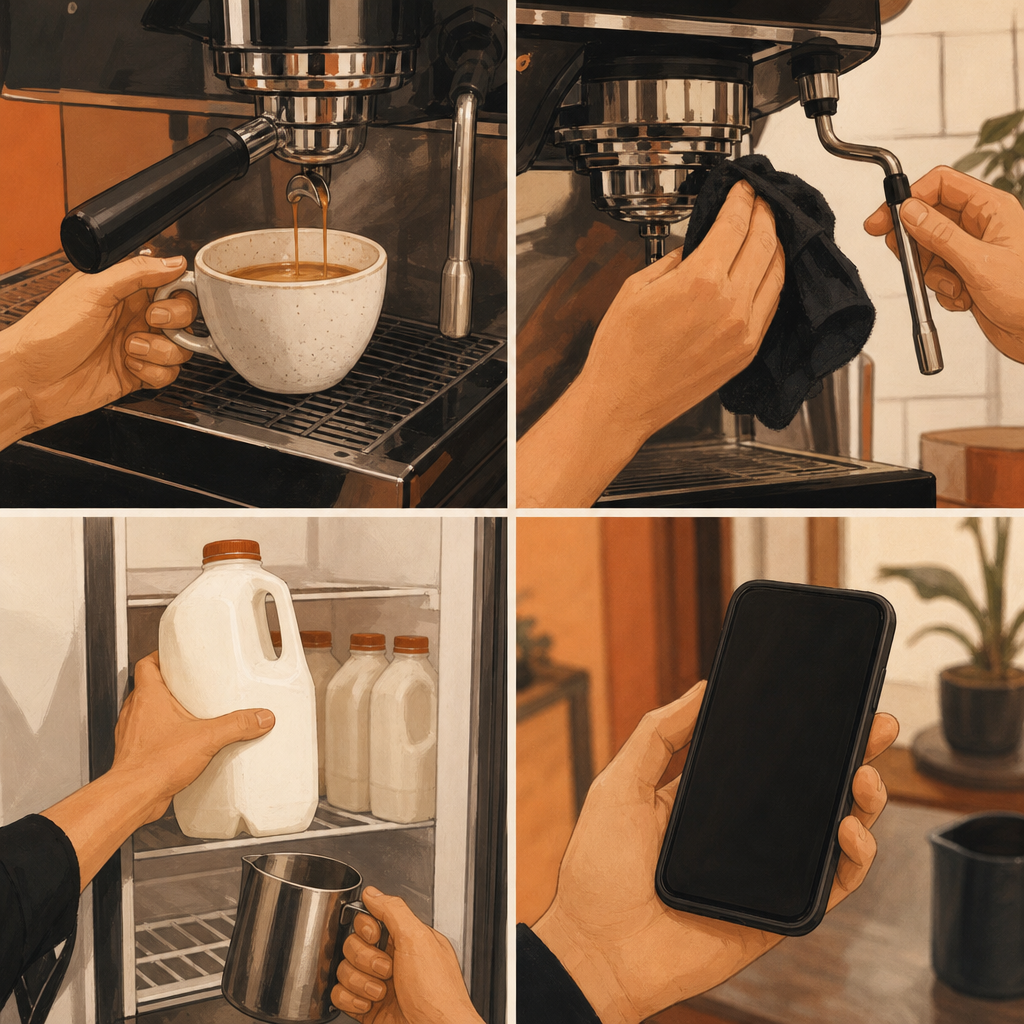
A good handover covers four things: how to make the drinks your team actually orders, how to clean the machine each day, how to handle milk safely, and who to call when something goes wrong. It should be practical, hands-on and done at the machine, not explained from a manual.
This section describes general best practice for any commercial machine handover. Use it as a yardstick when comparing suppliers, including us.
For context, our own Six-Step Process includes a first brew and training step on install, where at least two staff are trained and a cheat sheet is left behind. We keep it short and practical on purpose. The aim is confidence, not a lecture. The process typically takes most Melbourne clients from first call to installed machine in 5 to 7 business days (our own data).
1. Basic operation
Staff should leave the handover able to make the drinks your team orders most. That means:
- Making a flat white, latte, cappuccino, long black and hot chocolate if those are on your menu.
- Understanding what the buttons, screen and warning messages mean.
- Knowing how to fill the bean hopper, and which beans go in it.
- Knowing what not to touch, especially grinder settings.
Trainees should make the drinks themselves, not watch someone else do it. People learn with their hands. Ask the trainer to stay until each person has made at least one drink unaided.
2. Daily cleaning habits
Cleaning is the single biggest factor in long-term coffee quality and machine life. The handover should show the daily routine on the actual machine, following the manufacturer's instructions. In general, that includes:
- Purging the group heads and wiping the steam wand straight after each use.
- Emptying the drip tray and any used-coffee bin.
- Rinsing jugs and wiping down the bench.
- Running any automatic rinse or cleaning cycle the machine provides.
If a supplier cannot show you the daily routine in a few minutes of demonstration, the routine is too complicated for an office.
3. Milk handling
Milk is where most office machines fall down. Milk residue left in a wand or jug goes off, smells and affects taste. A good handover shows:
- How to steam milk without scalding it, and why a hot steam wand needs care to avoid burns.
- Wiping and purging the wand immediately after steaming.
- Using clean jugs, and never topping up old milk with fresh milk.
- Keeping milk refrigerated, and discarding leftover steamed milk rather than re-steaming it.
Food Standards Australia New Zealand (FSANZ) publishes food safety guidance for businesses that handle food and drink, and WorkSafe Victoria publishes general workplace safety guidance for employers. Both are worth a look if your office wants a documented hygiene routine.
4. Who to call
The last part of the handover is the simplest and the most overlooked. Staff should know exactly who to ring if something looks wrong. One name, one phone number, written on the cheat sheet and stuck on the machine. If the answer is a helpdesk or a ticket portal, expect delays and lost context.
How do you build simple daily and weekly habits around the machine?
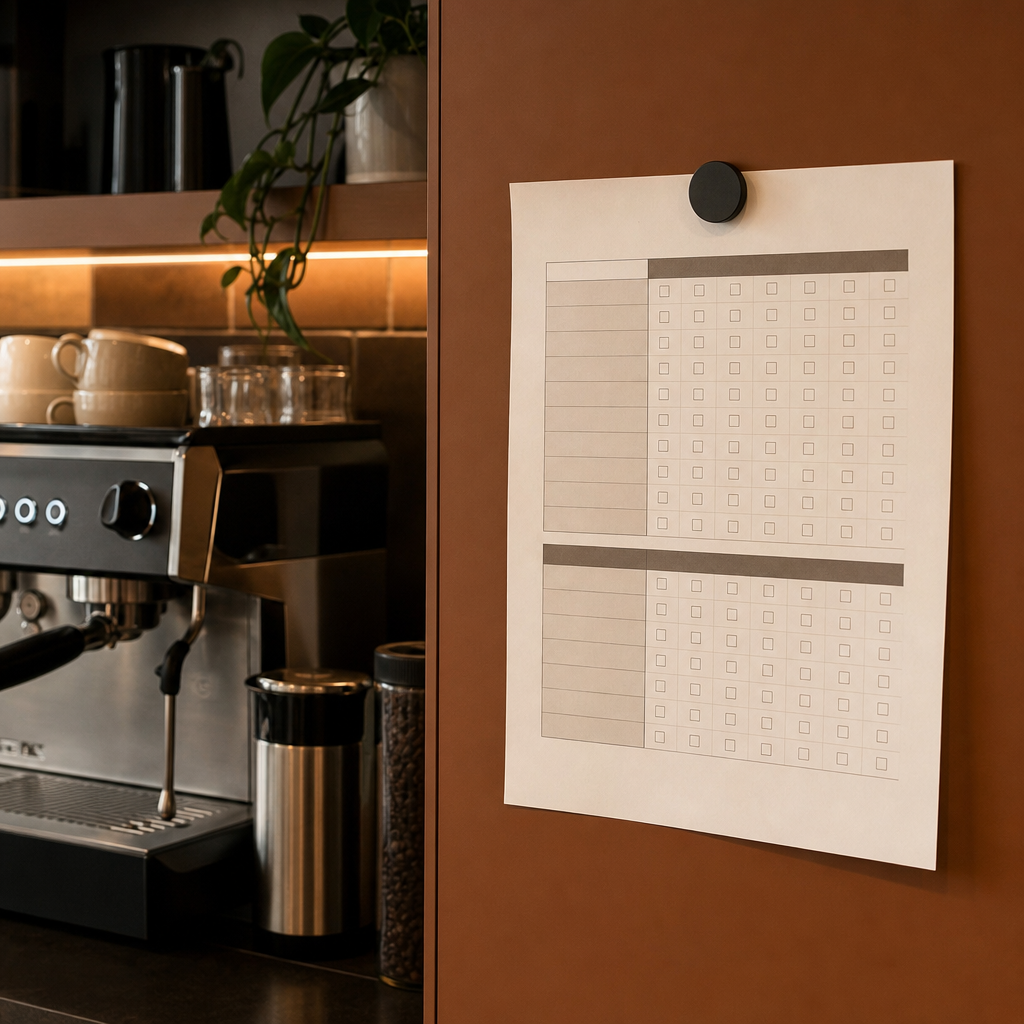
Build habits around a one-page checklist stuck near the machine. Daily tasks take only a few minutes: purge, wipe, empty, rinse and check supplies. Weekly tasks go slightly deeper. Name an owner for each task, keep the wording simple, and make the checklist easier to follow than to ignore.
A checklist works because it removes the need to remember. It also removes the awkward question of whose job it is. Here is a sample you can adapt. Always defer to your machine's manufacturer instructions and your supplier's guidance.
| Task | How often | Suggested owner |
|---|---|---|
| Purge group heads and wipe steam wand after use | Every use | Whoever made the drink |
| Rinse milk jugs | Every use | Whoever made the drink |
| Empty drip tray and used-coffee bin | Daily | Nominated daily owner |
| Wipe down machine and bench | Daily | Nominated daily owner |
| Run the machine's rinse or cleaning cycle | Daily, end of day | Nominated daily owner |
| Check bean hopper, milk and cup stock | Daily | Nominated daily owner |
| Check water filter indicator and warning messages | Weekly | Office lead |
| Deeper wipe of surrounding area and fridge shelf | Weekly | Office lead |
| Report anything unusual to your supplier | As soon as noticed | Anyone |
Make the checklist stick
A checklist only helps if people use it. Four rules help:
- Keep it to one page. If it needs two, it is too long.
- Rotate the daily owner. A roster spreads the load and avoids resentment.
- Put it where the work happens. Stick it on the wall or cupboard beside the machine, not in a shared drive.
- Name an office lead. One person owns the weekly tasks and the relationship with the supplier.
What mistakes do staff make in the first month?
The most common first-month mistakes are skipping daily cleaning, changing grinder settings, leaving milk out, mixing the wrong beans in the hopper and ignoring warning messages. Each is easy to prevent with a clear rule, a visible checklist and one person to ask when someone is unsure.
Skipping cleaning when the office is busy
Cleaning gets dropped first on busy days. Coffee oils build up, milk residue hardens and flavour suffers within days. Fix: make the end-of-day rinse a rostered task, not a goodwill gesture.
Adjusting the grinder
Someone decides the coffee tastes weak and winds the grinder finer. Now it is too bitter, and three more people have a go. Fix: a simple rule that nobody touches the grinder. If the coffee tastes off, call your supplier. We dial in the beans on install day, and a quick phone call is almost always faster than guesswork.
Mixing beans or overfilling the hopper
Staff sometimes top up the hopper with whatever beans are in the cupboard. Different roasts behave differently, and the grinder settings no longer match. Fix: one bean type, one person filling the hopper, and a supplier who keeps supplies topped up so nobody improvises.
Leaving milk out or topping it up
Milk left on the bench or topped up in the jug causes the smell and sour taste that puts people off office coffee. Fix: milk stays in the fridge, jugs get rinsed, and leftover steamed milk is discarded.
Ignoring warning messages
A low water or maintenance light is an early warning, not a suggestion. Ignoring it is how a small fault becomes a breakdown in peak hours. Fix: put the rule on the cheat sheet: any warning message, call the number.
Assuming the first blend is final
This one is a supplier mistake as much as a staff one. A blend that suits one team does not suit another. Our Curated Coffee Plan starts by asking about your team's drink preferences, such as espresso or milk-based, strength and any dislikes. We start on a well-matched blend, then adjust based on team feedback in the first month. Tell your supplier what your team actually thinks. Silence helps nobody.
How do you train new starters after the first day?
Treat every new starter to a short induction at the machine, not a favour. Pair them with a trained colleague, walk through the checklist once, and have them make a drink under supervision. A short session saves weeks of bad habits passed along informally.
This is the part most offices forget. Staff turn over, and the people trained on install day move teams or leave. Within a year, many people using the machine have learnt from someone who learnt from someone else, and the original instructions are long gone.
A simple workplace coffee machine induction looks like this:
- Pair. Assign a trained colleague as the new starter's guide.
- Show. Walk through the checklist and the cheat sheet, including who to call.
- Do. The new starter makes a drink while their guide watches.
- Confirm. The guide signs off, and the new starter knows the golden rules: nobody touches the grinder, milk stays refrigerated and warnings get reported.
Aim to have at least two trained people at all times, so leave and resignations never leave you without a go-to person. If your trained pair both move on, ask your supplier for a refresher. That should be a normal request, not an awkward one.
What ongoing support should you expect after setup?
You should expect one person who knows your setup, one phone number and a quick response. At Boutique Coffee, one person stays accountable from installation through ongoing service, and the typical response time on a service call is 24 hours across our active client base. No call centres, no corporate runaround.
Most corporate coffee suppliers route issues through helpdesks, ticket systems and tiered support teams. Our view is that this is the wrong model for office coffee. Most fixes can be talked through in two minutes when the person answering already knows your machine, your beans and your team. Same-day or next-day on-site response is only possible when there is no internal runaround to navigate first. That is what we mean by one number, one person.
What good ongoing support looks like
- A regular service rhythm. Scheduled visits where beans and consumables are topped up and the machine is checked.
- A direct line. A real person who recognises your site when you call.
- Honest advice. If your team has grown or shrunk, you should hear about it, even if the answer is a cheaper machine.
- Fast response when it matters. The coffee moments that matter happen at 8:30 on a Monday, not Thursday afternoon.
The cost side matters too. If you are weighing up budgets, our companion article on the daily cost of a commercial coffee machine breaks down what you actually pay for. For the broader process, see our overview of how office coffee machine rental works in Melbourne, and check our service coverage and delivery areas to confirm we service your suburb. Our rental FAQs cover the common questions about terms and supplies.
Is month-to-month rental a low-risk way to start?
Yes. Boutique Coffee rentals are month-to-month, with one month's notice to exit and free machine pickup. There is no lock-in, ever. If the machine, the beans or the service are not right for your office, you can leave. That puts the pressure on us to keep earning the relationship.
The usual industry view is that long contracts protect the supplier's revenue and are standard for equipment rental. We disagree. In 17 years, the no-lock-in policy has never cost us a client worth keeping. Clients who stay by choice are worth more than clients who stay by contract, and our average client relationship of 5+ years (our own data) supports that.
For an office manager, month-to-month terms change the risk calculation:
- You can trial a machine without a multi-year commitment.
- You can resize if your team grows or shrinks.
- You do not have to explain a long-term contract to finance.
- If the service slips, you leave with one month's notice and we collect the machine for free.
Training is part of that deal. If your team is not confident on the machine after a few weeks, tell us. A refresher costs us less than losing your trust.
Why the café gap in Melbourne offices is a people problem, not an equipment problem
The gap between Melbourne's café coffee and office coffee is closed by three things: a machine that fits the team, a clear handover and one accountable contact afterwards. Equipment alone does not close it. People who know what to do, and who to call, do.
Melbourne workers walk past great cafés on the way to work. Then they walk into an office with instant coffee or a neglected machine. Chris has always thought that gap never made sense, and closing it has been our sole focus since 2008. Here is what we have learnt from doing it across 200+ workplaces.
What Chris sees on the road
Chris drives around Melbourne looking after client machines, making sure they run smoothly and are fully stocked. The pattern he sees is that offices with the best coffee are not the ones with the most expensive machines. They are the ones where somebody owns the routine and someone external answers the phone.
Consider a mid-size Melbourne office that was running a coffee setup that was not meeting the team's needs. Chris upgraded them to a WMF commercial machine with full install, training and ongoing service included in the rental. The change was noticeable across the whole office. The site manager reported easy daily use, great coffee and hot chocolate quality, and consistent service maintained for years. Nothing about that outcome came from the machine alone. It came from the install, the training and the follow-up working together.
Then there is downtime. A busy Melbourne workplace had been disrupted whenever its machine went down during peak hours. Chris provided a reliably maintained machine with regular scheduled servicing and direct personal contact for any issue. The client's feedback was that reliable, regular service meant the team always had coffee when they needed it most. That is what we mean by your team never goes without coffee.
The same principle applies in a retail setting. A busy Melbourne business needed consistently great coffee for staff and customers every day. Chris supplied fresh beans and a fully maintained machine, and managed the supply and upkeep personally. The client credited that attention to detail as the reason they could serve great coffee daily without interruption.
One more story says something about the broader market. Chris once turned up at a client site and met someone who used to work at a previous client. That person asked for his card, to pass to senior management at their new employer. Their current coffee supplier, he said, provided the worst coffee, and he wanted Chris to help set up a new arrangement. People remember who looked after them.
Our contrarian position: train two people, not everyone
Many suppliers push whole-office training sessions. We do not. Our view is that training at least two people thoroughly, backed by a checklist and a trusted phone number, works better than a half-attended session for thirty. Two trained people become the go-to resource, the checklist covers everyone else, and the supplier covers the rest. It is also easier to keep going when staff change. The aim is not to make everyone a barista. It is to make the machine easy to use for everyone and easy to look after for two.
That is café-quality, made practical. It is also why we are not trying to be the biggest. We would rather be the coffee partner, not a supplier, that picks up the phone, knows your machine and tells you honestly when something is not right.
Ready to arrange a commercial machine rental for your Melbourne office? Contact Boutique Coffee. You get proper installation, a clear handover, one accountable contact and month-to-month terms with no lock-in. Tell us about your team and we will recommend the machine that fits, even if it is the cheaper option.
References
- Boutique Coffee, company information and client data (17 years in operation, 200+ active Melbourne workplace clients, 5+ year average client relationship, typical 24-hour service response, as of 2026): https://www.boutiquecoffee.com.au/
- Food Standards Australia New Zealand (FSANZ), food safety information for businesses: https://www.foodstandards.gov.au
- WorkSafe Victoria, workplace health and safety guidance for employers: https://www.worksafe.vic.gov.au
- Specialty Coffee Association (SCA), coffee standards and education: https://sca.coffee
Frequently asked questions
How long does staff training on an office coffee machine take?
It should be short and practical. In Boutique Coffee's Six-Step Process, first brew and training is a 20-minute step at install, with at least two staff trained and a cheat sheet left behind (the company's own data). Complex machines or larger teams may need more time, and new starters need a brief induction later.
Who should be trained on the office coffee machine?
At least two people. Choose staff who are in the office regularly and happy to take responsibility, such as an office manager and a team member. Two trained people mean the machine is never stranded by leave. They also become the go-to for everyone else.
How do you train staff on an office coffee machine?
Train at the machine, with your beans, and let staff make the drinks themselves. Cover basic operation, daily cleaning, milk handling and who to call. Leave a one-page cheat sheet and checklist beside the machine, and give new starters a short supervised induction.
What happens if staff misuse or break the machine?
Call your supplier straight away. Many problems can be talked through in a couple of minutes when the person answering knows your setup. For on-site issues, Boutique Coffee's typical response time on a service call is 24 hours across its active client base (the company's own data).
Can we cancel an office coffee machine rental if it is not working for us?
With Boutique Coffee, yes. Rentals are month-to-month, with one month's notice to exit and free machine pickup. There is no lock-in, so you can adjust or leave if the machine, beans or service are not right for your team.

Chris
Chris
Keep reading
Office Coffee Subscriptions in Melbourne: Why a Month-to-Month Machine Rental Beats Pods and Lock-In Contracts
The best office coffee subscription for a Melbourne workplace is a month-to-month commercial machine rental that includes installation, regular servicing and…
How to Set Up an Office Coffee Station: Layout, Equipment & Supply Checklist for 2026
A well-designed coffee station does more than dispense caffeine. It becomes the social hub of your workplace, the spot where people decompress between…
Office Coffee Machine Service, Maintenance and Breakdown Support in Melbourne: What Good Support Actually Looks Like
Good office coffee machine service in Melbourne means scheduled preventative visits, one phone number answered by someone who knows your machine, and a typical…